Home > Press > A new paradigm for nanoscale resolution MRI has been experimentally achieved
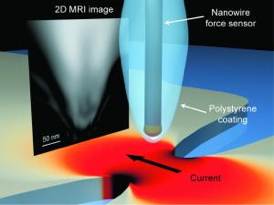 |
| Illustration of the experimental setup shows the two unique components of the teams novel MRI technique that was successful in producing a 2D MRI image with spatial resolution on the nanoscale. |
Abstract:
A team from the University of Illinois at Urbana-Champaign and Northwestern University has devised a novel nuclear magnetic resonance imaging (MRI) technique that delivers a roughly 10nanometer spatial resolution. This represents a significant advance in MRI sensitivity—modern MRI techniques commonly used in medical imaging yield spatial resolutions on the millimeter length scale, with the highest-resolution experimental instruments giving spatial resolution of a few micrometers.
A new paradigm for nanoscale resolution MRI has been experimentally achieved
Urbana, IL | Posted on September 28th, 2013"This is a very promising experimental result," said U. of I. physicist Raffi Budakian, who led the research effort. "Our approach brings MRI one step closer in its eventual progress toward atomic-scale imaging."
MRI is used widely in clinical practice to distinguish pathologic tissue from normal tissue. It is noninvasive and harmless to the patient, using strong magnetic fields and non-ionizing electromagnetic fields in the radio frequency range, unlike CT scans and tradiational X-rays, which both use more harmful ionizing radiation.
MRI uses static and time-dependent magnetic fields to detect the collective response of large ensembles of nuclear spins from molecules localized within millimeter-scale volumes in the body. Increasing the detection resolution from the millimeter to nanometer range would be a technological dream come true.
The team's breakthrough—the new technique introduces two unique components to overcome obstacles to applying classic pulsed magnetic resonance techniques in nanoscale systems. First, a novel protocol for spin manipulation applies periodic radio-frequency magnetic field pulses to encode temporal correlations in the statistical polarization of nuclear spins in the sample. Second, a nanoscale metal constriction focuses current, generating intense magnetic field-pulses.
In their proof-of-principal demonstration, the team used an ultrasensitive magnetic resonance sensor based on a silicon nanowire oscillator to reconstruct a two-dimensional projection image of the proton density in a polystyrene sample at nanoscale spatial resolution.
"We expect this new technique to become a paradigm for nanoscale magnetic-resonance imaging and spectroscopy into the future," added Budakian. "It is compatible with and can be incorporated into existing conventional MRI technologies."
####
For more information, please click here
Contacts:
Raffi Budakian
Department of Physics
217-333-3065
Siv Schwink
Department of Physics
217/552-5671
Copyright © University of Illinois College of Engineering
If you have a comment, please Contact us.Issuers of news releases, not 7th Wave, Inc. or Nanotechnology Now, are solely responsible for the accuracy of the content.
Bookmark:


| Related Links |
| Related News Press |
News and information
 Decoding hydrogen‑bond network of electrolyte for cryogenic durable aqueous zinc‑ion batteries January 30th, 2026
COF scaffold membrane with gate‑lane nanostructure for efficient Li+/Mg2+ separation January 30th, 2026
MXene nanomaterials enter a new dimension Multilayer nanomaterial: MXene flakes created at Drexel University show new promise as 1D scrolls January 30th, 2026
Imaging
ICFO researchers overcome long-standing bottleneck in single photon detection with twisted 2D materials August 8th, 2025
Simple algorithm paired with standard imaging tool could predict failure in lithium metal batteries August 8th, 2025
Discoveries
From sensors to smart systems: the rise of AI-driven photonic noses January 30th, 2026
Decoding hydrogen‑bond network of electrolyte for cryogenic durable aqueous zinc‑ion batteries January 30th, 2026
COF scaffold membrane with gate‑lane nanostructure for efficient Li+/Mg2+ separation January 30th, 2026
Announcements
Decoding hydrogen‑bond network of electrolyte for cryogenic durable aqueous zinc‑ion batteries January 30th, 2026
COF scaffold membrane with gate‑lane nanostructure for efficient Li+/Mg2+ separation January 30th, 2026
Interviews/Book Reviews/Essays/Reports/Podcasts/Journals/White papers/Posters
Metasurfaces smooth light to boost magnetic sensing precision January 30th, 2026
COF scaffold membrane with gate‑lane nanostructure for efficient Li+/Mg2+ separation January 30th, 2026
Tools
Metasurfaces smooth light to boost magnetic sensing precision January 30th, 2026
From sensors to smart systems: the rise of AI-driven photonic noses January 30th, 2026
Japan launches fully domestically produced quantum computer: Expo visitors to experience quantum computing firsthand August 8th, 2025
 |
||
 |
||
| The latest news from around the world, FREE | ||
 |
||
|
|
||
| Premium Products | ||
 |
||
|
Only the news you want to read!
Learn More |
||
 |
||
|
Full-service, expert consulting
Learn More |
||
|
|
||