Home > Press > Auto lubricant could rev up speed of medical imaging
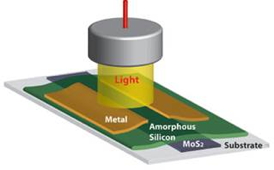 |
| Shown is an experimental photodetector made out of amorphous silicon and molybdenum disulfide (MoS2). The two semiconductors together form a high speed photodetector. Schematic by Mohammad Esmaeili-Rad |
Abstract:
Engineers at the University of California, Berkeley, have built a device that could speed up medical imaging without breaking the bank. The key ingredient? An engine lubricant called molybdenum disulfide, or MoS2, which has been sold in auto parts shops for decades.
Auto lubricant could rev up speed of medical imaging
Berkeley, CA | Posted on August 3rd, 2013Many photodetectors in large-area imaging devices use amorphous silicon because it absorbs light well and is relatively inexpensive to process. But this type of silicon has defects that prevent the fast, ordered movement of electrons, leading to slower operating speeds and more exposure to radiation. Getting better performance requires more expensive, high-temperature processing, adding to the price tag of the imaging device.
Sayeef Salahuddin, UC Berkeley assistant professor of electrical engineering and computer sciences, and postdoctoral scholar Mohammad Esmaeili-Rad solved this problem by pairing a thin film of MoS2 with a sheet of amorphous silicon. Because of the molecular structure of MoS2, the photo-generated electrons it collects are able to move through quickly.
Together, the MoS2 and amorphous silicon formed a diode that resulted in a photoresponse rate that was 10 times faster than conventional amorphous silicon alone.
"Our discovery could bring transformational changes in applications from biomedical imaging to solar cells to energy-efficient transistors," said Salahuddin.
The researchers published their findings today (Friday, Aug. 2) in the open-access journal Scientific Reports.
They point out that because these materials are easy and inexpensive to handle, the cost of speeding up photodetectors would be minimal. Unlike conventional semiconductors like silicon, MoS2 consists of individual nanosheets that can be torn off like pages in a book. These sheets can be used to make thin, novel electronic devices or to improve existing ones.
The National Science Foundation and the Defense Advanced Research Projects Agency helped support this work. Esmaeli-Rad's postdoctoral fellowship is supported by the Natural Sciences and Engineering Research Council of Canada.
####
For more information, please click here
Contacts:
Sarah Yang
Media Relations
(510) 643-7741
RESEARCHER CONTACT:
Sayeef Salahuddin
(510) 642-4662
Copyright © University of California, Berkeley
If you have a comment, please Contact us.Issuers of news releases, not 7th Wave, Inc. or Nanotechnology Now, are solely responsible for the accuracy of the content.
Bookmark:


| Related Links |
| Related News Press |
News and information
 Quantum computer improves AI predictions April 17th, 2026
Flexible sensor gains sensitivity under pressure April 17th, 2026
A reusable chip for particulate matter sensing April 17th, 2026
Detecting vibrational quantum beating in the predissociation dynamics of SF6 using time-resolved photoelectron spectroscopy April 17th, 2026
Imaging
Simple algorithm paired with standard imaging tool could predict failure in lithium metal batteries August 8th, 2025
Govt.-Legislation/Regulation/Funding/Policy
Quantum computer improves AI predictions April 17th, 2026
Metasurfaces smooth light to boost magnetic sensing precision January 30th, 2026
New imaging approach transforms study of bacterial biofilms August 8th, 2025
Nanomedicine
A fundamentally new therapeutic approach to cystic fibrosis: Nanobody repairs cellular defect April 17th, 2026
New molecular technology targets tumors and simultaneously silences two ‘undruggable’ cancer genes August 8th, 2025
New imaging approach transforms study of bacterial biofilms August 8th, 2025
Electrifying results shed light on graphene foam as a potential material for lab grown cartilage June 6th, 2025
Discoveries
Quantum computer improves AI predictions April 17th, 2026
Flexible sensor gains sensitivity under pressure April 17th, 2026
A reusable chip for particulate matter sensing April 17th, 2026
Detecting vibrational quantum beating in the predissociation dynamics of SF6 using time-resolved photoelectron spectroscopy April 17th, 2026
Announcements
A fundamentally new therapeutic approach to cystic fibrosis: Nanobody repairs cellular defect April 17th, 2026
UC Irvine physicists discover method to reverse ‘quantum scrambling’ : The work addresses the problem of information loss in quantum computing system April 17th, 2026
Interviews/Book Reviews/Essays/Reports/Podcasts/Journals/White papers/Posters
A fundamentally new therapeutic approach to cystic fibrosis: Nanobody repairs cellular defect April 17th, 2026
UC Irvine physicists discover method to reverse ‘quantum scrambling’ : The work addresses the problem of information loss in quantum computing system April 17th, 2026
Military
Quantum engineers ‘squeeze’ laser frequency combs to make more sensitive gas sensors January 17th, 2025
Chainmail-like material could be the future of armor: First 2D mechanically interlocked polymer exhibits exceptional flexibility and strength January 17th, 2025
Single atoms show their true color July 5th, 2024
NRL charters Navy’s quantum inertial navigation path to reduce drift April 5th, 2024
Photonics/Optics/Lasers
Metasurfaces smooth light to boost magnetic sensing precision January 30th, 2026
From sensors to smart systems: the rise of AI-driven photonic noses January 30th, 2026
 |
||
 |
||
| The latest news from around the world, FREE | ||
 |
||
|
|
||
| Premium Products | ||
 |
||
|
Only the news you want to read!
Learn More |
||
 |
||
|
Full-service, expert consulting
Learn More |
||
|
|
||