Home > Press > Nanotechnology imaging breakthrough
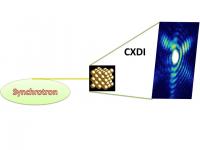 |
| Highly coherent X-rays from synchrotron sources can be used for imaging nanomaterials in 3-D at tens of nanometer of spatial resolution. This image shows a monochromatic hard X-rays patterns from a single crystal gold particle, which produces a speckle-like fringe image. Inverting such "diffraction images" under certain conditions can result in a high-resolution distribution of the electron density (amplitude) and strain of the lattice structure (phase shift).
Credit: Image courtesy Wenge Yang |
Abstract:
A team of researchers has made a major breakthrough in measuring the structure of nanomaterials under extremely high pressures. For the first time, they developed a way to get around the severe distortions of high-energy X-ray beams that are used to image the structure of a gold nanocrystal. The technique, described in April 9, 2013, issue of Nature Communications, could lead to advancements of new nanomaterials created under high pressures and a greater understanding of what is happening in planetary interiors.
Nanotechnology imaging breakthrough
Washington, DC | Posted on April 9th, 2013Lead author of the study, Wenge Yang of the Carnegie Institution's High Pressure Synergetic Consortium explained: "The only way to see what happens to such samples when under pressure is to use high-energy X-rays produced by synchrotron sources. Synchrotrons can provide highly coherent X-rays for advanced 3-D imaging with tens of nanometers of resolution. This is different from incoherent X-ray imaging used for medical examination that has micron spatial resolution. The high pressures fundamentally change many properties of the material."
The team found that by averaging the patterns of the bent waves—the diffraction patterns—of the same crystal using different sample alignments in the instrumentation, and by using an algorithm developed by researchers at the London Centre for Nanotechnology, they can compensate for the distortion and improve spatial resolution by two orders of magnitude.
"The wave distortion problem is analogous to prescribing eyeglasses for the diamond anvil cell to correct the vision of the coherent X-ray imaging system," remarked Ian Robinson, leader of the London team.
The researchers subjected a 400-nanometer (.000015 inch) single crystal of gold to pressures from about 8,000 times the pressure at sea level to 64,000 times that pressure, which is about the pressure in Earth's upper mantle, the layer between the outer core and crust.
The team conducted the imaging experiment at the Advanced Photon Source, Argonne National Laboratory. They compressed the gold nanocrystal and found at first, as expected, that the edges of the crystal become sharp and strained. But to their complete surprise, the strains disappeared upon further compression. The crystal developed a more rounded shape at the highest pressure, implying an unusual plastic-like flow.
"Nanogold particles are very useful materials," remarked Yang. "They are about 60% stiffer compared with other micron-sized particles and could prove pivotal for constructing improved molecular electrodes, nanoscale coatings, and other advanced engineering materials. The new technique will be critical for advances in these areas."
"Now that the distortion problem has been solved, the whole field of nanocrystal structures under pressure can be accessed," said Robinson. "The scientific mystery of why nanocrystals under pressure are somehow up to 60% stronger than bulk material may soon be unraveled."
This work was supported by EFree, an Energy Frontier Research Center funded by DOE-BES. The Advanced Photon Source is supported by DOE-BES.
####
About Carnegie Institution
The Carnegie Institution for Science is a private, nonprofit organization headquartered in Washington, D.C., with six research departments throughout the U.S. Since its founding in 1902, the Carnegie Institution has been a pioneering force in basic scientific research. Carnegie scientists are leaders in plant biology,
For more information, please click here
Contacts:
Wenge Yang
630-252-0487
Copyright © Carnegie Institution
If you have a comment, please Contact us.Issuers of news releases, not 7th Wave, Inc. or Nanotechnology Now, are solely responsible for the accuracy of the content.
Bookmark:


| Related News Press |
News and information
 Quantum computer improves AI predictions April 17th, 2026
Flexible sensor gains sensitivity under pressure April 17th, 2026
A reusable chip for particulate matter sensing April 17th, 2026
Detecting vibrational quantum beating in the predissociation dynamics of SF6 using time-resolved photoelectron spectroscopy April 17th, 2026
Imaging
Simple algorithm paired with standard imaging tool could predict failure in lithium metal batteries August 8th, 2025
First real-time observation of two-dimensional melting process: Researchers at Mainz University unveil new insights into magnetic vortex structures August 8th, 2025
New imaging approach transforms study of bacterial biofilms August 8th, 2025
Laboratories
Researchers develop molecular qubits that communicate at telecom frequencies October 3rd, 2025
Govt.-Legislation/Regulation/Funding/Policy
Quantum computer improves AI predictions April 17th, 2026
Metasurfaces smooth light to boost magnetic sensing precision January 30th, 2026
New imaging approach transforms study of bacterial biofilms August 8th, 2025
Discoveries
Quantum computer improves AI predictions April 17th, 2026
Flexible sensor gains sensitivity under pressure April 17th, 2026
A reusable chip for particulate matter sensing April 17th, 2026
Detecting vibrational quantum beating in the predissociation dynamics of SF6 using time-resolved photoelectron spectroscopy April 17th, 2026
Announcements
A fundamentally new therapeutic approach to cystic fibrosis: Nanobody repairs cellular defect April 17th, 2026
UC Irvine physicists discover method to reverse ‘quantum scrambling’ : The work addresses the problem of information loss in quantum computing system April 17th, 2026
Tools
Metasurfaces smooth light to boost magnetic sensing precision January 30th, 2026
From sensors to smart systems: the rise of AI-driven photonic noses January 30th, 2026
Japan launches fully domestically produced quantum computer: Expo visitors to experience quantum computing firsthand August 8th, 2025
 |
||
 |
||
| The latest news from around the world, FREE | ||
 |
||
|
|
||
| Premium Products | ||
 |
||
|
Only the news you want to read!
Learn More |
||
 |
||
|
Full-service, expert consulting
Learn More |
||
|
|
||