Home > Press > Electrochromic Bragg mirror
 |
Abstract:
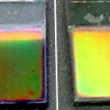
Researchers report the first example of an electrochromic Bragg mirror based on nanoporous multilayers of nickel oxide and tungsten trioxide nanoparticles.
Electrochromic Bragg mirror
Germany | Posted on September 13th, 2012Electrochromic materials change their color by electrically induced storage of ions and electrons in the material. This storage can be reversed by applying an opposing electrical bias.
Two prototypical electrochromic materials are tungsten trioxide, W(VI)O3, and nickel oxide, Ni(II)O.
Now, for the first time, both materials have been combined in a single photonic crystal architecture, where tungsten trioxide is the high refractive index component and nickel oxide the low refractive index component.
In contrast to electrochromic photonic crystals based on a single material, an applied potential does not lead to a strong spectral shift of the photonic stop band. Instead, the device behaves as an electrochromic Bragg mirror, where the reflectance can be modulated by the applied potential.
This reflectance modulation may be useful for tunable mirror devices and for grayscale control in reflective displays, such as ebooks.
The research was reported in Advanced Optical Materials, a new section in Advanced Materials dedicated to breakthrough discoveries and fundamental research in photonics, plasmonics, metamaterials, and more, covering all aspects of light-matter interactions.
####
For more information, please click here
Copyright © Wiley-VCH Materials Science Journals
If you have a comment, please Contact us.Issuers of news releases, not 7th Wave, Inc. or Nanotechnology Now, are solely responsible for the accuracy of the content.
Bookmark:


| Related Links |
 To get Advanced Optical Materials email alerts: click here:
The paper, “Electrochromic Bragg Mirror: ECBM”, is free to download for a limited time:
| Related News Press |
News and information
Quantum computer improves AI predictions April 17th, 2026
Flexible sensor gains sensitivity under pressure April 17th, 2026
A reusable chip for particulate matter sensing April 17th, 2026
Detecting vibrational quantum beating in the predissociation dynamics of SF6 using time-resolved photoelectron spectroscopy April 17th, 2026
Discoveries
Quantum computer improves AI predictions April 17th, 2026
Flexible sensor gains sensitivity under pressure April 17th, 2026
A reusable chip for particulate matter sensing April 17th, 2026
Detecting vibrational quantum beating in the predissociation dynamics of SF6 using time-resolved photoelectron spectroscopy April 17th, 2026
Announcements
A fundamentally new therapeutic approach to cystic fibrosis: Nanobody repairs cellular defect April 17th, 2026
UC Irvine physicists discover method to reverse ‘quantum scrambling’ : The work addresses the problem of information loss in quantum computing system April 17th, 2026
Photonics/Optics/Lasers
Metasurfaces smooth light to boost magnetic sensing precision January 30th, 2026
From sensors to smart systems: the rise of AI-driven photonic noses January 30th, 2026
 |
||
 |
||
| The latest news from around the world, FREE | ||
 |
||
|
|
||
| Premium Products | ||
 |
||
|
Only the news you want to read!
Learn More |
||
 |
||
|
Full-service, expert consulting
Learn More |
||
|
|
||