Home > Press > Tracking stem cells in the body
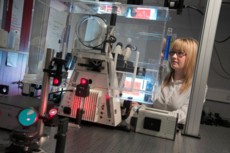 |
| Dr Lara Bogart uses a photothermal microscope to examine live stem cells |
Abstract:
Researchers at the University have developed new methods to track stem cells and further understanding of what happens to them after they have been in the body for a significant period of time.
Tracking stem cells in the body
Liverpool, UK | Posted on June 21st, 2012Stem cells are used to treat conditions such as leukaemia and have the potential to treat many more diseases and disorders where patient survival is reliant on organ and tissue donation. Currently, however, it is difficult for medics to establish whether stem cells have survived following transplantation in the body and if they reach their target site or migrate elsewhere.
In order to track stem cells in the body scientists use superparamagnetic iron oxide nanoparticles (SPIONs) to ‘label' the cells before they are administered into the patient. These particles can be picked up by magnetic resonance imaging (MRI) scans and help medics establish if the stem cells reach their intended target. Conditions within the body's cells, however, can lead to the degradation of SPIONs and reduce the ability of MRI scans to pick up on their signal in the long-term.
Scientists at Liverpool are developing methods to visualise SPIONs in the cells before they enter the body to learn where the particles are going within the stem cell and help predict how they might perform once they are inside the body over a long period of time. They are using a photothermal technique, a unique optical imaging system, to improve SPION labelling so that particles survive for longer and have minimal impact on the function of the transplanted cells.
Effective monitoring
Dr Lara Bogart, from the University's Institute of Integrative Biology, said: "Stem cells have the potential to replace and repair damaged tissue to preclude the need for a patient to wait for an organ or tissue transplant. Research is ongoing into how it could be used to treat a wide variety of diseases such as Alzheimer's, Parkinson's disease, and type one diabetes.
"In order to fully explore this potential, however, more technological developments are needed to understand how stem cells behave in the body after transplantation. If we can't monitor stem cells effectively, it can have serious implications for patient health. Studies have already shown that if cells migrate to the circulatory system, beyond their target organ or tissue site, then it can cause inflammation in the body.
"Labelling stem cells is hugely valuable to tracking their movements in the body, but we need to know more about how the particles used interact with stem cells. Using new imaging systems we can work out their precise location in the cell and how they behave over time. We hope to use this information to improve understanding of the MRI signal that tracks SPIONs once stem cells have been transplanted."
####
For more information, please click here
Copyright © University of Liverpool
If you have a comment, please Contact us.Issuers of news releases, not 7th Wave, Inc. or Nanotechnology Now, are solely responsible for the accuracy of the content.
Bookmark:


| Related Links |
| Related News Press |
News and information
 Quantum computer improves AI predictions April 17th, 2026
Flexible sensor gains sensitivity under pressure April 17th, 2026
A reusable chip for particulate matter sensing April 17th, 2026
Detecting vibrational quantum beating in the predissociation dynamics of SF6 using time-resolved photoelectron spectroscopy April 17th, 2026
Govt.-Legislation/Regulation/Funding/Policy
Quantum computer improves AI predictions April 17th, 2026
Metasurfaces smooth light to boost magnetic sensing precision January 30th, 2026
New imaging approach transforms study of bacterial biofilms August 8th, 2025
Nanomedicine
A fundamentally new therapeutic approach to cystic fibrosis: Nanobody repairs cellular defect April 17th, 2026
New molecular technology targets tumors and simultaneously silences two ‘undruggable’ cancer genes August 8th, 2025
New imaging approach transforms study of bacterial biofilms August 8th, 2025
Electrifying results shed light on graphene foam as a potential material for lab grown cartilage June 6th, 2025
Discoveries
Quantum computer improves AI predictions April 17th, 2026
Flexible sensor gains sensitivity under pressure April 17th, 2026
A reusable chip for particulate matter sensing April 17th, 2026
Detecting vibrational quantum beating in the predissociation dynamics of SF6 using time-resolved photoelectron spectroscopy April 17th, 2026
Announcements
A fundamentally new therapeutic approach to cystic fibrosis: Nanobody repairs cellular defect April 17th, 2026
UC Irvine physicists discover method to reverse ‘quantum scrambling’ : The work addresses the problem of information loss in quantum computing system April 17th, 2026
 |
||
 |
||
| The latest news from around the world, FREE | ||
 |
||
|
|
||
| Premium Products | ||
 |
||
|
Only the news you want to read!
Learn More |
||
 |
||
|
Full-service, expert consulting
Learn More |
||
|
|
||