Home > Press > Novel Gold-Nanoparticle-Based Assay for Understanding Alzheimer’s Disease
 |
Abstract:
Acetylcholinesterase (AChE) is an enzyme that can catalytically break down acetylcholine at cholinergic synapses, resulting in the termination of synaptic transmission. It had been shown that the level of AChE in the cerebrospinal fluid of individuals suffering from Alzheimer's disease is significantly reduced. Therefore, a low level of AChE may indicate a risk or a preclinical stage of Alzheimer's disease. This information could be useful for early prevention and treatment of the disease. However, to date there is no accurate method for identifying Alzheimer's disease in an early or asymptomatic stage of the disease.
Novel Gold-Nanoparticle-Based Assay for Understanding Alzheimer’s Disease
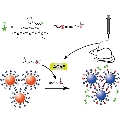
Germany | Posted on December 13th, 2011The clinical application of existing gold nanoparticle (AuNP)-based colorimetric assays is hampered by their moderate sensitivity and selectivity. Now, however, Xingyu Jiang and co-workers (National Center for Nanoscience and Technology, Beijing) have developed a novel AuNP-based assay highly sensitive to acetylcholinesterase (AChE). The fluorescence of Rhodamine B detached from Au surfaces is measured and simultaneously the color change of AuNPs solutions is known.
This new assay provides a detection limit (0.1 mU/mL) much lower than that of all existing probes for AChE. Such a high sensitivity allows the measurement of AChE in the cerebrospinal fluid even after being diluted more than a thousand times. In this manner, false positive results for other components like biothiols in real samples can be ruled out and relevant clinical tests are rendered possible. The study shows that the level of AChE in model mice that suffer from Alzheimer's disease (AD) is lower than that in healthy mice. The assay also allows the progression of the disease and the effect of drug treatments to be studied by monitoring the AChE level in the model mice treated with different drug dosages.
####
For more information, please click here
Copyright © Wiley-VCH Materials Science Journals
If you have a comment, please Contact us.Issuers of news releases, not 7th Wave, Inc. or Nanotechnology Now, are solely responsible for the accuracy of the content.
Bookmark:


| Related Links |
 Dingbin Liu et al., Adv. Healthcare Mat. ; DOI: 10.1002/adhm.201100002
| Related News Press |
News and information
Quantum computer improves AI predictions April 17th, 2026
Flexible sensor gains sensitivity under pressure April 17th, 2026
A reusable chip for particulate matter sensing April 17th, 2026
Detecting vibrational quantum beating in the predissociation dynamics of SF6 using time-resolved photoelectron spectroscopy April 17th, 2026
Nanomedicine
A fundamentally new therapeutic approach to cystic fibrosis: Nanobody repairs cellular defect April 17th, 2026
New molecular technology targets tumors and simultaneously silences two ‘undruggable’ cancer genes August 8th, 2025
New imaging approach transforms study of bacterial biofilms August 8th, 2025
Electrifying results shed light on graphene foam as a potential material for lab grown cartilage June 6th, 2025
Discoveries
Quantum computer improves AI predictions April 17th, 2026
Flexible sensor gains sensitivity under pressure April 17th, 2026
A reusable chip for particulate matter sensing April 17th, 2026
Detecting vibrational quantum beating in the predissociation dynamics of SF6 using time-resolved photoelectron spectroscopy April 17th, 2026
Announcements
A fundamentally new therapeutic approach to cystic fibrosis: Nanobody repairs cellular defect April 17th, 2026
UC Irvine physicists discover method to reverse ‘quantum scrambling’ : The work addresses the problem of information loss in quantum computing system April 17th, 2026
 |
||
 |
||
| The latest news from around the world, FREE | ||
 |
||
|
|
||
| Premium Products | ||
 |
||
|
Only the news you want to read!
Learn More |
||
 |
||
|
Full-service, expert consulting
Learn More |
||
|
|
||