Home > Press > Fluorescent Clusters Provide Window into Live Cells
 |
Abstract:
Important information about live cells' behavior and environment may be gained using a new, easy to make fluorescent gold nanocluster, say scientists in Germany and USA.
Fluorescent Clusters Provide Window into Live Cells
Germany | Posted on August 29th, 2011Studying the behavior of live cells is vastly important to help us understand how our own cells react to changes in environment or invasion, and also to devise better ways to control and contain hostile microbes. To visualize the cells and their processes, labels of some sort are usually required; many of these are fluorescent and can be tracked using external microscopy. Such labels can be laborious to produce and their stability and biocompatibility are a primary concern. Recent advances in nanotechnology have given rise to a new class of fluorescent labels, fluorescent metal nanoclusters. These tiny clusters of metal are small and highly fluorescent and have particular electronic properties because of their size. Their stability can be severely affected by the choice of ligand that sits on the outside of the cluster.
Now, researchers at Karlsruhe Institute of Technology, Germany and University of Illinois in the USA, led by Professor Ulrich Nienhaus, have developed an easy way to make water-soluble fluorescent gold nanoclusters (Au NCs) stabilized with a ligand called dihydrolipoic acid (DHLA). DHLA has two connection points (bidentate) to the cluster which helps to make the cluster extra stable. These Au NCs are highly stable, have bright near-infrared fluorescence emission, are very small, and very biocompatible, all of which makes them promising as novel fluorescent probes for application in biological research. The fluorescence lifetime of the clusters is approximately twice that of background cell fluorescence, so they could easily be visualized within or around a cell using fluorescence lifetime imaging (FLIM).
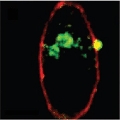
But the researchers did not stop there. Keen to show just how promising their ligand-stabilized clusters are, they visualized the internalization of the Au NCs by live HeLa cells using FLIM. This technique not only reveals the uptake of the Au NCs by the cells but also provides information about the changed local environment of the Au NCs on uptake through the cell membrane. Au NCs near the cell membrane have a longer fluorescence lifetime than those actually internalized by the cells.
The scientists anticipate that their fluorescent Au NCs will find wide application in biomedical research, including intracellular drug delivery, ultrasensitive molecular diagnostics, and image-guided therapy.
####
For more information, please click here
Copyright © Wiley-VCH Materials Science Journals
If you have a comment, please Contact us.Issuers of news releases, not 7th Wave, Inc. or Nanotechnology Now, are solely responsible for the accuracy of the content.
Bookmark:


| Related Links |
 L. Shang et al., Small ; DOI: 10.1002/smll.201100746
| Related News Press |
News and information
Quantum computer improves AI predictions April 17th, 2026
Flexible sensor gains sensitivity under pressure April 17th, 2026
A reusable chip for particulate matter sensing April 17th, 2026
Detecting vibrational quantum beating in the predissociation dynamics of SF6 using time-resolved photoelectron spectroscopy April 17th, 2026
Imaging
Simple algorithm paired with standard imaging tool could predict failure in lithium metal batteries August 8th, 2025
Nanomedicine
A fundamentally new therapeutic approach to cystic fibrosis: Nanobody repairs cellular defect April 17th, 2026
New molecular technology targets tumors and simultaneously silences two ‘undruggable’ cancer genes August 8th, 2025
New imaging approach transforms study of bacterial biofilms August 8th, 2025
Electrifying results shed light on graphene foam as a potential material for lab grown cartilage June 6th, 2025
Discoveries
Quantum computer improves AI predictions April 17th, 2026
Flexible sensor gains sensitivity under pressure April 17th, 2026
A reusable chip for particulate matter sensing April 17th, 2026
Detecting vibrational quantum beating in the predissociation dynamics of SF6 using time-resolved photoelectron spectroscopy April 17th, 2026
Announcements
A fundamentally new therapeutic approach to cystic fibrosis: Nanobody repairs cellular defect April 17th, 2026
UC Irvine physicists discover method to reverse ‘quantum scrambling’ : The work addresses the problem of information loss in quantum computing system April 17th, 2026
Research partnerships
Lab to industry: InSe wafer-scale breakthrough for future electronics August 8th, 2025
HKU physicists uncover hidden order in the quantum world through deconfined quantum critical points April 25th, 2025
 |
||
 |
||
| The latest news from around the world, FREE | ||
 |
||
|
|
||
| Premium Products | ||
 |
||
|
Only the news you want to read!
Learn More |
||
 |
||
|
Full-service, expert consulting
Learn More |
||
|
|
||