Home > Press > A New Therapy Without Side Effects Could Improve Dramatically Chemotherapy
 |
Abstract:
This significant progress -based on nanotechnology- has been achieved by researchers of the universities of Granada, Edimbourgh and Kebangsaan (Malaisie). This therapy is based on the encapsulation of a catalyst (palladium) into microspheres, to synthesize artificial materials or activate drugs into human cells, thus avoiding any toxicity.
A New Therapy Without Side Effects Could Improve Dramatically Chemotherapy
Spain | Posted on July 19th, 2011Researchers of the University of Granada and Edimbourgh have developed a new therapy for cancer based on nanotechnology that might improve significantly chemotherapy, as it has not cause side effects.
This therapy is based on the encapsulation of a catalyst (palladium) into microspheres, to synthesize artificial materials or activate drugs within human cells, thus avoiding any toxicity. This system captures palladium within its microstructure. Palladium is a metal not found naturally in human cells that allows to catalyze chemical reactions within cells without altering its basic functions such as protein synthesis and metabolism. This technique allows to "create" anti-cancer drugs within cells, which could be used for the specific treatment of tumors and would improve dramatically current chemotherapy treatments.
The results of this research -conducted in collaboration with the University of Kebangsaan (Malasia)- were recently published in the prestigious journal Nature Chemistry.
Participation Of The University of Granada
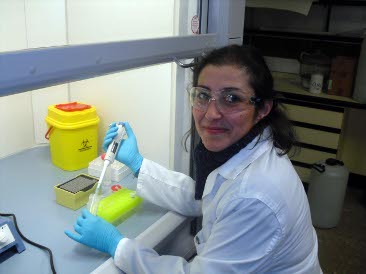
Rosario María Sánchez Martín -the researcher that has developed this technology at the School of Chemistry of the University of Edimbourgh- has recently joined the Department of Pharmaceutical and Organic Chemistry of the University of Granada.
Another of the scientists that forms this research group, Asier Unciti Broceta, did his undergraduate studies and doctorate at the Department of Pharmaceutical and Organic Chemistry at the University of Granada, and he currently continues his successful career in Edinburgh, where he was recently named Fellow of the Edinburgh Cancer Research UK Centre, and received the award of Young Life Scientist of the Year 2010 in Scotland. Additionally, he has founded a new company, Deliverics Ltd, based on one of his patents.
Researchers pointed that, given the wide range of therapeutic applications of nanotechnology, this research will be further developed by University of Granada professor Dr Sanchez Martin, who will continue her collaboration with the research group conducted by professor Mark Bradley of the University of Edimbourgh.
####
For more information, please click here
Contacts:
Rosario María Sánchez Martín
Department of Pharmaceutical and Organic Chemistry
University of Granada
Phone:+0034 958 246 678
Copyright © Universidad de Granada
If you have a comment, please Contact us.Issuers of news releases, not 7th Wave, Inc. or Nanotechnology Now, are solely responsible for the accuracy of the content.
Bookmark:


| Related News Press |
News and information
 Quantum computer improves AI predictions April 17th, 2026
Flexible sensor gains sensitivity under pressure April 17th, 2026
A reusable chip for particulate matter sensing April 17th, 2026
Detecting vibrational quantum beating in the predissociation dynamics of SF6 using time-resolved photoelectron spectroscopy April 17th, 2026
Nanomedicine
A fundamentally new therapeutic approach to cystic fibrosis: Nanobody repairs cellular defect April 17th, 2026
New molecular technology targets tumors and simultaneously silences two ‘undruggable’ cancer genes August 8th, 2025
New imaging approach transforms study of bacterial biofilms August 8th, 2025
Electrifying results shed light on graphene foam as a potential material for lab grown cartilage June 6th, 2025
Discoveries
Quantum computer improves AI predictions April 17th, 2026
Flexible sensor gains sensitivity under pressure April 17th, 2026
A reusable chip for particulate matter sensing April 17th, 2026
Detecting vibrational quantum beating in the predissociation dynamics of SF6 using time-resolved photoelectron spectroscopy April 17th, 2026
Announcements
A fundamentally new therapeutic approach to cystic fibrosis: Nanobody repairs cellular defect April 17th, 2026
UC Irvine physicists discover method to reverse ‘quantum scrambling’ : The work addresses the problem of information loss in quantum computing system April 17th, 2026
Research partnerships
Lab to industry: InSe wafer-scale breakthrough for future electronics August 8th, 2025
HKU physicists uncover hidden order in the quantum world through deconfined quantum critical points April 25th, 2025
 |
||
 |
||
| The latest news from around the world, FREE | ||
 |
||
|
|
||
| Premium Products | ||
 |
||
|
Only the news you want to read!
Learn More |
||
 |
||
|
Full-service, expert consulting
Learn More |
||
|
|
||