Home > Press > Space suit safety
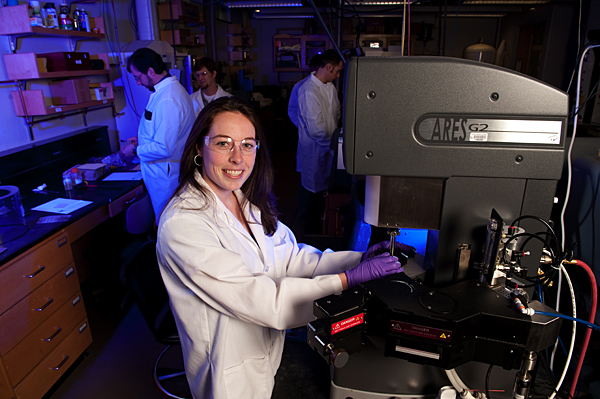 |
| Work by Kate Gurnon could improve space suit safety for NASA astronauts |
Abstract:
Kate Gurnon, a doctoral student in the Department of Chemical Engineering at the University of Delaware, will spend the next year studying materials that show promise to improve MMOD resistance in the next generation space suits as a NASA Delaware Space Grant Fellow.
by Annie Marshall
Space suit safety
Newark, DE | Posted on June 16th, 2011Astronauts are exposed to many dangers in space, particularly debris encountered while working outside the aircraft.
Micrometeoroid orbital debris (MMOD) are sub-centimeter sized particles that can travel up to 19 kilometers per second and have the potential to penetrate space suits, placing astronauts at risk and sometimes forcing them to abort their mission.
Kate Gurnon, a doctoral student in the Department of Chemical Engineering at the University of Delaware, will spend the next year studying materials that show promise to improve MMOD resistance in the next generation space suits as a NASA Delaware Space Grant Fellow.
The one-year, $26,000 grant will fund Gurnon's research on Shear Thickening Fluids (STFs), a novel nanotechnology with the potential to make nanoparticles in a carrier fluid become stiff and dissipate energy, creating a protective layer on select materials. When incorporated into ballistic textiles, such as Kevlar, STF nanocomposites demonstrate increased ballistic protection and puncture resistance.
Gurnon is advised by Norman J. Wagner, Alvin B. and Julia O. Stiles Professor of Chemical Engineering and department chair, and John W. (Jack) Gillespie, Jr., Donald C. Phillips Professor and director of UD's Center for Composite Materials. Her research focuses on a new approach to dynamic materials testing, Large Amplitude Oscillatory Shear (LAOS), which will enable her to develop rheological equations that describe the stress state of STFs under dynamic loading.
"Nanocomposite material performance research is a complicated, yet crucial element in engineering STFs for spacesuit applications," explains Wagner. "Kate must consider not only impact loads and deformation fields, but also how STF composition and microstructure will perform in space."
If successful, her work could lead to more durable, penetration resistant materials for space suits. Gurnon says she hopes the fellowship will also help her become a scientific leader in nanomaterial design and applications, and a role model for future female engineers.
"By disseminating knowledge of the potential advantages of STF technology to a broad audience, I have the opportunity to influence other young women, like myself, to pursue a career in science and technology," she says.
Gurnon is a member of Tau Beta Pi, the national engineering honors society.
The University of Delaware is a Land Grant, Sea Grant and Space Grant institution. Grants are offered to each of these distinct research areas to foster the growth of information by promoting education and providing funds for researchers.
####
For more information, please click here
Contacts:
University of Delaware
Office of Communications & Marketing
302-831-NEWS
Copyright © University of Delaware
If you have a comment, please Contact us.Issuers of news releases, not 7th Wave, Inc. or Nanotechnology Now, are solely responsible for the accuracy of the content.
Bookmark:


| Related News Press |
News and information
 Quantum computer improves AI predictions April 17th, 2026
Flexible sensor gains sensitivity under pressure April 17th, 2026
A reusable chip for particulate matter sensing April 17th, 2026
Detecting vibrational quantum beating in the predissociation dynamics of SF6 using time-resolved photoelectron spectroscopy April 17th, 2026
Possible Futures
A fundamentally new therapeutic approach to cystic fibrosis: Nanobody repairs cellular defect April 17th, 2026
UC Irvine physicists discover method to reverse ‘quantum scrambling’ : The work addresses the problem of information loss in quantum computing system April 17th, 2026
Academic/Education
Rice University launches Rice Synthetic Biology Institute to improve lives January 12th, 2024
Multi-institution, $4.6 million NSF grant to fund nanotechnology training September 9th, 2022
Materials/Metamaterials/Magnetoresistance
First real-time observation of two-dimensional melting process: Researchers at Mainz University unveil new insights into magnetic vortex structures August 8th, 2025
Researchers unveil a groundbreaking clay-based solution to capture carbon dioxide and combat climate change June 6th, 2025
A 1960s idea inspires NBI researchers to study hitherto inaccessible quantum states June 6th, 2025
Institute for Nanoscience hosts annual proposal planning meeting May 16th, 2025
Aerospace/Space
Decoding hydrogen‑bond network of electrolyte for cryogenic durable aqueous zinc‑ion batteries January 30th, 2026
ICFO researchers overcome long-standing bottleneck in single photon detection with twisted 2D materials August 8th, 2025
Onion-like nanoparticles found in aircraft exhaust May 14th, 2025
Grants/Sponsored Research/Awards/Scholarships/Gifts/Contests/Honors/Records
Quantum computer improves AI predictions April 17th, 2026
Detecting vibrational quantum beating in the predissociation dynamics of SF6 using time-resolved photoelectron spectroscopy April 17th, 2026
Metasurfaces smooth light to boost magnetic sensing precision January 30th, 2026
 |
||
 |
||
| The latest news from around the world, FREE | ||
 |
||
|
|
||
| Premium Products | ||
 |
||
|
Only the news you want to read!
Learn More |
||
 |
||
|
Full-service, expert consulting
Learn More |
||
|
|
||