Home > Press > CNST Researchers Develop Integrated Nanomechanical Sensor for Atomic Force Microscopy
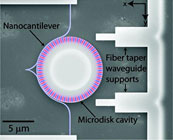 |
| Scanning electron micrograph of the cantilever-microdisksystem. The image has a calculated z-component of the magnetic field overlaid on the structure. |
Abstract:
The atomic force microscope (AFM) is an important tool for nanoscale surface metrology. Typical AFMs map local tip-surface interactions by scanning a flexible cantilever probe over a surface. They rely on bulky optical sensing instrumentation to measure the motion of the probe, which limits the sensitivity, stability, and accuracy of the microscope, and precludes the use of probes much smaller than the wavelength of light. As reported in Nano Letters,* CNST researchers have fabricated a novel integrated sensor combining a nanomechanical cantilever probe with a high sensitivity nanophotonic interferometer on a single silicon chip. Replacing the bulky laser detection system allowed them to build cantilevers orders of magnitude smaller than those used in conventional AFMs.
CNST Researchers Develop Integrated Nanomechanical Sensor for Atomic Force Microscopy
Gaithersburg, MD | Posted on June 6th, 2011Because each of these smaller structures has an effective mass less than a picogram, the detection bandwidth is dramatically increased, reducing the system response time to a few hundred nanoseconds. While probe stiffness was kept comparable to conventional microcantilevers in order to maintain high mechanical gain (how much the tip moves when it senses a force change), the probe size was reduced to a mere 25 µm in length, 260 nm in thickness, and only 65 nm in width. Readout is based on "cavity optomechanics", with the probe fabricated adjacent to a microdisk optical cavity at a gap of less than 100 nm. Due to this close separation, light circulating within the cavity is strongly influenced by the motion of the probe tip. The cavity has a high optical quality factor (Q), meaning that the light makes tens of thousands of round-trips inside the cavity before leaking out of it, all the time accumulating information about the probe's position. The combination of small probe-cavity separation and high Q gives the device sensitivity to probe motion at less than 1 fm/√Hz, while the cavity is able to sense changes in probe position with high bandwidth. The entire device is nanofabricated as a single, monolithic unit on a silicon wafer. It is therefore compact (chip-scale), self-aligned, and stable. Fiber optic waveguides couple light into and out of the sensor, so that it can be easily interfaced with standard optical sources and detectors. Finally, through simple changes to the probe geometry, the mechanics of the probe tip can be greatly varied, allowing for the different combinations of mechanical gain and bandwidth needed for a variety of AFM applications.
*Optomechanical transduction of an integrated silicon cantilever probe using a microdisk resonator, K. Srinivasan, H. Miao, M.T. Rakher, M. Davanco, and V. Aksyuk, Nano Letters 11, 791-797 (2011).
####
About National Institute of Standards and Technology (NIST)
Founded in 1901, NIST is a non-regulatory federal agency within the U.S. Department of Commerce. NIST's mission is to promote U.S. innovation and industrial competitiveness by advancing measurement science, standards, and technology in ways that enhance economic security and improve our quality of life.
For more information, please click here
Contacts:
Kartik Srinivasan
301-975-5938
Copyright © NIST
If you have a comment, please Contact us.Issuers of news releases, not 7th Wave, Inc. or Nanotechnology Now, are solely responsible for the accuracy of the content.
Bookmark:


| Related News Press |
News and information
 Quantum computer improves AI predictions April 17th, 2026
Flexible sensor gains sensitivity under pressure April 17th, 2026
A reusable chip for particulate matter sensing April 17th, 2026
Detecting vibrational quantum beating in the predissociation dynamics of SF6 using time-resolved photoelectron spectroscopy April 17th, 2026
Imaging
Simple algorithm paired with standard imaging tool could predict failure in lithium metal batteries August 8th, 2025
First real-time observation of two-dimensional melting process: Researchers at Mainz University unveil new insights into magnetic vortex structures August 8th, 2025
New imaging approach transforms study of bacterial biofilms August 8th, 2025
Laboratories
Researchers develop molecular qubits that communicate at telecom frequencies October 3rd, 2025
Govt.-Legislation/Regulation/Funding/Policy
Quantum computer improves AI predictions April 17th, 2026
Metasurfaces smooth light to boost magnetic sensing precision January 30th, 2026
New imaging approach transforms study of bacterial biofilms August 8th, 2025
Discoveries
Quantum computer improves AI predictions April 17th, 2026
Flexible sensor gains sensitivity under pressure April 17th, 2026
A reusable chip for particulate matter sensing April 17th, 2026
Detecting vibrational quantum beating in the predissociation dynamics of SF6 using time-resolved photoelectron spectroscopy April 17th, 2026
Announcements
A fundamentally new therapeutic approach to cystic fibrosis: Nanobody repairs cellular defect April 17th, 2026
UC Irvine physicists discover method to reverse ‘quantum scrambling’ : The work addresses the problem of information loss in quantum computing system April 17th, 2026
Tools
Metasurfaces smooth light to boost magnetic sensing precision January 30th, 2026
From sensors to smart systems: the rise of AI-driven photonic noses January 30th, 2026
Japan launches fully domestically produced quantum computer: Expo visitors to experience quantum computing firsthand August 8th, 2025
 |
||
 |
||
| The latest news from around the world, FREE | ||
 |
||
|
|
||
| Premium Products | ||
 |
||
|
Only the news you want to read!
Learn More |
||
 |
||
|
Full-service, expert consulting
Learn More |
||
|
|
||