Home > Press > Compact High-Temperature Superconducting Cables Demonstrated at NIST
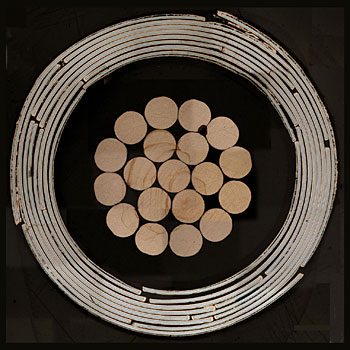 |
| Cross-section of a high-temperature superconducting cable design invented at NIST. In the center are copper wires bundled with nylon and plastic insulation. The outer rings are a series of superconducting tapes wrapped in spirals around the copper. The cable is 7.5 millimeters in outer diameter. Credit: van der Laan/NIST |
Abstract:
A researcher at the National Institute of Standards and Technology (NIST) has invented a method of making high-temperature superconducting (HTS) cables that are thinner and more flexible than demonstration HTS cables now installed in the electric power grid while carrying the same or more current. The compact cables could be used in the electric grid as well as scientific and medical equipment and may enable HTS power transmission for military applications.
Compact High-Temperature Superconducting Cables Demonstrated at NIST
Gaithersburg, MD | Posted on February 14th, 2011Described in a paper just published online,* the new method involves winding multiple HTS-coated conductors** around a multi-strand copper "former" or core. The superconducting layers are wound in spirals in alternating directions. One prototype cable is 6.5 millimeters (mm) in outer diameter and carries a current of 1,200 amperes; a second cable is 7.5 mm in diameter and carries a current as high as 2,800 amperes. They are roughly one-tenth the diameter of typical HTS cables used in the power grid. (Standard electrical transmission lines normally operate at currents below 1,000 amperes.)
HTS materials, which conduct electricity without resistance when cooled sufficiently (below 77 K, or minus 196 C/minus 321 F, for the new cables) with liquid nitrogen or helium gas, are used to boost efficiency in some power grids. The main innovation in the compact cables is the tolerance of newer HTS conductors to compressive strain that allows use of the unusually slender copper former, says developer Danko van der Laan, a University of Colorado scientist working at NIST.
"The knowledge I gained while working at NIST on electromechanical properties of high-temperature superconductors was very important for inventing the initial cable concept," van der Laan says. "For instance, my discovery that the conductor survives large compressive strains*** made me realize that wrapping the conductor around a small diameter former would most likely work."
Van der Laan and NIST colleagues demonstrated the feasibility of the new concept by making several cables and testing their performance. They used an HTS material with a critical current that is less sensitive to strain than some other materials. Although the prototype cables are wound by hand, several manufacturers say mass production is feasible.
NIST researchers are now developing prototype compact HTS cables for the military, which requires small size and light weight as well as flexibility to pull transmission lines through conduits with tight bends. Beside power transmission, the flexible cabling concept could be used for superconducting transformers, generators, and magnetic energy storage devices that require high-current windings. The compact cables also could be used in high-field magnets for fusion and for medical applications such as next-generation magnetic resonance imaging and proton cancer treatment systems.
The work was supported in part by the U.S. Department of Energy.
* D.C. van der Laan, X.F. Lu, and L.F. Goodrich. Compact GdBa2Cu3O7-ä. coated conductor cables for electric power transmission and magnet applications. Superconductor Science & Technology. 24 042001, doi: 10.1088/0953-2048/24/4/042001.
** The superconducting compound used in the work is gadolinium-barium-copper-oxide, or GdBa2Cu3O7-ä.
*** See the NIST Feb. 15, 2007, Tech Beat article "Strain Has Major Effect on High-Temp Superconductors," at www.nist.gov/public_affairs/techbeat/tb2007_0215.htm#htc.
####
For more information, please click here
Contacts:
Laura Ost
303-497-4880
Copyright © NIST
If you have a comment, please Contact us.Issuers of news releases, not 7th Wave, Inc. or Nanotechnology Now, are solely responsible for the accuracy of the content.
Bookmark:


| Related News Press |
News and information
 Quantum computer improves AI predictions April 17th, 2026
Flexible sensor gains sensitivity under pressure April 17th, 2026
A reusable chip for particulate matter sensing April 17th, 2026
Detecting vibrational quantum beating in the predissociation dynamics of SF6 using time-resolved photoelectron spectroscopy April 17th, 2026
Possible Futures
A fundamentally new therapeutic approach to cystic fibrosis: Nanobody repairs cellular defect April 17th, 2026
UC Irvine physicists discover method to reverse ‘quantum scrambling’ : The work addresses the problem of information loss in quantum computing system April 17th, 2026
Announcements
A fundamentally new therapeutic approach to cystic fibrosis: Nanobody repairs cellular defect April 17th, 2026
UC Irvine physicists discover method to reverse ‘quantum scrambling’ : The work addresses the problem of information loss in quantum computing system April 17th, 2026
Military
Quantum engineers ‘squeeze’ laser frequency combs to make more sensitive gas sensors January 17th, 2025
Chainmail-like material could be the future of armor: First 2D mechanically interlocked polymer exhibits exceptional flexibility and strength January 17th, 2025
Single atoms show their true color July 5th, 2024
NRL charters Navy’s quantum inertial navigation path to reduce drift April 5th, 2024
Environment
A reusable chip for particulate matter sensing April 17th, 2026
Researchers unveil a groundbreaking clay-based solution to capture carbon dioxide and combat climate change June 6th, 2025
 |
||
 |
||
| The latest news from around the world, FREE | ||
 |
||
|
|
||
| Premium Products | ||
 |
||
|
Only the news you want to read!
Learn More |
||
 |
||
|
Full-service, expert consulting
Learn More |
||
|
|
||