Home > Press > Researchers discover less-expensive low-temperature catalyst for hydrogen purification
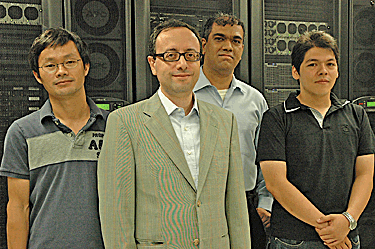 |
| Left to right: Chemical and Biological Engineering postdoctoral associate Guowen Peng, Professor Manos Mavrikakis, postdoctoral researcher Rahul Nabar, and PhD student Jeff Herron. Photo by Renee Meiller. |
Abstract:
Engineering researchers from Tufts University, the University of Wisconsin-Madison and Harvard University have demonstrated the low-temperature efficacy of an atomically dispersed platinum catalyst, which could be suitable for on-board hydrogen production in fuel-cell-powered vehicles of the future.
Researchers discover less-expensive low-temperature catalyst for hydrogen purification
Madison, WI | Posted on October 1st, 2010An alternative to copper, which under certain conditions can ignite spontaneously, the platinum-based catalyst is highly active and stable. The researchers' understanding of the structure and function of the new catalyst could help manufacturers design highly effective — but less costly — catalysts on standard, inexpensive support metal oxides.
Led by Maria Flytzani-Stephanopoulos, a Tufts University School of Engineering professor of chemical and biological engineering, and Manos Mavrikakis, a UW-Madison professor of chemical and biological engineering, the research team published its findings in the September 24, 2010, issue of the journal Science.
Only small amounts of hydrogen occur naturally on Earth — yet, according to the U.S. Department of Energy, the country's demand for hydrogen is about 9 million tons per year.
Manufacturers produce about 95 percent of this hydrogen through steam reforming of natural gas, a catalytic process in which steam reacts with methane to yield carbon monoxide and hydrogen. This mixture is known as synthesis gas, or syngas, and is an intermediate in production processes for synthetic fuels, ammonia and methanol, among other compounds.
Another application for hydrogen is fuel for the hydrogen economy, an effort that aims to exploit high-energy-density hydrogen as a cleaner source of energy, particularly for low-temperature fuel-cell-powered devices, including vehicles.
Fuel cells use electrochemical processes to convert hydrogen and oxygen into water, producing direct current that powers a motor. Fuel cell vehicles require highly purified hydrogen, which is produced through a water-gas-shift reaction. This key step strips "residual" carbon monoxide from hydrogen generated through steam reforming of fossil fuels, such as natural gas. Water-gas-shift catalysts decrease the amount of carbon monoxide in hydrogen and increase the hydrogen content by harvesting hydrogen from water molecules.
Catalysts currently used in industry for hydrogen purification are copper-based, supported on zinc oxide and alumina. Because copper is pyrophoric (it could spontaneously ignite when exposed to air; air in fuel cell operation is relatively common), researchers have considered platinum as a substitute. However, platinum is costly and, says Flytzani-Stephanopoulos, researchers must prepare it in very fine particles on more "exotic" supports, such as the rare-earth oxide ceria, which makes it effective for a low-temperature water-gas-shift reaction.
However, while cerium is the most abundant of the rare-earth elements, this natural abundance occurs in just a few places around the world, and, says Mavrikakis, access to it may be limited for various reasons, including geopolitical.
The Tufts researchers initially discovered that sodium improves the platinum activity in the water-gas-shift reaction, which now can take place at low temperatures, even on inert materials like silica. They carried out detailed structural studies and found extra active oxygen species on the surface that helped the platinum complete the reaction cycle. They also found that the sodium or potassium ions helped to stabilize the catalytic site.
In later experiments, they saw their catalyst perform as well as platinum on ceria. Collaborator David Bell of Harvard University used atomic-resolution electron microscopy to view stabilized platinum clusters and atoms on the silica support — visual confirmation that the new catalyst operates like those on ceria supports.
Mavrikakis' team set out to understand why. The researchers drew on powerful computational resources, including the UW-Madison Division of Information Technology and the Center for High-Throughput Computing, as well as an ultrafast 10G data network, to model the new catalyst, atom by atom. "There is no experimental way that you can look at the atoms ‘at work' — that is, while the reaction is happening," says Mavrikakis. "You need to start talking about individual atoms, which you can see with the highest-resolution electron microscopes — but not during the reaction. So you can only suggest that perhaps these atoms are active, but there is no way to substantiate it unless you put an atomic-scale quantum-mechanical model together and come up with a more realistic and well-founded suggestion about what is responsible for making this catalyst so active."
Although platinum is among the most expensive catalytic materials, the new catalyst contains only trace amounts of platinum, yet is robust and effective at low temperatures. Essentially, its structure is a series of small "clusters" comprising only a few atoms, each in a specific arrangement. Each cluster is composed of one or a few a platinum atoms surrounded by a mixture of oxygen, hydroxyl and potassium atoms and is "seated" on the standard aluminum or silica support.
The researchers say the advance is important in part because, through a combination of experiments and first-principles theory, the work reveals a new type of active site for a specific, very important chemical reaction. "Most of the time, people are happy to say, ‘Well, we've found a material. It works for a given application,'" says Mavrikakis.
In this case, says Flytzani-Stephanopoulos, the team took the next step to determine how and why the catalyst works. "If we want to move to the next stage with cheaper materials that are doing the specific chemical transformations, we need to understand the fundamentals," she says.
Other authors on the paper include UW-Madison postdoctoral associate Guowen Peng, PhD student Jeff Herron, and then-PhD students (now alumni) Peter Ferrin and Anand Nilekar; and Tufts University Research Professor Howard Saltsburg, postdoctoral associate Rui Si, PhD student Yanping Zhai and former PhD student Weiling Deng, and master's student Danny Pierre.
The U.S. Department of Energy and National Science Foundation provided primary funding for the research.
####
For more information, please click here
Copyright © University of Wisconsin-Madison
If you have a comment, please Contact us.Issuers of news releases, not 7th Wave, Inc. or Nanotechnology Now, are solely responsible for the accuracy of the content.
Bookmark:


| Related News Press |
News and information
 Quantum computer improves AI predictions April 17th, 2026
Flexible sensor gains sensitivity under pressure April 17th, 2026
A reusable chip for particulate matter sensing April 17th, 2026
Detecting vibrational quantum beating in the predissociation dynamics of SF6 using time-resolved photoelectron spectroscopy April 17th, 2026
Chemistry
Projecting light to dispense liquids: A new route to ultra-precise microdroplets January 30th, 2026
From sensors to smart systems: the rise of AI-driven photonic noses January 30th, 2026
"Nanoreactor" cage uses visible light for catalytic and ultra-selective cross-cycloadditions October 3rd, 2025
Cambridge chemists discover simple way to build bigger molecules – one carbon at a time June 6th, 2025
Possible Futures
A fundamentally new therapeutic approach to cystic fibrosis: Nanobody repairs cellular defect April 17th, 2026
UC Irvine physicists discover method to reverse ‘quantum scrambling’ : The work addresses the problem of information loss in quantum computing system April 17th, 2026
Academic/Education
Rice University launches Rice Synthetic Biology Institute to improve lives January 12th, 2024
Multi-institution, $4.6 million NSF grant to fund nanotechnology training September 9th, 2022
Announcements
A fundamentally new therapeutic approach to cystic fibrosis: Nanobody repairs cellular defect April 17th, 2026
UC Irvine physicists discover method to reverse ‘quantum scrambling’ : The work addresses the problem of information loss in quantum computing system April 17th, 2026
Environment
A reusable chip for particulate matter sensing April 17th, 2026
Researchers unveil a groundbreaking clay-based solution to capture carbon dioxide and combat climate change June 6th, 2025
Energy
Sensors innovations for smart lithium-based batteries: advancements, opportunities, and potential challenges August 8th, 2025
Simple algorithm paired with standard imaging tool could predict failure in lithium metal batteries August 8th, 2025
Automotive/Transportation
Decoding hydrogen‑bond network of electrolyte for cryogenic durable aqueous zinc‑ion batteries January 30th, 2026
Sensors innovations for smart lithium-based batteries: advancements, opportunities, and potential challenges August 8th, 2025
Simple algorithm paired with standard imaging tool could predict failure in lithium metal batteries August 8th, 2025
Fuel Cells
Deciphering local microstrain-induced optimization of asymmetric Fe single atomic sites for efficient oxygen reduction August 8th, 2025
Current and Future Developments in Nanomaterials and Carbon Nanotubes: Applications of Nanomaterials in Energy Storage and Electronics October 28th, 2022
 |
||
 |
||
| The latest news from around the world, FREE | ||
 |
||
|
|
||
| Premium Products | ||
 |
||
|
Only the news you want to read!
Learn More |
||
 |
||
|
Full-service, expert consulting
Learn More |
||
|
|
||