Home > Press > Submarines could use new nanotube technology for sonar and stealth
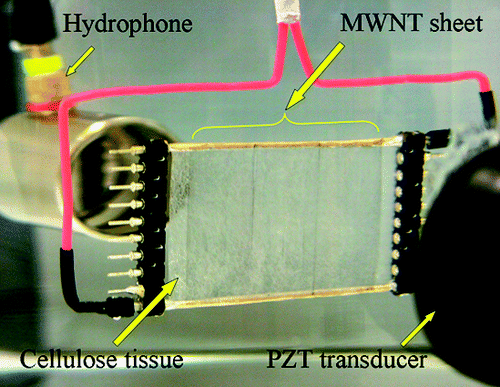 |
| The application of solid-state fabricated carbon nanotube sheets as thermoacoustic projectors is extended from air to underwater applications, thereby providing surprising results. While the acoustic generation efficiency of a liquid immersed nanotube sheet is profoundly degraded by nanotube wetting, the hydrophobicity of the nanotube sheets in water results in an air envelope about the nanotubes that increases pressure generation efficiency a hundred-fold over that obtained by immersion in wetting alcohols. Due to nonresonant sound generation, the emission spectrum of a liquid-immersed nanotube sheet varies smoothly over a wide frequency range, 1−105 Hz. Copyright American Chemical Society |
Abstract:
Speakers made from carbon nanotube sheets that are a fraction of the width of a human hair can both generate sound and cancel out noise -- properties ideal for submarine sonar to probe the ocean depths and make subs invisible to enemies. That's the topic of a report on these "nanotube speakers," which appears in ACS' Nano Letters, a monthly journal.
Submarines could use new nanotube technology for sonar and stealth
Richardson, TX | Posted on September 5th, 2010Ali Aliev and colleagues explain that thin films of nanotubes can generate sound waves via a thermoacoustic effect. Every time that an electrical pulse passes through the microscopic layer of carbon tubes, the air around them heats up and creates a sound wave. Chinese scientists first discovered that effect in 2008, and applied it in building flexible speakers. In a remarkable demonstration, which made its way onto YouTube, the Chinese nanoscientists stuck a sheet of nanotubes onto the side of a flag, and attached it to an mp3 player. They used the nanotube-coated flag to play a song while it flapped in the breeze. But they did not test its ability to operate under water.
Aliev's group took that step, showing that nanotube sheets produce the kind of low-frequency sound waves that enable sonar to determine the location, depth, and speed of underwater objects. They also verified that the speakers can be tuned to specific frequencies to cancel out noise, such as the sound of a submarine moving through the depths.
Full Article: pubs.acs.org/stoken/presspac/presspac/full/10.1021/nl100235n
####
For more information, please click here
Contacts:
Ali Aliev, Ph.D.
MacDiarmid NanoTech Institute
University of Texas at Dallas
Richardson, Texas 75083
Michael Bernstein
202-872-6042
American Chemical Society
Copyright © American Chemical Society
If you have a comment, please Contact us.Issuers of news releases, not 7th Wave, Inc. or Nanotechnology Now, are solely responsible for the accuracy of the content.
Bookmark:


| Related News Press |
News and information
 Quantum computer improves AI predictions April 17th, 2026
Flexible sensor gains sensitivity under pressure April 17th, 2026
A reusable chip for particulate matter sensing April 17th, 2026
Detecting vibrational quantum beating in the predissociation dynamics of SF6 using time-resolved photoelectron spectroscopy April 17th, 2026
Marine/Watercraft
Strain-sensing smart skin ready to deploy: Nanotube-embedded coating detects threats from wear and tear in large structures July 15th, 2022
A sunlight-driven “self-healing” anti-corrosion coating May 27th, 2022
Quantum tech in space? Scientists design remote monitoring system for inaccessible quantum devices February 11th, 2022
Possible Futures
A fundamentally new therapeutic approach to cystic fibrosis: Nanobody repairs cellular defect April 17th, 2026
UC Irvine physicists discover method to reverse ‘quantum scrambling’ : The work addresses the problem of information loss in quantum computing system April 17th, 2026
Academic/Education
Rice University launches Rice Synthetic Biology Institute to improve lives January 12th, 2024
Multi-institution, $4.6 million NSF grant to fund nanotechnology training September 9th, 2022
Nanotubes/Buckyballs/Fullerenes/Nanorods/Nanostrings/Nanosheets
Tiny nanosheets, big leap: A new sensor detects ethanol at ultra-low levels January 30th, 2026
Enhancing power factor of p- and n-type single-walled carbon nanotubes April 25th, 2025
Chainmail-like material could be the future of armor: First 2D mechanically interlocked polymer exhibits exceptional flexibility and strength January 17th, 2025
Innovative biomimetic superhydrophobic coating combines repair and buffering properties for superior anti-erosion December 13th, 2024
Discoveries
Quantum computer improves AI predictions April 17th, 2026
Flexible sensor gains sensitivity under pressure April 17th, 2026
A reusable chip for particulate matter sensing April 17th, 2026
Detecting vibrational quantum beating in the predissociation dynamics of SF6 using time-resolved photoelectron spectroscopy April 17th, 2026
Announcements
A fundamentally new therapeutic approach to cystic fibrosis: Nanobody repairs cellular defect April 17th, 2026
UC Irvine physicists discover method to reverse ‘quantum scrambling’ : The work addresses the problem of information loss in quantum computing system April 17th, 2026
Military
Quantum engineers ‘squeeze’ laser frequency combs to make more sensitive gas sensors January 17th, 2025
Chainmail-like material could be the future of armor: First 2D mechanically interlocked polymer exhibits exceptional flexibility and strength January 17th, 2025
Single atoms show their true color July 5th, 2024
NRL charters Navy’s quantum inertial navigation path to reduce drift April 5th, 2024
 |
||
 |
||
| The latest news from around the world, FREE | ||
 |
||
|
|
||
| Premium Products | ||
 |
||
|
Only the news you want to read!
Learn More |
||
 |
||
|
Full-service, expert consulting
Learn More |
||
|
|
||