Home > Press > Smaller and Sharper
 |
Abstract:
Nanoscale Metal-Organic Frameworks (NMOFs) as MRI Contrast Agents
Smaller and Sharper
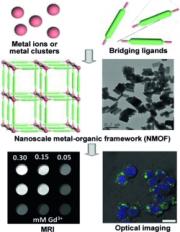
Weinheim, Germany | Posted on July 8th, 2010Developing more sensitive methods of biomedical imaging that are effective with minimal amounts of contrast agents is an important challenge in the early and accurate diagnosis of illnesses. A new class of materials that appear promising in this quest were introduced in 2006 by Prof. Wenbin Lin of the University of North Carolina at Chapel Hill. Ever since, this emerging area has been growing rapidly as new materials with improved properties are discovered. Wenbin Lin and Joseph Della Rocca present the progress in this field in the Microreview published in the European Journal of Inorganic Chemistry.
Magnetic resonance imaging (MRI) is a noninvasive technique based on the detection of nuclear spin reorientations in a magnetic field, which, however, is relatively insensitive and typically relies on large doses of administered contrast agents to distinguish adequately between normal and diseased tissues. Nanoscale Metal-Organic Frameworks (NMOFs) are combinations of metals and organic molecules on the nanoscale that provide unlimited possibilities for designing task-specific molecules. They are intrinsically biodegradable, and their high porosity makes them ideal for targeted delivery of entrapped agents. They can be specifically targeted to certain regions of the body. In addition to a wealth of applications in other fields, these properties make NMOFs also very suitable for use in biological systems and in particular as more effective contrast agents at lower doses. In addition to Gd carboxylate materials, NMOFs based on Fe, Mn, and Zn were investigated. Coatings such as amorphous silica, biocompatible polymers, and polyoxometalate-peptide hybrid spheres were used to enhance the stability, dispersibility, and biocompatibility of NMOFs. Furthermore, some systems doped with lanthanides were studied as potential multimodal contrast agents.
The in vivo and in vitro effectiveness of these agents has been demonstrated. For example, iron carboxylate NMOFs modified with biocompatible polymers were used for imaging the liver and spleen of Wistar rats. Silica-coated, peptide-targeted Mn NMOFs were shown to be selectively taken up by a human colon cancer cell line in vitro. Finally, a versatile iron carboxylate system post-synthetically modified to contain a fluorophore or a chemotherapeutic showed strong fluorescence upon release from the framework and exhibited cytotoxicity comparable to cisplatin against colon cancer cells.
Author: Wenbin Lin, University of North Carolina, Chapel Hill (USA), www.unc.edu/~wlin/
Title: Nanoscale Metal-Organic Frameworks: Magnetic Resonance Imaging Contrast Agents and Beyond
European Journal of Inorganic Chemistry, Permalink to the article: dx.doi.org/10.1002/ejic.201000496
####
For more information, please click here
Copyright © European Journal of Inorganic Chemistry
If you have a comment, please Contact us.Issuers of news releases, not 7th Wave, Inc. or Nanotechnology Now, are solely responsible for the accuracy of the content.
Bookmark:


| Related News Press |
News and information
 Quantum computer improves AI predictions April 17th, 2026
Flexible sensor gains sensitivity under pressure April 17th, 2026
A reusable chip for particulate matter sensing April 17th, 2026
Detecting vibrational quantum beating in the predissociation dynamics of SF6 using time-resolved photoelectron spectroscopy April 17th, 2026
Possible Futures
A fundamentally new therapeutic approach to cystic fibrosis: Nanobody repairs cellular defect April 17th, 2026
UC Irvine physicists discover method to reverse ‘quantum scrambling’ : The work addresses the problem of information loss in quantum computing system April 17th, 2026
Academic/Education
Rice University launches Rice Synthetic Biology Institute to improve lives January 12th, 2024
Multi-institution, $4.6 million NSF grant to fund nanotechnology training September 9th, 2022
Nanomedicine
A fundamentally new therapeutic approach to cystic fibrosis: Nanobody repairs cellular defect April 17th, 2026
New molecular technology targets tumors and simultaneously silences two ‘undruggable’ cancer genes August 8th, 2025
New imaging approach transforms study of bacterial biofilms August 8th, 2025
Electrifying results shed light on graphene foam as a potential material for lab grown cartilage June 6th, 2025
Announcements
A fundamentally new therapeutic approach to cystic fibrosis: Nanobody repairs cellular defect April 17th, 2026
UC Irvine physicists discover method to reverse ‘quantum scrambling’ : The work addresses the problem of information loss in quantum computing system April 17th, 2026
Nanobiotechnology
A fundamentally new therapeutic approach to cystic fibrosis: Nanobody repairs cellular defect April 17th, 2026
New molecular technology targets tumors and simultaneously silences two ‘undruggable’ cancer genes August 8th, 2025
New imaging approach transforms study of bacterial biofilms August 8th, 2025
Electrifying results shed light on graphene foam as a potential material for lab grown cartilage June 6th, 2025
 |
||
 |
||
| The latest news from around the world, FREE | ||
 |
||
|
|
||
| Premium Products | ||
 |
||
|
Only the news you want to read!
Learn More |
||
 |
||
|
Full-service, expert consulting
Learn More |
||
|
|
||