Home > Press > Record wavelength at FLASH – First lasing below 4.5 nanometres at DESY´s free-electron laser
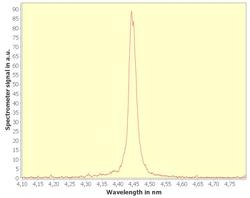 |
| The spectrum of the record laser pulse peaks at a wavelength of 4.45 nanometres. |
Abstract:
For the first time, FLASH produced laser light with a wavelength of 4.45 nanometres; thus, DESY's free-electron laser for soft X-ray light considerably beat its previous record of 6.5 nanometres. At the same time, the peak intensity of single light pulses nearly doubled, with 0.3 millijoule. Prior to this, there was a five-month machine upgrade, above all with a significant improvement of the superconducting linear accelerator.
Record wavelength at FLASH – First lasing below 4.5 nanometres at DESY´s free-electron laser
Hamburg | Posted on June 16th, 2010FLASH, the world's first X-ray free-electron laser is available to the photon science user community for experiments since 2005. Last winter, the facility underwent a major upgrade. The accelerator was equipped with a seventh superconducting accelerator module to increase the maximum electron energy to 1.2 Giga-electronvolts (GeV). Moreover, a special 3.9-GHz module was installed to improve the quality of the accelerated electron bunches. The first tests during the current commissioning showed excellent results: the linear accelerator was operated at 1.207 GeV and the 3.9-GHz module shapes the electron bunches in a way that the intensity of the laser light is higher than ever before.
"It is absolutely impressing, how fast and promising FLASH is operating after such a substantial upgrade. My compliments to the FLASH accelerator team," congratulates Reinhard Brinkmann, director of the DESY accelerator section. With the now obtainable laser wavelength, experiments with carbon in organic molecules come within reach, and magneto-dynamics experiments with the third-harmonic wavelength benefit from substantially increased intensities.
This success is also an important milestone for the European XFEL on the way to the observation of movements that only take femtoseconds. The accelerator module recently built-in at FLASH is a prototype for the XFEL accelerator, and the properties of the 3.9-GHz module too are decisive for operating the XFEL injector. The third FLASH user period is to start end of August.
####
For more information, please click here
Contacts:
Notkestraße 85
22607 Hamburg
Tel: +49 40 8998-0
Fax: +49 40 8998-3282
Copyright © Deutsches Elektronen-Synchrotron
If you have a comment, please Contact us.Issuers of news releases, not 7th Wave, Inc. or Nanotechnology Now, are solely responsible for the accuracy of the content.
Bookmark:


| Related News Press |
News and information
 Quantum computer improves AI predictions April 17th, 2026
Flexible sensor gains sensitivity under pressure April 17th, 2026
A reusable chip for particulate matter sensing April 17th, 2026
Detecting vibrational quantum beating in the predissociation dynamics of SF6 using time-resolved photoelectron spectroscopy April 17th, 2026
Announcements
A fundamentally new therapeutic approach to cystic fibrosis: Nanobody repairs cellular defect April 17th, 2026
UC Irvine physicists discover method to reverse ‘quantum scrambling’ : The work addresses the problem of information loss in quantum computing system April 17th, 2026
Photonics/Optics/Lasers
Metasurfaces smooth light to boost magnetic sensing precision January 30th, 2026
From sensors to smart systems: the rise of AI-driven photonic noses January 30th, 2026
 |
||
 |
||
| The latest news from around the world, FREE | ||
 |
||
|
|
||
| Premium Products | ||
 |
||
|
Only the news you want to read!
Learn More |
||
 |
||
|
Full-service, expert consulting
Learn More |
||
|
|
||