 |
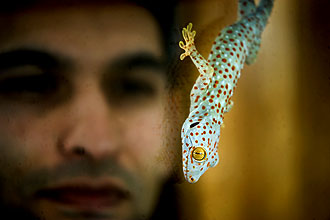
| Noshir Pesika developed polymer-based dry adhesive structures that mimic the adhesive system on the feet of his gecko, Nikki. (Photos by Paula Burch-Celentano) |
Abstract:
She's four years old, lives in a lab in the Boggs building and is among a family of reptiles inspiring development of a new reusable dry adhesive. She's a Tokay gecko named Nikki.
"We're working to develop a synthetic dry adhesive following the same science behind what nature has evolved," says Noshir Pesika, an assistant professor of chemical and biomolecular engineering.
By Belinda Lacoste
Stuck Up
New Orleans, LA | Posted on May 26th, 2010When scientists began studying the gecko adhesive system, they discovered that geckos stick not by suction, or capillary forces, or by sticky substances on their toes, but by weak electromagnetic forces called van der Waals interactions.
It is the force of millions of nanoscale "split hairs" contacting a surface at once that gives the gecko a grip so strong it can hold its own body weight by a single toe, Pesika says.
Many research groups are fabricating structures of hair-like fibers attempting to replicate the gecko adhesive system.
In his laboratory, Pesika developed polymer-based dry adhesive structures that mimic the gecko adhesive system.
Along with collaborators at the University of California-Santa Barbara and Lewis & Clark College, Pesika has developed an innovative and simple technique to incorporate tilt in the hairy fibers. The angled fibers more closely duplicate the natural curve of the gecko hairs, which Pesika says exploits friction forces to enhance adhesion.
"We have structures that are already working," Pesika says. "Our aim is to further improve adhesion and simplify the processing scheme to make the technology attractive to an industrial market."
Pesika anticipates that dry adhesives may be used as self-stick notes and page tabs that would not leave a residue, as bandages that would not fall off when wet, and possibly as adhesive pads on astronaut's shoes.
They have an advantage over traditional "sticky" adhesives, Pesika says, because they are a solid material that would not collect dirt and would still adhere in water or in space, where glue would evaporate.
Belinda Lacoste is a student studying journalism in the School of Continuing Studies and a staff member who writes for the School of Science and Engineering.
####
For more information, please click here
Contacts:
Belinda Lacoste
Copyright © Tulane University
If you have a comment, please Contact us.Issuers of news releases, not 7th Wave, Inc. or Nanotechnology Now, are solely responsible for the accuracy of the content.
Bookmark:


| Related News Press |
News and information
 Quantum computer improves AI predictions April 17th, 2026
Flexible sensor gains sensitivity under pressure April 17th, 2026
A reusable chip for particulate matter sensing April 17th, 2026
Detecting vibrational quantum beating in the predissociation dynamics of SF6 using time-resolved photoelectron spectroscopy April 17th, 2026
Possible Futures
A fundamentally new therapeutic approach to cystic fibrosis: Nanobody repairs cellular defect April 17th, 2026
UC Irvine physicists discover method to reverse ‘quantum scrambling’ : The work addresses the problem of information loss in quantum computing system April 17th, 2026
Academic/Education
Rice University launches Rice Synthetic Biology Institute to improve lives January 12th, 2024
Multi-institution, $4.6 million NSF grant to fund nanotechnology training September 9th, 2022
Announcements
A fundamentally new therapeutic approach to cystic fibrosis: Nanobody repairs cellular defect April 17th, 2026
UC Irvine physicists discover method to reverse ‘quantum scrambling’ : The work addresses the problem of information loss in quantum computing system April 17th, 2026
Research partnerships
Lab to industry: InSe wafer-scale breakthrough for future electronics August 8th, 2025
HKU physicists uncover hidden order in the quantum world through deconfined quantum critical points April 25th, 2025
 |
||
 |
||
| The latest news from around the world, FREE | ||
 |
||
|
|
||
| Premium Products | ||
 |
||
|
Only the news you want to read!
Learn More |
||
 |
||
|
Full-service, expert consulting
Learn More |
||
|
|
||