Home > Press > Artificial diamonds may make fuel cells more affordable
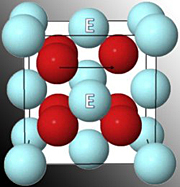 |
| Oxygen (red spheres) migrates from one vacancy to another inside the scandia-doped cubic zirconia. The cations the oxygen must brush past are marked by the letter E. |
Abstract:
Using specialized cubic zirconia or artificial diamonds, scientists from Nanjing Normal University in China and DOE's Pacific Northwest National Laboratory created a membrane that could drop the temperature inside solid oxide fuel cells (SOFCs).
Artificial diamonds may make fuel cells more affordable
Richland, WA | Posted on May 11th, 2010Lowering the temperature means these cells could be built from less expensive materials.
Currently, the temperature inside SOFCs is about 1000 degrees Celsius. With this much heat, the cells must be constructed using very durable, very expensive ceramics. Lower temperatures mean the cells could be built from inexpensive stainless steel. The trick to dropping the temperature, and thus the cost, is the membrane at the heart of the cell. The team's new scandia-doped cubic zirconia can work at temperatures as low as 650°C.
This work was done at DOE's EMSL, a national scientific user facility.
####
About Environmental Molecular Sciences Laboratory
EMSL is funded by DOE's Office of Biological Research, which supports world-class research in the biological, chemical, and environmental sciences to provide innovative solutions to the nation's environmental challenges as well as those related to energy production. EMSL's distinctive focus on integrating computational and experimental capabilities as well as collaborating among disciplines yields a strong, synergistic scientific environment. Bringing together experts and state-of-the-art instruments critical to their research under one roof, EMSL has helped thousands of researchers use a multidisciplinary, collaborative approach to solve some of the most important national challenges in energy, environmental sciences, and human health. These challenges cover a wide range of research, including synthesis, characterization, theory and modeling, dynamical properties, and environmental testing.
For more information, please click here
Contacts:
Kristin Manke
509.372.6011
Copyright © Environmental Molecular Sciences Laboratory
If you have a comment, please Contact us.Issuers of news releases, not 7th Wave, Inc. or Nanotechnology Now, are solely responsible for the accuracy of the content.
Bookmark:


| Related News Press |
News and information
 Quantum computer improves AI predictions April 17th, 2026
Flexible sensor gains sensitivity under pressure April 17th, 2026
A reusable chip for particulate matter sensing April 17th, 2026
Detecting vibrational quantum beating in the predissociation dynamics of SF6 using time-resolved photoelectron spectroscopy April 17th, 2026
Possible Futures
A fundamentally new therapeutic approach to cystic fibrosis: Nanobody repairs cellular defect April 17th, 2026
UC Irvine physicists discover method to reverse ‘quantum scrambling’ : The work addresses the problem of information loss in quantum computing system April 17th, 2026
Materials/Metamaterials/Magnetoresistance
First real-time observation of two-dimensional melting process: Researchers at Mainz University unveil new insights into magnetic vortex structures August 8th, 2025
Researchers unveil a groundbreaking clay-based solution to capture carbon dioxide and combat climate change June 6th, 2025
A 1960s idea inspires NBI researchers to study hitherto inaccessible quantum states June 6th, 2025
Institute for Nanoscience hosts annual proposal planning meeting May 16th, 2025
Announcements
A fundamentally new therapeutic approach to cystic fibrosis: Nanobody repairs cellular defect April 17th, 2026
UC Irvine physicists discover method to reverse ‘quantum scrambling’ : The work addresses the problem of information loss in quantum computing system April 17th, 2026
Energy
Sensors innovations for smart lithium-based batteries: advancements, opportunities, and potential challenges August 8th, 2025
Simple algorithm paired with standard imaging tool could predict failure in lithium metal batteries August 8th, 2025
Fuel Cells
Deciphering local microstrain-induced optimization of asymmetric Fe single atomic sites for efficient oxygen reduction August 8th, 2025
Current and Future Developments in Nanomaterials and Carbon Nanotubes: Applications of Nanomaterials in Energy Storage and Electronics October 28th, 2022
 |
||
 |
||
| The latest news from around the world, FREE | ||
 |
||
|
|
||
| Premium Products | ||
 |
||
|
Only the news you want to read!
Learn More |
||
 |
||
|
Full-service, expert consulting
Learn More |
||
|
|
||