Home > Press > NREL finds a way to give LEDs the green light
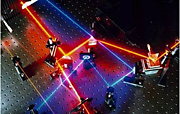 |
| NREL’s Solar Energy Research Facility is the site of experiments using lasers to probe the light-emitting properties of gallium indium phosphide alloys for making light-emitting diodes. |
Abstract:
Light bulbs that last 100 years and fill rooms with brilliant ambiance may become a reality sooner rather than later, thanks to a discovery by DOE's National Renewable Energy Laboratory.
NREL finds a way to give LEDs the green light
Washington, D.C. | Posted on May 11th, 2010NREL scientists found a way to generate a tricky combination of green and red that may just prove to be the biggest boost for illumination since Edison's light bulb.
Green isn't just a symbol of environmentalism, it is a real color, and a desperately needed one for researchers looking for a way to light homes, streets and buildings at a fraction of today's costs.
LEDs—light-emitting diodes—are the promise of the future because unlike tungsten bulbs or compact fluorescent bulbs, they deliver most of their energy as light, rather than heat.
To make an LED that appears white, researchers minimally need the colors red, green and blue. Red proved easy to generate, and about 15 years ago, Japanese scientists found a way to generate blue, thus providing two of the key colors from the spectrum of white light.
But green has been elusive. In fact, the $10 LEDs that people can buy now are made to look white by aiming the blue light at a phosphor, which then emits green. It works OK, but the clunky process saps a big chunk of the efficiency from the light.
Along came NREL, a world leader in designing solar cells, but a neophyte in the lighting realm.
NREL scientist Angelo Mascarenhas realized that an LED is just the reverse of a solar cell. One takes electricity and turns it into light; the other takes sunlight and turns it into electricity.
"We had already developed some of the know-how to capture sunlight in this green spectral region," Mascarenhas said.
Why not try that same process, only in reverse, to make a reliable deep-green LED using gallium nitride and indium?
Astonishingly, once the concept was understood, Mascarenhas's team produced a radiant deep green on their very first try. The aim now is to provide a fourth color to make that white light even whiter. "We have full confidence that this is achievable," Mascarenhas said.
####
About NREL
NREL is the only federal laboratory dedicated to the research, development, commercialization and deployment of renewable energy and energy efficiency technologies. Backed by 32 years of achievement, NREL leads the way in helping meet the growing demand for clean energy.
For more information, please click here
Contacts:
George Douglas
303.275.4096
Copyright © NREL
If you have a comment, please Contact us.Issuers of news releases, not 7th Wave, Inc. or Nanotechnology Now, are solely responsible for the accuracy of the content.
Bookmark:


| Related News Press |
News and information
 Quantum computer improves AI predictions April 17th, 2026
Flexible sensor gains sensitivity under pressure April 17th, 2026
A reusable chip for particulate matter sensing April 17th, 2026
Detecting vibrational quantum beating in the predissociation dynamics of SF6 using time-resolved photoelectron spectroscopy April 17th, 2026
Display technology/LEDs/SS Lighting/OLEDs
Spinel-type sulfide semiconductors to operate the next-generation LEDs and solar cells For solar-cell absorbers and green-LED source October 3rd, 2025
Efficient and stable hybrid perovskite-organic light-emitting diodes with external quantum efficiency exceeding 40 per cent July 5th, 2024
Possible Futures
A fundamentally new therapeutic approach to cystic fibrosis: Nanobody repairs cellular defect April 17th, 2026
UC Irvine physicists discover method to reverse ‘quantum scrambling’ : The work addresses the problem of information loss in quantum computing system April 17th, 2026
Discoveries
Quantum computer improves AI predictions April 17th, 2026
Flexible sensor gains sensitivity under pressure April 17th, 2026
A reusable chip for particulate matter sensing April 17th, 2026
Detecting vibrational quantum beating in the predissociation dynamics of SF6 using time-resolved photoelectron spectroscopy April 17th, 2026
Announcements
A fundamentally new therapeutic approach to cystic fibrosis: Nanobody repairs cellular defect April 17th, 2026
UC Irvine physicists discover method to reverse ‘quantum scrambling’ : The work addresses the problem of information loss in quantum computing system April 17th, 2026
 |
||
 |
||
| The latest news from around the world, FREE | ||
 |
||
|
|
||
| Premium Products | ||
 |
||
|
Only the news you want to read!
Learn More |
||
 |
||
|
Full-service, expert consulting
Learn More |
||
|
|
||