Home > Press > Researchers Discover Weak Link in Alzheimer’s Drug Candidates
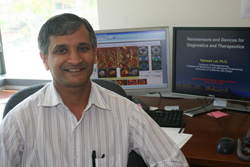 |
| Ratnesh Lal, a UCSD bioengineering and mechanical engineering professor, led a multi-disciplinary team of researchers in a breakthrough discovery relating to Alzheimer's disease. |
Abstract:
Some current therapies being investigated for Alzheimer's disease may cause further neural degeneration and cell death, according to a breakthrough discovery by UC San Diego researchers. By combining three dimensional computer simulations with high resolution atomic force microscopy membrane protein and cell imaging, electrical recording and various cellular assays, UCSD nano-biophysicist Ratnesh Lal and his colleagues investigated the structure and function of truncated peptides, known as nonamyloidgenic peptides, formed by some Alzheimer's drug candidates.
By Andrea Siedsma
Researchers Discover Weak Link in Alzheimer’s Drug Candidates
San Diego, CA | Posted on April 2nd, 2010The researchers found that the nonamyloidgenic peptides formed active ion channels that caused the cells to take in very high levels of calcium ions, which damaged synaptic efficiency and eventually killed neurons, neurons that are linked to memory loss in human brain.
As a result of their current findings and related previous work, Lal and his colleagues believe that aggregate-forming amyloidogenic peptides promote neurological diseases by forming holes or channels in cell membranes, disturbing ionic homeostasis by allowing unwanted ion flow in-and-out of cells, and most importantly allowing toxic amounts of calcium ions into neural cells.
Truncated, shorter non-amyloidogenic peptide fragments that also form ion channels and alter neuronal viability, are assumed by biomedical researchers to be non-toxic and are currently targeted to treat Alzheimer's disease patients. Details of their research were recently published in a paper entitled "Truncated â-amyloid peptide channels provide an alternative mechanism for Alzheimer's Disease and Down syndrome" in the Proceedings of the National Academy of Sciences.
"There are several drugs to treat Alzheimer's in Trials I and II, but we don't believe that they will be adopted for clinical usage," said Lal, a joint professor in the UCSD Jacobs School of Engineering's Department of Mechanical and Aerospace Engineering and Bioengineering. We believe we are providing the most direct mechanism of Alzheimer's disease and Down Syndrome pathology. Through our research we have provided a structure and mechanism (an ion channel) that can account for the pathology. The strategy to control the activity of this structure - the opening and closing of the channel - should be targeted for an effective treatment."
Lal and his colleagues are now working on a 3D structural model of the ion channel using their data to identify the domains (or sites) of the channel for designing effective therapeutics. Lal said the use of advanced nanotechnology and biology combined with a multi disciplinary approach, aided in the researchers' breakthrough discovery.
"Without advances in technology and a multi disciplinary approach this kind of complex research would not move forward," said Lal, a trained physicist and neurobiologist who joined the UCSD faculty in January 2010 from the University of Chicago. ""My goal is to provide practical solutions for effective human health management using advances in nanoscience and technology with a multidisciplinary and multi-scale (nano-to-translational) integrated approach," he added.
####
About University of California, San Diego
UC San Diego is dedicated to the advancement of knowledge through excellence in education and research at the undergraduate, graduate, professional school and postdoctoral levels. The campus is committed to community engagement, public service and industry partnerships in order to advance the health and well-being of our region, state, nation and the world. Our academic community of world-renowned faculty, bright students and dedicated staff is characterized by a culture of interdisciplinary collaboration and innovation which spans the globe.
To foster the best possible working and learning environment, our university strives to maintain a climate of fairness, cooperation, and professionalism, which is embodied in our campus Principles of Community. UC San Diego embraces diversity, equity, and inclusion as essential ingredients of academic excellence in higher education.
For more information, please click here
Contacts:
Media Contact
Andrea Siedsma
858.822.0899
Copyright © University of California, San Diego
If you have a comment, please Contact us.Issuers of news releases, not 7th Wave, Inc. or Nanotechnology Now, are solely responsible for the accuracy of the content.
Bookmark:


| Related News Press |
News and information
 Quantum computer improves AI predictions April 17th, 2026
Flexible sensor gains sensitivity under pressure April 17th, 2026
A reusable chip for particulate matter sensing April 17th, 2026
Detecting vibrational quantum beating in the predissociation dynamics of SF6 using time-resolved photoelectron spectroscopy April 17th, 2026
Possible Futures
A fundamentally new therapeutic approach to cystic fibrosis: Nanobody repairs cellular defect April 17th, 2026
UC Irvine physicists discover method to reverse ‘quantum scrambling’ : The work addresses the problem of information loss in quantum computing system April 17th, 2026
Academic/Education
Rice University launches Rice Synthetic Biology Institute to improve lives January 12th, 2024
Multi-institution, $4.6 million NSF grant to fund nanotechnology training September 9th, 2022
Nanomedicine
A fundamentally new therapeutic approach to cystic fibrosis: Nanobody repairs cellular defect April 17th, 2026
New molecular technology targets tumors and simultaneously silences two ‘undruggable’ cancer genes August 8th, 2025
New imaging approach transforms study of bacterial biofilms August 8th, 2025
Electrifying results shed light on graphene foam as a potential material for lab grown cartilage June 6th, 2025
Announcements
A fundamentally new therapeutic approach to cystic fibrosis: Nanobody repairs cellular defect April 17th, 2026
UC Irvine physicists discover method to reverse ‘quantum scrambling’ : The work addresses the problem of information loss in quantum computing system April 17th, 2026
Nanobiotechnology
A fundamentally new therapeutic approach to cystic fibrosis: Nanobody repairs cellular defect April 17th, 2026
New molecular technology targets tumors and simultaneously silences two ‘undruggable’ cancer genes August 8th, 2025
New imaging approach transforms study of bacterial biofilms August 8th, 2025
Electrifying results shed light on graphene foam as a potential material for lab grown cartilage June 6th, 2025
 |
||
 |
||
| The latest news from around the world, FREE | ||
 |
||
|
|
||
| Premium Products | ||
 |
||
|
Only the news you want to read!
Learn More |
||
 |
||
|
Full-service, expert consulting
Learn More |
||
|
|
||