Home > Press > Contact lenses loaded with vitamin E may treat glaucoma
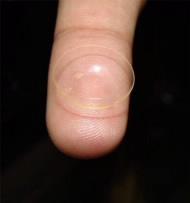 |
| Contact lenses containing vitamin E like the one above can treat glaucoma, the second leading cause of blindness, and other eye conditions, scientists are reporting. Credit: Anuj Chauhan, Ph.D. |
Abstract:
The popular dietary supplement vitamin E, loaded into special medicated contact lenses, can keep glaucoma medicine near the eye — where it can treat that common disease— almost 100 times longer than possible with current commercial lenses, scientists reported here today.
Contact lenses loaded with vitamin E may treat glaucoma
Washington, DC | Posted on March 29th, 2010In a presentation at the 239th National Meeting of the American Chemical Society (ACS), they described use of vitamin E to develop contact lenses that may deliver more medication for glaucoma and perhaps other diseases to the eye.
Anuj Chauhan, Ph.D., who headed the research team, explained that glaucoma is second only to cataracts as the leading cause of vision loss and blindness in the world. It affects almost 67 million people. Eye drops that relieve the abnormal build-up of pressure inside the eye that occurs in glaucoma, are a mainstay treatment.
Chauhan and colleagues have developed a new extended-release delivery approach incorporating vitamin E into contact lenses. The invisible clusters, or aggregates, of vitamin E molecules form what Chauhan describes as "transport barriers." that slow down the elusion of the glaucoma medication from the lens into the eye. The drug released from the lens into the eye stays in the tears far longer than the 2-5 minutes with eye drops, leading to more effective therapy.In research with laboratory animals, the lenses containing vitamin E nanobricks administered drugs up to 100 times longer than most commercial lenses. The lenses could be designed for continuous wear for up to a month, Chauhan said.
####
About American Chemical Society
ACS is a congressionally chartered independent membership organization which represents professionals at all degree levels and in all fields of chemistry and sciences that involve chemistry.
For more information, please click here
Contacts:
Science Inquiries:
Michael Woods
Editor
202-872-6293
General Inquiries:
Michael Bernstein
202-872-6042
Copyright © American Chemical Society
If you have a comment, please Contact us.Issuers of news releases, not 7th Wave, Inc. or Nanotechnology Now, are solely responsible for the accuracy of the content.
Bookmark:


| Related News Press |
News and information
 Quantum computer improves AI predictions April 17th, 2026
Flexible sensor gains sensitivity under pressure April 17th, 2026
A reusable chip for particulate matter sensing April 17th, 2026
Detecting vibrational quantum beating in the predissociation dynamics of SF6 using time-resolved photoelectron spectroscopy April 17th, 2026
Possible Futures
A fundamentally new therapeutic approach to cystic fibrosis: Nanobody repairs cellular defect April 17th, 2026
UC Irvine physicists discover method to reverse ‘quantum scrambling’ : The work addresses the problem of information loss in quantum computing system April 17th, 2026
Nanomedicine
A fundamentally new therapeutic approach to cystic fibrosis: Nanobody repairs cellular defect April 17th, 2026
New molecular technology targets tumors and simultaneously silences two ‘undruggable’ cancer genes August 8th, 2025
New imaging approach transforms study of bacterial biofilms August 8th, 2025
Electrifying results shed light on graphene foam as a potential material for lab grown cartilage June 6th, 2025
Announcements
A fundamentally new therapeutic approach to cystic fibrosis: Nanobody repairs cellular defect April 17th, 2026
UC Irvine physicists discover method to reverse ‘quantum scrambling’ : The work addresses the problem of information loss in quantum computing system April 17th, 2026
 |
||
 |
||
| The latest news from around the world, FREE | ||
 |
||
|
|
||
| Premium Products | ||
 |
||
|
Only the news you want to read!
Learn More |
||
 |
||
|
Full-service, expert consulting
Learn More |
||
|
|
||