Home > Press > Researchers can precisely manipulate polarization in nanostructures
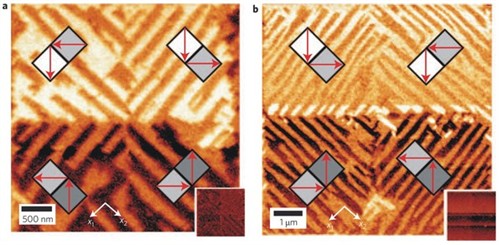 |
| Manipulation of the polarization in nanostructures. In Figure a, the researchers created an artificial star; in Figure b there is a diamond pattern. |
Abstract:
Data storage with very high data densities on the horizon
Researchers can precisely manipulate polarization in nanostructures
The Netherlands | Posted on October 26th, 2009Researchers from the MESA+ Institute for Nanotechnology at the University of Twente, working with American researchers, have succeeded in using an electrical signal to control both the elastic and the magnetic properties of a nanomaterial at a very localized level. This opens up new possibilities for data storage with very high data densities. Their findings are to be published in November in the leading scientific journal Nature Nanotechnology.
In what are known as 'multiferroic' materials, the electrical, magnetic and elastic properties of the material are coupled. These materials make it possible to create new, complex structures that are suitable for e.g. data storage. Until recently, nobody had succeeded in controlling these multiferroic properties, but researchers from Oakridge National Laboratory (USA), the University of California, Berkeley (USA), Pennsylvania State University (USA) and the University of Twente's MESA+ Institute for Nanotechnology demonstrate in the next issue of Nature Nanotechnology that it is indeed possible.
In their experiments, the scientists succeeded in manipulating a nanostructure made of bismuth ferrate (BiFeO3) in an ordered way using scanning probe microscopy. This is a technique in which a surface can be manipulated at the atomic scale, using a miniscule needle.
By applying an electrical voltage to the needle and moving it over the surface of the material, the scientists are able to 'charge' a nanomaterial with different elastic and magnetic properties at a very localized level. This opens new avenues for data storage with very high information densities.
Notes for the press
The article 'Deterministic control of ferroelastic switching in multiferroic materials' by N. Balke, S. Jesse, A. P. Baddorf, S. V. Kalinin (ORNL), Y. H. Chu, R. Ramesh (UC Berkeley), S. Choudhury and L. Q. Chen (Penn State) and M. Huijben (MESA+) will appear in the November issue of Nature Nanotechnology. We can send you the publication as a PDF file by e-mail.
####
About University of Twente
The University of Twente is an entrepreneurial research university. It is the only campus University in the Netherlands and provides academic education and research in a wide variety of fields, for example from psychology to public administration and applied physics to biomedical technology. The University of Twente is part of the 3TU.Federation and works cooperatively with Delft University of Technology and Eindhoven University of Technology. The University of Twente is also a member of the European Consortium of Innovative Universities.
For more information, please click here
Contacts:
Joost Bruysters
+31 (0)53‑489‑2773
Copyright © University of Twente
If you have a comment, please Contact us.Issuers of news releases, not 7th Wave, Inc. or Nanotechnology Now, are solely responsible for the accuracy of the content.
Bookmark:


| Related News Press |
News and information
 Quantum computer improves AI predictions April 17th, 2026
Flexible sensor gains sensitivity under pressure April 17th, 2026
A reusable chip for particulate matter sensing April 17th, 2026
Detecting vibrational quantum beating in the predissociation dynamics of SF6 using time-resolved photoelectron spectroscopy April 17th, 2026
Possible Futures
A fundamentally new therapeutic approach to cystic fibrosis: Nanobody repairs cellular defect April 17th, 2026
UC Irvine physicists discover method to reverse ‘quantum scrambling’ : The work addresses the problem of information loss in quantum computing system April 17th, 2026
Memory Technology
Researchers tackle the memory bottleneck stalling quantum computing October 3rd, 2025
First real-time observation of two-dimensional melting process: Researchers at Mainz University unveil new insights into magnetic vortex structures August 8th, 2025
Utilizing palladium for addressing contact issues of buried oxide thin film transistors April 5th, 2024
Announcements
A fundamentally new therapeutic approach to cystic fibrosis: Nanobody repairs cellular defect April 17th, 2026
UC Irvine physicists discover method to reverse ‘quantum scrambling’ : The work addresses the problem of information loss in quantum computing system April 17th, 2026
 |
||
 |
||
| The latest news from around the world, FREE | ||
 |
||
|
|
||
| Premium Products | ||
 |
||
|
Only the news you want to read!
Learn More |
||
 |
||
|
Full-service, expert consulting
Learn More |
||
|
|
||