Home > Press > Proximity Effect Correction software seamlessly integrates with Nanometer Pattern Generation Systems
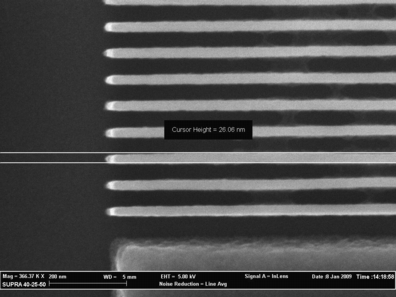 |
| SEM micrograph of 20nm lines, 50nm pitch that highlights very stable and dense HSQ structure using the optimal doses provided by the NanoMaker software. HSQ resist thickness is 180nm. |
Abstract:
The NanoMaker Workbench software automatically generates a Proximity Effect Corrected runfile, compatible with NPGS systems, for SEM-based electron beam lithography.
Proximity Effect Correction software seamlessly integrates with Nanometer Pattern Generation Systems
North Billerica, MA | Posted on May 20th, 2009The newly designed NanoMaker software has been successfully demonstrated at the Nanoscale Integration Laboratory, University of Texas at Dallas. The hardware platform included a Zeiss Supra 40 Field Emission Scanning Electron Microscope (SEM) with a NPGS 9.2 pattern generator.
The experiment consisted of fabricating 20nm and 25nm lines with 50nm and 100nm pitched arrays, respectively, separated by a large solid rectangle in the middle. The HSQ resist thickness on Si was 180nm. Before using the NanoMaker Proximity Effect Correction (PEC) software, many different doses were tried to fabricate the structure correctly without success. Upon using the NanoMaker PEC software, the optimal doses were automatically assigned, the data exported to the NPGS, and the device was successfully fabricated.
"Usually, it is difficult to fabricate dense nanolines with higher aspect ratios because of the proximity effect," states Professor Walter Hu, of the Nanoscale Integration Lab at UTD, "The preliminary NanoMaker results that show its ability to get down to uniform 20nm lines in width with 50nm pitch is remarkable."
Scanning Electron Microscopes are typically limited in acceleration voltage to 30kV. This is where proximity effects are dominant. For organizations that need to create dense nano-patterns with a SEM, the NanoMaker design and PEC software package adds tremendous value to existing NPGS systems.
Your browser may not support display of this image."We are grateful to Professor Walter Hu and his team for allowing us the opportunity to prove the power of the NanoMaker software," states Dr. Sergey Zaitsev, CTO of NanoMaker and Head of the Theoretical Department at the Institute of Microelectronics Technology - Russian Academy of Sciences (IMT RAS), "We look forward to a continued partnership with UTD and other research institutes interested in electron/ion beam fabrication of nanodevices and structures using the NanoMaker system."
####
About SEMTech Solutions, Inc.
NanoMaker is a powerful software/hardware system for SEM/FIB based lithography that is intended for state-of-the-art design and manufacturing of micro and nano electronic devices and structures. For more information on the NanoMaker software/hardware system, visit www.nanomaker.com, or contact our North American representative directly at SEMTech Solutions, (978) 663-9822, www.semtechsolutions.com.
About the Nanoscale Integration Laboratory at UTD:
The Nanoscale Integration Laboratory is focused on integrating nanoscale elements of electronics, chemistry, and biology. Such nano-bio-engineering fusion may provide rare opportunities to explore new science and applications. For more information visit the Nanoscale Integration Laboratory website at the University of Texas at Dallas.
For more information, please click here
Contacts:
Gary Brake, Marketing Manager
SEMTech Solutions, Inc.
(978) 663-9822 x235
Copyright © NanoMaker
If you have a comment, please Contact us.Issuers of news releases, not 7th Wave, Inc. or Nanotechnology Now, are solely responsible for the accuracy of the content.
Bookmark:


| Related News Press |
News and information
 Quantum computer improves AI predictions April 17th, 2026
Flexible sensor gains sensitivity under pressure April 17th, 2026
A reusable chip for particulate matter sensing April 17th, 2026
Detecting vibrational quantum beating in the predissociation dynamics of SF6 using time-resolved photoelectron spectroscopy April 17th, 2026
Software
Visualizing nanoscale structures in real time: Open-source software enables researchers to see materials in 3D while they're still on the electron microscope August 19th, 2022
Luisier wins SNSF Advanced Grant to develop simulation tools for nanoscale devices July 8th, 2022
Oxford Instruments’ Atomfab® system is production-qualified at a market-leading GaN power electronics device manufacturer December 17th, 2021
Chip Technology
A reusable chip for particulate matter sensing April 17th, 2026
Metasurfaces smooth light to boost magnetic sensing precision January 30th, 2026
Announcements
A fundamentally new therapeutic approach to cystic fibrosis: Nanobody repairs cellular defect April 17th, 2026
UC Irvine physicists discover method to reverse ‘quantum scrambling’ : The work addresses the problem of information loss in quantum computing system April 17th, 2026
Tools
Metasurfaces smooth light to boost magnetic sensing precision January 30th, 2026
From sensors to smart systems: the rise of AI-driven photonic noses January 30th, 2026
Japan launches fully domestically produced quantum computer: Expo visitors to experience quantum computing firsthand August 8th, 2025
 |
||
 |
||
| The latest news from around the world, FREE | ||
 |
||
|
|
||
| Premium Products | ||
 |
||
|
Only the news you want to read!
Learn More |
||
 |
||
|
Full-service, expert consulting
Learn More |
||
|
|
||