Home > Press > Dolphins inspire nanotech work, earn researcher $400K
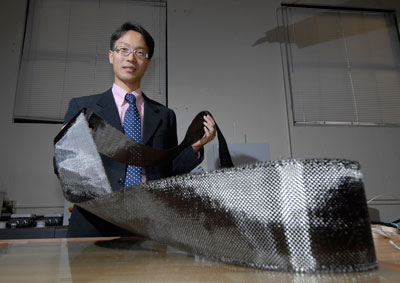 |
| Jonghwan Suhr envisions using the pliable manufactured nanocomposites to allow airplanes and aerospace vehicles to cut through the air more efficiently, saving fuel. Photo by Crista Hecht. |
Abstract:
Inspired with the speed at which dolphins swim through the water compared to other aquatic life, Jonghwan Suhr of the University of Nevada, Reno, decided to mimic the dolphin's skin using nanotechnology in order to make objects move more efficiently through the air.
Dolphins inspire nanotech work, earn researcher $400K
Reno, NV | Posted on December 31st, 2008Suhr's research impressed the National Science Foundation, which recently presented him with their most prestigious honor for junior teacher-scholars, a Faculty Early Career Development (CAREER) Program award. The award brings with it $400,000 of funding over five years for his research and teaching.
"These are very competitive and prestigious grants and they are clear evidence of the scholarly potential of the recipient and the excellence of the program," College of Engineering Dean Manos Maragakis said. "The award can have a profound positive effect on the development and the career of the faculty member. It enhances the reputation of the department and the college and gives the opportunity for graduate students to work on state-of-the-art research."
In his groundbreaking research, Suhr, an assistant professor of mechanical engineering, and his colleagues developed new carbon nanotube composite materials with increased strength and damping qualities over conventional materials. Generally, the nanotubes are in a hollow cylindrical shape with nanoscale diameters and microscopic lengths.
"Most materials show compromise between two properties - strength and damping, but this particular system showed an increase in both," Suhr said. In addition, the continuously reinforced nanotube composites are lightweight, flexible, have mechanical robustness, outstanding fatigue resistance, electrical and thermal conductivities and also have tissue-like behavior, he said.
The new nanotube surface material Suhr's research team created, continuous carbon nanotube-polymer composites, will reduce drag force by increasing aerodynamic efficiency. The technology may also be used on wind turbine blades, enhancing the efficiency and reducing noise associated with the renewable energy machines.
Suhr envisions using the pliable manufactured nanocomposites to allow airplanes and aerospace vehicles to cut through the air more efficiently, saving fuel. He is already working with the aircraft company Boeing to investigate creating the artificial skin for wing structures of unmanned air vehicles.
Suhr will work with undergraduate students in his senior capstone course to demonstrate the concept of the artificial skins as a design project. The NSF CAREER award will support Suhr's research and his innovative teaching.
Kwang Kim, chairman of the Mechanical Engineering Department, said in his letter of support for Suhr's CAREER proposal, "his proposed research work regarding Continuous Nanotube Composite structures for bio-mimicking applications is new and will represent one of the most tangible, concrete and promising applications of nanotechnology to realistic mechanical systems in the near future." His work leads to a new frontier in nanotechnology.
Suhr's plan for the new composite also includes applications in which he hopes to make the soft tissue-like material into an electroactive polymer that would eliminate the need for many mechanical parts in a mechanism, to possibly mimic muscles and produce new structural applications.
####
For more information, please click here
Copyright © University of Nevada, Reno
If you have a comment, please Contact us.Issuers of news releases, not 7th Wave, Inc. or Nanotechnology Now, are solely responsible for the accuracy of the content.
Bookmark:


| Related News Press |
News and information
 Quantum computer improves AI predictions April 17th, 2026
Flexible sensor gains sensitivity under pressure April 17th, 2026
A reusable chip for particulate matter sensing April 17th, 2026
Detecting vibrational quantum beating in the predissociation dynamics of SF6 using time-resolved photoelectron spectroscopy April 17th, 2026
Govt.-Legislation/Regulation/Funding/Policy
Quantum computer improves AI predictions April 17th, 2026
Metasurfaces smooth light to boost magnetic sensing precision January 30th, 2026
New imaging approach transforms study of bacterial biofilms August 8th, 2025
Discoveries
Quantum computer improves AI predictions April 17th, 2026
Flexible sensor gains sensitivity under pressure April 17th, 2026
A reusable chip for particulate matter sensing April 17th, 2026
Detecting vibrational quantum beating in the predissociation dynamics of SF6 using time-resolved photoelectron spectroscopy April 17th, 2026
Announcements
A fundamentally new therapeutic approach to cystic fibrosis: Nanobody repairs cellular defect April 17th, 2026
UC Irvine physicists discover method to reverse ‘quantum scrambling’ : The work addresses the problem of information loss in quantum computing system April 17th, 2026
Aerospace/Space
Decoding hydrogen‑bond network of electrolyte for cryogenic durable aqueous zinc‑ion batteries January 30th, 2026
ICFO researchers overcome long-standing bottleneck in single photon detection with twisted 2D materials August 8th, 2025
Onion-like nanoparticles found in aircraft exhaust May 14th, 2025
Grants/Sponsored Research/Awards/Scholarships/Gifts/Contests/Honors/Records
Quantum computer improves AI predictions April 17th, 2026
Detecting vibrational quantum beating in the predissociation dynamics of SF6 using time-resolved photoelectron spectroscopy April 17th, 2026
Metasurfaces smooth light to boost magnetic sensing precision January 30th, 2026
 |
||
 |
||
| The latest news from around the world, FREE | ||
 |
||
|
|
||
| Premium Products | ||
 |
||
|
Only the news you want to read!
Learn More |
||
 |
||
|
Full-service, expert consulting
Learn More |
||
|
|
||