Home > Press > Nanoparticles in the Home: More and Smaller Than Previously Detected
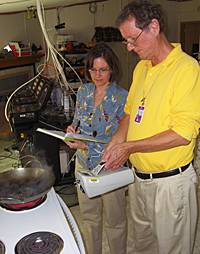 |
| NIST researcher Cynthia Howard Reed and guest researcher Lance Wallace measure nanoparticles emitted by common household appliances. The new experiments can measure 'ultrafine particles' ranging in size from 2 to 10 nanometers.
Credit: NIST |
Abstract:
Extremely small nanoscale particles are released by common kitchen appliances in abundant amounts, greatly outnumbering the previously detected, larger-size nanoparticles emitted by these appliances, according to new findings* by researchers at the National Institute of Standards and Technology (NIST). So-called "ultrafine particles" (UFP) range in size from 2 to 10 nanometers. They are emitted by motor vehicles and a variety of indoor sources and have attracted attention because of increasing evidence that they can cause respiratory and cardiovascular illnesses.
Nanoparticles in the Home: More and Smaller Than Previously Detected
GAITHERSBURG, MD | Posted on November 12th, 2008NIST researchers conducted a series of 150 experiments using gas and electric stoves and electric toaster ovens to determine their impacts on indoor levels of nano-sized particles. Previous studies have been limited to measuring particles with diameters greater than 10 nm, but new technology used in these experiments allowed researchers to measure down to 2 nm particles—approximately 10 times the size of a large atom.
This previously unexplored range of 2 to 10 nm contributed more than 90 percent of all the particles produced by the electric and gas stovetop burners/coils. The gas and electric ovens and the toaster oven produced most of their UFP in the 10 nm to 30 nm range.
"The results of this test," said researcher Lance Wallace, "should affect future studies of human exposure to particulates and associated health effects, particularly since personal exposure to these indoor UFP sources can often exceed exposure to the outdoor UFP."
Researchers will continue to explore the production of UFP by indoor sources. Many common small appliances such as hair dryers, steam irons and electric power tools include heating elements or motors that may produce UFP. People often use these small appliances at close range for relatively long times, so exposure could be large even if the emissions are low.
The experiments were conducted in a three-bedroom test house at NIST that is equipped to measure ventilation rates, environmental conditions and contaminant concentrations.
* L. Wallace, F. Wang, C. Howard-Reed and A. Persily. Contribution of gas and electric stoves to residential ultrafine particle concentrations between 2 and 64 nm: Size distributions and emission and coagulation rates. Environmental Science and Technology, DOI 10.1021/es801402v, published online Oct. 30, 2008.
####
About NIST
Founded in 1901, NIST is a non-regulatory federal agency within the U.S. Department of Commerce. NIST's mission is to promote U.S. innovation and industrial competitiveness by advancing measurement science, standards, and technology in ways that enhance economic security and improve our quality of life.
For more information, please click here
Contacts:
Evelyn Brown
(301) 975-5661
Copyright © NIST
If you have a comment, please Contact us.Issuers of news releases, not 7th Wave, Inc. or Nanotechnology Now, are solely responsible for the accuracy of the content.
Bookmark:


| Related News Press |
News and information
 Quantum computer improves AI predictions April 17th, 2026
Flexible sensor gains sensitivity under pressure April 17th, 2026
A reusable chip for particulate matter sensing April 17th, 2026
Detecting vibrational quantum beating in the predissociation dynamics of SF6 using time-resolved photoelectron spectroscopy April 17th, 2026
Discoveries
Quantum computer improves AI predictions April 17th, 2026
Flexible sensor gains sensitivity under pressure April 17th, 2026
A reusable chip for particulate matter sensing April 17th, 2026
Detecting vibrational quantum beating in the predissociation dynamics of SF6 using time-resolved photoelectron spectroscopy April 17th, 2026
Announcements
A fundamentally new therapeutic approach to cystic fibrosis: Nanobody repairs cellular defect April 17th, 2026
UC Irvine physicists discover method to reverse ‘quantum scrambling’ : The work addresses the problem of information loss in quantum computing system April 17th, 2026
Safety-Nanoparticles/Risk management
Tiny nanosheets, big leap: A new sensor detects ethanol at ultra-low levels January 30th, 2026
Onion-like nanoparticles found in aircraft exhaust May 14th, 2025
Closing the gaps — MXene-coating filters can enhance performance and reusability February 28th, 2025
 |
||
 |
||
| The latest news from around the world, FREE | ||
 |
||
|
|
||
| Premium Products | ||
 |
||
|
Only the news you want to read!
Learn More |
||
 |
||
|
Full-service, expert consulting
Learn More |
||
|
|
||