Home > Press > New material could speed development of hydrogen powered vehicles
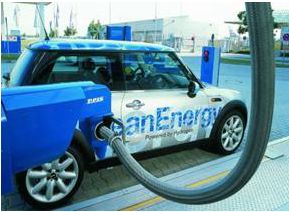 |
| Researchers have designed a material made of graphene sheets for hydrogen storage that could advance development of hydrogen powered vehicles. Credit: Oak Ridge National Laboratory |
Abstract:
Researchers in Greece report design of a new material that almost meets the U.S. Department of Energy (DOE) 2010 goals for hydrogen storage and could help eliminate a key roadblock to practical hydrogen-powered vehicles. Their study on a way of safely storing hydrogen, an explosive gas, is scheduled for the Oct. 8 issue of ACS' Nano Letters, a monthly journal.
New material could speed development of hydrogen powered vehicles
Crete, Greece | Posted on October 1st, 2008Georgios K. Dimitrakakis, Emmanuel Tylianakis, and George E. Froudakis note that researchers long have sought ways of using carbon nanotubes (CNTs) to store hydrogen in fuel cell vehicles. CNTs are minute cylinders of carbon about 50,000 times thinner than the width of a human hair. Scientists hope to use CNTs as miniature storage tanks for hydrogen in the coming generation of fuel cell vehicles.
In the new study, the researchers used computer modeling to design a unique hydrogen-storage structure consisting of parallel graphene sheets — layers of carbon just one atom thick —stabilized by vertical columns of CNTs. They also added lithium ions to the material's design to enhance its storage capacity. The scientists' calculations showed that their so-called "pillared graphene" could theoretically store up to 41 grams of hydrogen per liter, almost matching the DOE's target (45 grams of hydrogen per liter) for transportation applications. "Experimentalists are challenged to fabricate this material and validate its storage capacity," the researchers note. — MTS
####
For more information, please click here
Contacts:
George E. Froudakis, Ph.D.
University of Crete
Heraklion, Crete
Greece
Phone: 30-2810545055
Fax: 30-281545001
Copyright © American Chemical Society (ACS)
If you have a comment, please Contact us.Issuers of news releases, not 7th Wave, Inc. or Nanotechnology Now, are solely responsible for the accuracy of the content.
Bookmark:


| Related News Press |
News and information
 Quantum computer improves AI predictions April 17th, 2026
Flexible sensor gains sensitivity under pressure April 17th, 2026
A reusable chip for particulate matter sensing April 17th, 2026
Detecting vibrational quantum beating in the predissociation dynamics of SF6 using time-resolved photoelectron spectroscopy April 17th, 2026
Discoveries
Quantum computer improves AI predictions April 17th, 2026
Flexible sensor gains sensitivity under pressure April 17th, 2026
A reusable chip for particulate matter sensing April 17th, 2026
Detecting vibrational quantum beating in the predissociation dynamics of SF6 using time-resolved photoelectron spectroscopy April 17th, 2026
Announcements
A fundamentally new therapeutic approach to cystic fibrosis: Nanobody repairs cellular defect April 17th, 2026
UC Irvine physicists discover method to reverse ‘quantum scrambling’ : The work addresses the problem of information loss in quantum computing system April 17th, 2026
Energy
Sensors innovations for smart lithium-based batteries: advancements, opportunities, and potential challenges August 8th, 2025
Simple algorithm paired with standard imaging tool could predict failure in lithium metal batteries August 8th, 2025
Automotive/Transportation
Decoding hydrogen‑bond network of electrolyte for cryogenic durable aqueous zinc‑ion batteries January 30th, 2026
Sensors innovations for smart lithium-based batteries: advancements, opportunities, and potential challenges August 8th, 2025
Simple algorithm paired with standard imaging tool could predict failure in lithium metal batteries August 8th, 2025
Fuel Cells
Deciphering local microstrain-induced optimization of asymmetric Fe single atomic sites for efficient oxygen reduction August 8th, 2025
Current and Future Developments in Nanomaterials and Carbon Nanotubes: Applications of Nanomaterials in Energy Storage and Electronics October 28th, 2022
 |
||
 |
||
| The latest news from around the world, FREE | ||
 |
||
|
|
||
| Premium Products | ||
 |
||
|
Only the news you want to read!
Learn More |
||
 |
||
|
Full-service, expert consulting
Learn More |
||
|
|
||