Home > Press > Zetasizer Nano helps establish size independence in DNA driven nanoparticle structuring
 |
Abstract:
A research team led by Dr Oleg Gang at the Brookhaven Center for Functional Nanomaterials (CFN) in New York is using the Zetasizer Nano particle characterization system from Malvern Instruments in ground-breaking work that has demonstrated successful DNA-guided formation of ordered 3-D crystalline structures. DNA's natural ability to self-assemble according to pre-programmed genetic codes within its pairing bases makes it the perfect architectural device for construction of novel crystalline structures. The ability to engineer such 3-D structures enables the production of functional materials that take advantage of the unique properties that may exist at the nanoscale - for example, enhanced magnetism, improved catalytic activity, or new optical properties.
Zetasizer Nano helps establish size independence in DNA driven nanoparticle structuring
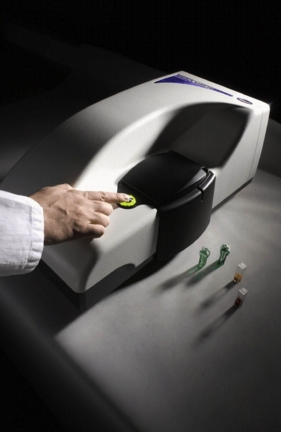
Malvern, UK | Posted on July 24th, 2008Dr. Gang and his team have succeeded in building open, DNA stabilized 3D ordered structures and clusters from nanoparticles. This structure will be also able to incorporate additional small molecules, proteins or polymers within a 3D matrix. They achieved this by tuning the balance, between the attractive force provided by complementary outer-shell DNA regions with the repulsive force of non-complementary DNA or inner-shell DNA spacers. The resulting interactions lead to various morphologies of assemblies, including particle organization with crystalline order and regulated clustering, containing from millions to single particles per cluster.
DNA-guided self-assembly of nanoparticles is predominantly controlled by the surface fraction of DNA on each particle, irrespective of particle size. The Dynamic Light Scattering (DLS) kinetic profiles and aggregate size distribution data provided by the Zetasizer Nano, together with information from other techniques, were used in sample analysis. The results demonstrate that any particle size increase resulting from increased average surface coverage of DNA strands is balanced by a loss in entropic interDNA interaction due to an increase in the particle's surface curvature.
Malcolm Connah, Product Manager Nanometrics at Malvern Instruments, is delighted that the Zetasizer Nano is being used in such inspirational research. "The work of Dr Gang and his team lays the foundation for numerous and diverse advances in nanotechnology," he said. "This is an exciting prospect and Malvern is very pleased that the Zetasizer Nano is making such a valuable contribution."
####
About Malvern Instruments Ltd
Malvern Instruments provides a range of complementary materials characterization tools that deliver inter-related measurements reflecting the complexities of particulates and disperse systems, nanomaterials and macromolecules. Analytical instruments from Malvern are used in the characterization of a wide variety of materials, from industrial bulk powders to the latest nanomaterials and delicate macromolecules. A broad portfolio of innovative technologies is combined with intelligent, user-friendly software. These systems deliver industrially relevant data enabling our customers to make the connection between micro (such as particle size) and macro (bulk) material properties (rheology) and chemical composition (chemical imaging).
Particle size distribution, particle shape information, zeta potential, molecular weight, chemical composition, and bulk materials properties can all be determined with instruments from the Malvern range. The company’s laboratory, at-line, on-line and in-line solutions are proven in sectors as diverse as cement production and pharmaceutical drug discovery.
Headquartered in Malvern, UK, Malvern Instruments has subsidiary organizations in all major European markets, North America, China, Korea and Japan, a joint venture in India, a global distributor network and applications laboratories around the world.
For more information, please click here
Contacts:
Trish Appleton
Kapler Communications
Knowledge Centre
Wyboston Lakes
Great North Road,
Wyboston
Bedfordshire
MK44 3BY
UK
T: +44 (0)1480 479280;
F: +44 (0)1480 470343
USA contact:
Marisa Fraser
Malvern Instruments Inc
117 Flanders Road
Westborough
MA 01581-1042
USA
Tel: +1 508 768 6400
Fax: +1 508 768 6403
Please send sales enquiries to:
Alison Vines
Malvern Instruments Ltd
Enigma Business Park
Grovewood Road
Malvern
Worcestershire
WR14 1XZ
UK
Tel: +44 (0) 1684 892456;
Fax: +44 (0) 1684 892789
Copyright © Malvern Instruments Ltd
If you have a comment, please Contact us.Issuers of news releases, not 7th Wave, Inc. or Nanotechnology Now, are solely responsible for the accuracy of the content.
Bookmark:


| Related News Press |
News and information
 Quantum computer improves AI predictions April 17th, 2026
Flexible sensor gains sensitivity under pressure April 17th, 2026
A reusable chip for particulate matter sensing April 17th, 2026
Detecting vibrational quantum beating in the predissociation dynamics of SF6 using time-resolved photoelectron spectroscopy April 17th, 2026
Discoveries
Quantum computer improves AI predictions April 17th, 2026
Flexible sensor gains sensitivity under pressure April 17th, 2026
A reusable chip for particulate matter sensing April 17th, 2026
Detecting vibrational quantum beating in the predissociation dynamics of SF6 using time-resolved photoelectron spectroscopy April 17th, 2026
Announcements
A fundamentally new therapeutic approach to cystic fibrosis: Nanobody repairs cellular defect April 17th, 2026
UC Irvine physicists discover method to reverse ‘quantum scrambling’ : The work addresses the problem of information loss in quantum computing system April 17th, 2026
Tools
Metasurfaces smooth light to boost magnetic sensing precision January 30th, 2026
From sensors to smart systems: the rise of AI-driven photonic noses January 30th, 2026
Japan launches fully domestically produced quantum computer: Expo visitors to experience quantum computing firsthand August 8th, 2025
Nanobiotechnology
A fundamentally new therapeutic approach to cystic fibrosis: Nanobody repairs cellular defect April 17th, 2026
New molecular technology targets tumors and simultaneously silences two ‘undruggable’ cancer genes August 8th, 2025
New imaging approach transforms study of bacterial biofilms August 8th, 2025
Electrifying results shed light on graphene foam as a potential material for lab grown cartilage June 6th, 2025
 |
||
 |
||
| The latest news from around the world, FREE | ||
 |
||
|
|
||
| Premium Products | ||
 |
||
|
Only the news you want to read!
Learn More |
||
 |
||
|
Full-service, expert consulting
Learn More |
||
|
|
||