Home > Press > NIH recognizes Clemson nanotechnology for molecule tracking
 |
Abstract:
The National Institutes of Health has awarded two Clemson chemistry faculty members nearly $1 million to detect, track and image the interior of cells. Jason McNeill and Ken Christensen will receive the $960,000 grant to develop polymer dot nanoparticles for tracking single molecules in live cells.
NIH recognizes Clemson nanotechnology for molecule tracking
CLEMSON, SC | Posted on October 31st, 2007The development of techniques for following individual molecules within cells is important because scientists could use this technology to determine the body's defenses against invading viruses and bacteria or how proteins operate within the cell. The technology also could help doctors pinpoint the exact location of cancer cells in order to better focus treatment and minimize damage to healthy tissue. Other possible targets of investigation include plaques and fibrils in the brain associated with Alzheimer's disease and mad cow disease.
For the last decade, scientists around the globe have worked to develop and refine highly fluorescent nanoparticles that light up when bathed with laser light, enabling scientists to pinpoint the location of an individual molecule inside a living cell or tissue.
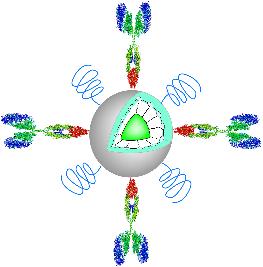
Recently, Clemson chemists developed novel, highly fluorescent nanoparticles called "polymer dots" that can be attached to individual proteins, DNA or invading microbes. According to chemist Jason McNeill, the polymer dot particles are hundreds or thousands of times brighter than conventional fluorescent dyes.
Tissue cells that protect from infection loaded with nanoparticles."We were initially interested in developing polymer semiconductor nanoparticles for making inexpensive, highly efficient solar cells and light-emitting displays. When we aimed a laser at the particles in a microscope, we were surprised to see individual particles light up very brightly," said McNeill.
"When I heard about these extremely bright particles, my group was very interested in working with Dr. McNeill to push this technology into live cell imaging," said Christensen. "Biology is often driven by new discoveries in chemistry and physics and these polymer dots will definitely impact our studies of cellular biology."
The two chemists credit the highly collaborative, multidisciplinary environment at Clemson as a key factor in this new frontier in nanotechnology.
Details of the nanoparticle technology were recently presented at the 2007 national meeting of the American Chemical Society in Boston and have been published in the Journal of the American Chemical Society, Langmuir and in the Journal of Physical Chemistry.
Editors: This material is based upon work supported by the NSF/EPSCoR under grant numbers 2001RII-EPS-0132573 and 2004RII-EPS-0447660, NSF CAREER grant number CHE-0547846 and NIH grant number 1R01GM081040. Any opinions, findings and conclusions or recommendations expressed in this material are those of the authors and do not necessarily reflect the views of the National Science Foundation or the National Institutes of Health.
####
About Clemson University
Today, Clemson is redefining the term “top-tier research university” by combining the best of two models: the scientific and technological horsepower of a major research university and the highly engaged academic and social environment of a small college. With a distinctive governance system that fosters stability in leadership, unique college structures that create an unmatched climate for collaboration, and a driven, competitive spirit that encourages faculty, staff and students to embrace bold, sometimes audacious, goals, Clemson has set its sights on being one of the nation’s top-20 public universities by 2011.
For more information, please click here
Contacts:
Jason McNeill
(864) 656-4065
WRITER: Susan Polowczuk
(864) 656-2063
Copyright © Clemson University
If you have a comment, please Contact us.Issuers of news releases, not 7th Wave, Inc. or Nanotechnology Now, are solely responsible for the accuracy of the content.
Bookmark:


| Related News Press |
Govt.-Legislation/Regulation/Funding/Policy
 Quantum computer improves AI predictions April 17th, 2026
Metasurfaces smooth light to boost magnetic sensing precision January 30th, 2026
New imaging approach transforms study of bacterial biofilms August 8th, 2025
Discoveries
Quantum computer improves AI predictions April 17th, 2026
Flexible sensor gains sensitivity under pressure April 17th, 2026
A reusable chip for particulate matter sensing April 17th, 2026
Detecting vibrational quantum beating in the predissociation dynamics of SF6 using time-resolved photoelectron spectroscopy April 17th, 2026
Announcements
A fundamentally new therapeutic approach to cystic fibrosis: Nanobody repairs cellular defect April 17th, 2026
UC Irvine physicists discover method to reverse ‘quantum scrambling’ : The work addresses the problem of information loss in quantum computing system April 17th, 2026
Grants/Sponsored Research/Awards/Scholarships/Gifts/Contests/Honors/Records
Quantum computer improves AI predictions April 17th, 2026
Detecting vibrational quantum beating in the predissociation dynamics of SF6 using time-resolved photoelectron spectroscopy April 17th, 2026
Metasurfaces smooth light to boost magnetic sensing precision January 30th, 2026
 |
||
 |
||
| The latest news from around the world, FREE | ||
 |
||
|
|
||
| Premium Products | ||
 |
||
|
Only the news you want to read!
Learn More |
||
 |
||
|
Full-service, expert consulting
Learn More |
||
|
|
||