Home > Press > Yale Scientists Use Nanotechnology to Fight E. coli
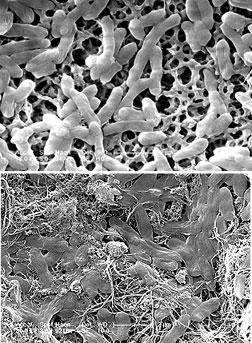 |
| E.coli incubated for one hour on support matrix in the absence (1) or in the presence (2) of nanotubes. (Elimelech/Yale) |
Abstract:
Single-walled carbon nanotubes (SWCNTs) can kill bacteria like the common pathogen E. coli by severely damaging their cell walls, according to a recent report from Yale researchers in the American Chemical Society (ACS) journal Langmuir.
Yale Scientists Use Nanotechnology to Fight E. coli
NEW HAVEN, CT | Posted on September 3rd, 2007"We began the study out of concerns for the possible toxicity of nanotubes in aquatic environments and their presence in the food chain," said Menachem Elimelech, professor and chair of chemical and environmental engineering at Yale and senior author on the paper. "While nanotubes have great promise for medical and commercial applications there is little understanding of how they interact with humans and the environment."
"The nanotubes are microscopic carbon cylinders, thousands of times smaller than a human hair that can be easily taken up by human cells," said Elimelech. "We wanted to find out more about where and how they are toxic."
This "nanoscience version of a David-and-Goliath story" was hailed in an ACS preview of the work as the first direct evidence that "carbon nanotubes have powerful antimicrobial activity, a discovery that could help fight the growing problem of antibiotic resistant infections."
Using the simple E. coli as test cells, the researchers incubated cultures of the bacteria in the presence of the nanotubes for up to an hour. The microbes were killed outright - but only when there was direct contact with aggregates of the SWCNTs that touched the bacteria. Elimelech speculates that the long, thin nanotubes puncture the cells and cause cellular damage.
The study ruled out metal toxicity as a source of the cell damage. To avoid metal contaminants in commercial sources, the SWCNTs were rigorously synthesized and purified in the laboratory of co-author Professor Lisa Pfefferle.
"We're now studying the toxicity of multi-walled carbon nanotubes and our preliminary results show that they are less toxic than SWCNTs," Elimelech said. "We are also looking at the effects of SWCNTs on a wide range of bacterial strains to better understand the mechanism of cellular damage."
Elimelech projects that SWCNTs could be used to create antimicrobial materials and surface coatings to improve hygiene, while their toxicity could be managed by embedding them to prevent their leaching into the environment.
Other authors on the paper are Seoktae Kang and Mathieu Pinault. The project was funded by a research grant from the National Science Foundation.
Citation: Langmuir 23(17): 8670-8673 (August 28, 2007).
####
About Yale University
Yale University comprises three major academic components: Yale College (the undergraduate program), the Graduate School of Arts and Sciences, and the professional schools. In addition, Yale encompasses a wide array of centers and programs, libraries, museums, and administrative support offices. Approximately 11,250 students attend Yale.
For more information, please click here
Contacts:
Janet Rettig Emanuel
203-432-2157
Copyright © Yale University
If you have a comment, please Contact us.Issuers of news releases, not 7th Wave, Inc. or Nanotechnology Now, are solely responsible for the accuracy of the content.
Bookmark:


| Related News Press |
Nanomedicine
 A fundamentally new therapeutic approach to cystic fibrosis: Nanobody repairs cellular defect April 17th, 2026
New molecular technology targets tumors and simultaneously silences two ‘undruggable’ cancer genes August 8th, 2025
New imaging approach transforms study of bacterial biofilms August 8th, 2025
Electrifying results shed light on graphene foam as a potential material for lab grown cartilage June 6th, 2025
Discoveries
Quantum computer improves AI predictions April 17th, 2026
Flexible sensor gains sensitivity under pressure April 17th, 2026
A reusable chip for particulate matter sensing April 17th, 2026
Detecting vibrational quantum beating in the predissociation dynamics of SF6 using time-resolved photoelectron spectroscopy April 17th, 2026
Announcements
A fundamentally new therapeutic approach to cystic fibrosis: Nanobody repairs cellular defect April 17th, 2026
UC Irvine physicists discover method to reverse ‘quantum scrambling’ : The work addresses the problem of information loss in quantum computing system April 17th, 2026
 |
||
 |
||
| The latest news from around the world, FREE | ||
 |
||
|
|
||
| Premium Products | ||
 |
||
|
Only the news you want to read!
Learn More |
||
 |
||
|
Full-service, expert consulting
Learn More |
||
|
|
||