Home > Press > Capturing the Fugitive...in Art: Surface Enhanced Raman Spectroscopy (SERS) reveals invisible colors in art masterpieces
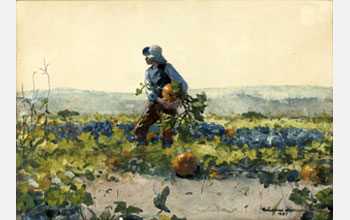 |
| Winslow Homer (1836-1910) For to Be a Farmer's Boy 1887 (Gift of Mrs George T. Langhorne in memory of Edward Carson Waller, AIC 1963.760). This image had long puzzled scholars due to the seemingly unfinished and flat sky in a highly finished work.
Credit: © The Art Institute of Chicago |
Abstract:
What do Winslow Homer's For to Be a Farmer's Boy (1887) and Vincent van Gogh's The Bedroom (1889) have in common?
First, they are both displayed at the Art Institute of Chicago (AIC). Homer's painting represents a high point in the career of America's premiere watercolorist, while Van Gogh's painting is perhaps one of most recognizable paintings in the world. However, they also share a key physical trait.
Capturing the Fugitive...in Art: Surface Enhanced Raman Spectroscopy (SERS) reveals invisible colors in art masterpieces
Arlington, VA | Posted on April 4th, 2011"These breathtaking artworks are both painted with colorants that are sensitive to light, or, as we say in museums, they are 'fugitive,' meaning they quickly vanish if exposed to too much light," says Francesca Casadio, A.W. Mellon senior conservation scientist at the AIC. "Fading can dramatically change the color balance of fragile works of art and go so far as to obfuscate, in part, the artist's intended effect."
In For to Be a Farmer's Boy, the sky is starkly blank--gone are the vibrant colors that Homer is known to have used for his evocative renditions of skies and seas. Yet, through research funded by the National Science Foundation's (NSF) Chemistry and Materials Research in Cultural Heritage Science (CHS) program, a new story is being revealed about Homer's painting.
After painstakingly peering through binocular microscopes, art conservators working behind the scenes at AIC discovered some microscopic particles of colored pigments trapped in the artwork's paper fibers. Precise identification of such pigments was key to "recognizing the implicit emotional, narrative and symbolic content" of the artist's work, according to AIC curator Martha Tedeschi.
Effectively identifying the red "lake" pigments that Homer used is difficult using conventional analytical techniques. For example, Raman spectroscopy, normally used to fingerprint artists' palettes, is strongly affected by the overwhelming fluorescence of natural colorants.
Nanotechnology comes to the rescue
Now, art historians and art conservators have one more tool in their arsenal to preserve our cultural treasures: Surface Enhanced Raman Spectroscopy (SERS). Although this technique has been around for almost 30 years, only recently has SERS fully realized its potential, thanks to the nanotechnology boom.
SERS is an ideal technique for art analysis--it is highly sensitive and can detect vanishingly small amounts of organic pigments that have long eluded identification by other approaches. Yet, only a handful of research groups are working on this application.
"Imagine a child in a sandbox with toys. The toys are the molecules--we want to study them, but they are hidden under the sand and you cannot see them," explains Richard P. Van Duyne, the Charles E. and Emma H. Morrison Professor of Chemistry at Northwestern University, who is best known for the discovery of SERS. "Our technique gets rid of the sand so that you can see the toys and identify what they are."
By using a colloidal suspension of silver nanoparticles as a "performance enhancing drug," researchers, for the first time, can identify natural organic colorants on a single grain of pigment otherwise invisible to the naked eye.
SERS analysis
Indeed, only a handful of pigment particles were available from the Homer watercolor. Compared to reference 19th century watercolor pigments available at AIC, these colorants were identified as Indian purple (cochineal precipitated with copper sulfate) and madder purple, two natural dyestuffs derived from an insect and vegetable-root sources, respectively.
The results indicate that in Homer's For to Be a Farmer's Boy, the "empty" sky once depicted a vibrant autumn sunset, with organic purples and reds, in addition to inorganic reds and yellows. Although these results are promising, there is still a need to improve the identification of pigments from severely faded paintings. This is because pigment particles are normally applied in a complex medium, which increases the fluorescence background of the spectra, much like adding more sand to the sandbox covers up the toys (molecules) below.
In order to reduce the fluorescence, research professor Nilam Shah, also of Northwestern, will be developing ad hoc-tailored nanoparticles optimized to resonate with infrared lasers, which are less damaging to the artworks, and more universal. These next-generation nanoparticles hold promise as tools to unlock information on dyes, pigments and binding media, as present in Van Gogh's The Bedroom.
Capturing the fugitive
Typically, researchers who use SERS for materials identification search an unknown compound against a database of references, much like matching fingerprints of known criminals to forensic evidence collected on the crime scene.
Thanks to the theoretical expertise of George Schatz, Morrison Professor of Chemistry at Northwestern, this painstaking database search will no longer be a limiting factor. In fact, researchers will be able to calculate from theory not only the expected SERS spectrum of unknown fugitive dyes, but also the tell-tale signs of dyes disappearing after prolonged exposure to light.
Taking into account the pigment identification by SERS and nuances of shade and tone that are typical of Homer's paint handling, art conservators proposed a digital re-creation of the Homer watercolor. By shining laser light on particles buried in the artwork, SERS investigators have now unearthed the materials evidence that allows viewers to truly experience the hues of Homer's faded sunsets for the first time in modern times.
Substantial seed funding for this research was also provided by the Andrew W. Mellon Foundation.
-- Francesca Casadio, The Art Institute of Chicago,
This Behind the Scenes article was provided to LiveScience in partnership with the National Science Foundation.
Investigators
Francesca Casadio
Martha Tedeschi
George Schatz
Nilam Shah
Richard Van Duyne
Related Institutions/Organizations
Art Institute of Chicago
Northwestern University
Locations
Illinois
####
For more information, please click here
Contacts:
Francesca Casadio
The Art Institute of Chicago
Copyright © National Science Foundation
If you have a comment, please Contact us.Issuers of news releases, not 7th Wave, Inc. or Nanotechnology Now, are solely responsible for the accuracy of the content.
Bookmark:


| Related News Press |
News and information
 Simulating magnetization in a Heisenberg quantum spin chain April 5th, 2024
NRL charters Navy’s quantum inertial navigation path to reduce drift April 5th, 2024
Discovery points path to flash-like memory for storing qubits: Rice find could hasten development of nonvolatile quantum memory April 5th, 2024
Imaging
Nanoscale CL thermometry with lanthanide-doped heavy-metal oxide in TEM March 8th, 2024
The USTC realizes In situ electron paramagnetic resonance spectroscopy using single nanodiamond sensors November 3rd, 2023
Observation of left and right at nanoscale with optical force October 6th, 2023
Govt.-Legislation/Regulation/Funding/Policy
NRL charters Navy’s quantum inertial navigation path to reduce drift April 5th, 2024
Discovery points path to flash-like memory for storing qubits: Rice find could hasten development of nonvolatile quantum memory April 5th, 2024
Chemical reactions can scramble quantum information as well as black holes April 5th, 2024
Discoveries
Chemical reactions can scramble quantum information as well as black holes April 5th, 2024
New micromaterial releases nanoparticles that selectively destroy cancer cells April 5th, 2024
Utilizing palladium for addressing contact issues of buried oxide thin film transistors April 5th, 2024
Announcements
NRL charters Navy’s quantum inertial navigation path to reduce drift April 5th, 2024
Discovery points path to flash-like memory for storing qubits: Rice find could hasten development of nonvolatile quantum memory April 5th, 2024
Tools
Ferroelectrically modulate the Fermi level of graphene oxide to enhance SERS response November 3rd, 2023
The USTC realizes In situ electron paramagnetic resonance spectroscopy using single nanodiamond sensors November 3rd, 2023
Human Interest/Art
Drawing data in nanometer scale September 30th, 2022
Scientists prepare for the world’s smallest race: Nanocar Race II March 18th, 2022
Graphene nanotubes revolutionize touch screen use for prosthetic hands August 3rd, 2021
JEOL Announces 2020 Microscopy Image Grand Prize Winners January 7th, 2021
 |
||
 |
||
| The latest news from around the world, FREE | ||
 |
||
|
|
||
| Premium Products | ||
 |
||
|
Only the news you want to read!
Learn More |
||
 |
||
|
Full-service, expert consulting
Learn More |
||
|
|
||