Home > Press > Metallic molecules to nanotubes: Spread out!
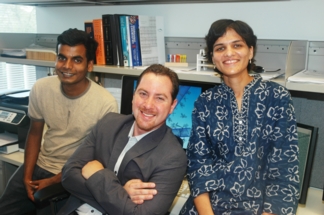 |
| Rice researchers -- from left, Avishek Saha, Professor Angel Marti and Disha Jain -- found an efficient way to both dissolve and functionalize carbon nanotubes in a solution. (Credit: Rice University) |
Abstract:
Rice University lab uses ruthenium complexes to dissolve nanotubes, add functionality
Metallic molecules to nanotubes: Spread out!
Houston, TX | Posted on February 23rd, 2011A lab at Rice University has stepped forward with an efficient method to disperse nanotubes in a way that preserves their unique properties -- and adds more.
The new technique allows inorganic metal complexes with different functionalities to remain in close contact with single-walled carbon nanotubes while keeping them separated in a solution.
That separation is critical to manufacturers who want to spin fiber from nanotubes, or mix them into composite materials for strength or to take advantage of their electrical properties. For starters, the ability to functionalize the nanotubes at the same time may advance imaging sensors, catalysis and solar-activated hydrogen fuel cells.
Better yet, a batch of nanotubes can apparently stay dispersed in water for weeks on end.
Keeping carbon nanotubes from clumping in aqueous solutions and combining them with molecules that add novel abilities have been flies in the ointment for scientists exploring the use of these highly versatile materials.
They've tried attaching organic molecules to the nanotubes' surfaces to add functionality as well as solubility. But while these techniques can separate nanotubes from one another, they take a toll on the nanotubes' electronic, thermal and mechanical properties.
Angel Marti, a Rice assistant professor of chemistry and bioengineering and a Norman Hackerman-Welch Young Investigator, and his students reported this month in the Royal Society of Chemistry journal Chemical Communications that ruthenium polypyridyl complexes are highly effective at dispersing nanotubes in water efficiently and for long periods. Ruthenium is a rare metallic element.
One key is having just the right molecule for the job. Marti and his team created ruthenium complexes by combining the element with ligands, stable molecules that bind to metal ions. The resulting molecular complex is part hydrophobic (the ligands) and part hydrophilic (the ruthenium). The ligands strongly bind to nanotubes while the attached ruthenium molecules interact with water to maintain the tubes in solution and keep them apart from one another.
Another key turned out to be moderation.
Originally, Marti said, he and co-authors Disha Jain and Avishek Saha weren't out to solve a problem that has boggled chemists for decades, but their willingness to "do something crazy" paid off big-time. Jain is a former postdoctoral researcher in Marti's lab, and Saha is a graduate student.
The researchers were eyeing ruthenium complexes as part of a study to track amyloid deposits associated with Alzheimer's disease. "We started to wonder what would happen if we modified the metal complex so it could bind to a nanotube," Marti said. "That would provide solubility, individualization, dispersion and functionality."
It did, but not at first. "Avishek put this together with purified single-walled carbon nanotubes (created via Rice's HiPco process) and sonicated. Absolutely nothing happened. The nanotubes didn't get into solution -- they just clumped at the bottom.
"That was very weird, but that's how science works -- some things you think are good ideas never work."
Saha removed the liquid and left the clumped nanotubes at the bottom of the centrifuge tube. "So I said, 'Well, why don't you do something crazy. Just add water to that, and with the little bit of ruthenium that might remain there, try to do the reaction.' He did that, and the solution turned black."
A low concentration of ruthenium did the trick. "We found out that 0.05 percent of the ruthenium complex is the optimum concentration to dissolve nanotubes," Marti said. Further experimentation showed that simple ruthenium complexes alone did not work. The molecule requires its hydrophobic ligand tail, which seeks to minimize its exposure to water by binding with nanotubes. "That's the same thing nanotubes want to do, so it's a favorable relationship," he said.
Marti also found the nanotubes' natural fluorescence unaffected by the ruthenium complexes. "Even though they've been purified, which can introduce defects, they still exhibit very good fluorescence," he said.
He said that certain ruthenium complexes have the ability to stay in an excited state for a long time -- about 600 nanoseconds, or 100 times longer than normal organic molecules. "It means the probability that it will transfer an electron is high. That's convenient for energy transfer applications, which are important for imaging," he said.
That nanotubes stay suspended for a long time should catch the eye of manufacturers who use them in bulk. "They should stay separated for weeks without problems," Marti said. "We have solutions that have been sitting for months without any signs of crashing."
The Welch Foundation supported the research.
####
About Rice University
Located in Houston, Rice University is consistently ranked among the nation's top 20 universities by U.S. News & World Report. A Tier One research university known for its "unconventional wisdom," Rice has schools of Architecture, Business, Continuing Studies, Engineering, Humanities, Music, Natural Sciences and Social Sciences and offers its 3,485 undergraduates and 2,275 graduate students a wide range of majors. Rice has the sixth-largest endowment per student among American private research universities and is rated No. 4 for Ïbest valueÓ among private universities by Kiplinger’s Personal Finance. Its undergraduate student-to-faculty ratio is less than 6-to-1. With a residential college system that builds close-knit and diverse communities and collaborative culture, Rice has been ranked No. 1 for best quality of life multiple times by the Princeton Review.
For more information, please click here
Contacts:
David Ruth
713-348-6327
Mike Williams
713-348-6728
Copyright © Rice University
If you have a comment, please Contact us.Issuers of news releases, not 7th Wave, Inc. or Nanotechnology Now, are solely responsible for the accuracy of the content.
Bookmark:


| Related News Press |
News and information
 Simulating magnetization in a Heisenberg quantum spin chain April 5th, 2024
NRL charters Navy’s quantum inertial navigation path to reduce drift April 5th, 2024
Discovery points path to flash-like memory for storing qubits: Rice find could hasten development of nonvolatile quantum memory April 5th, 2024
Imaging
Nanoscale CL thermometry with lanthanide-doped heavy-metal oxide in TEM March 8th, 2024
The USTC realizes In situ electron paramagnetic resonance spectroscopy using single nanodiamond sensors November 3rd, 2023
Observation of left and right at nanoscale with optical force October 6th, 2023
Nanotubes/Buckyballs/Fullerenes/Nanorods/Nanostrings
Tests find no free-standing nanotubes released from tire tread wear September 8th, 2023
Detection of bacteria and viruses with fluorescent nanotubes July 21st, 2023
Nanomedicine
New micromaterial releases nanoparticles that selectively destroy cancer cells April 5th, 2024
Good as gold - improving infectious disease testing with gold nanoparticles April 5th, 2024
Researchers develop artificial building blocks of life March 8th, 2024
Discoveries
Chemical reactions can scramble quantum information as well as black holes April 5th, 2024
New micromaterial releases nanoparticles that selectively destroy cancer cells April 5th, 2024
Utilizing palladium for addressing contact issues of buried oxide thin film transistors April 5th, 2024
Announcements
NRL charters Navy’s quantum inertial navigation path to reduce drift April 5th, 2024
Discovery points path to flash-like memory for storing qubits: Rice find could hasten development of nonvolatile quantum memory April 5th, 2024
 |
||
 |
||
| The latest news from around the world, FREE | ||
 |
||
|
|
||
| Premium Products | ||
 |
||
|
Only the news you want to read!
Learn More |
||
 |
||
|
Full-service, expert consulting
Learn More |
||
|
|
||