Home > Press > Paintable Electronics? NIST Studies Spray-On Manufacturing of Transistors
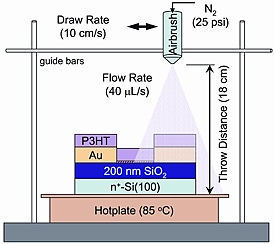 |
| This airbrush technique deposits a well-studied material called P3HT to create spray-on transistors, which perform comparably to lab-standard equivalents made by spin coating. Credit: NIST |
Abstract:
A multidisciplinary research team at the National Institute of Standards and Technology (NIST) has found* that an organic semiconductor may be a viable candidate for creating large-area electronics, such as solar cells and displays that can be sprayed onto a surface as easily as paint.
Paintable Electronics? NIST Studies Spray-On Manufacturing of Transistors
Gaithersburg, MD | Posted on March 31st, 2010While the electronics will not be ready for market anytime soon, the research team says the material they studied could overcome one of the main cost hurdles blocking the large-scale manufacture of organic thin-film transistors, the development of which also could lead to a host of devices inexpensive enough to be disposable.
Silicon is the iconic material of the electronics industry, the basic material for most microprocessors and memory chips. Silicon has proved highly successful as a substance because billions of computer elements can be crammed into a tiny area, and the manufacturing process behind these high-performance chips is well-established.
But the electronics industry for a long time has been pursuing novel organic materials to create semiconductor products—materials that perhaps could not be packed as densely as state-of-the-art silicon chips, but that would require less power, cost less and do things silicon devices cannot: bend and fold, for example. Proponents predict that organic semiconductors, once perfected, might permit the construction of low-cost solar cells and video displays that could be sprayed onto a surface just as paint is.
"At this stage, there is no established best material or manufacturing process for creating low-cost, large-area electronics," says Calvin Chan, an electrical engineer at NIST. "What our team has done is to translate a classic material deposition method, spray painting, to a way of manufacturing cheap electronic devices."
The team's work showed that a commonly used organic transistor material, poly(3-hexylthiophene), or P3HT, works well as a spray-on transistor material because, like beauty, transistors aren't very deep. When sprayed onto a flat surface, inhomogeneities give the P3HT film a rough and uneven top surface that causes problems in other applications. But because the transistor effects occur along its lower surface—where it contacts the substrate—it functions quite well.
Chan says the simplicity of spray-on electronics gives it a potential cost advantage over other manufacturing processes for organic electronics. Other candidate processes, he says, require costly equipment to function or are simply not suitable for use in high-volume manufacturing.
* C.K. Chan, L.J. Richter, B.Dinardo, C.Jaye, B.R. Conrad, H.W. Ro, D. S. Germack, D.A. Fischer, D.M. DeLongchamp, D. J. Gundlach. High performance airbrushed organic thin film transistors. Applied Physics Letters, 96, 133304. March 30, 2010. doi:10.1063/1.3360230
####
About NIST
From automated teller machines and atomic clocks to mammograms and semiconductors, innumerable products and services rely in some way on technology, measurement, and standards provided by the National Institute of Standards and Technology.
Founded in 1901, NIST is a non-regulatory federal agency within the U.S. Department of Commerce. NIST's mission is to promote U.S. innovation and industrial competitiveness by advancing measurement science, standards, and technology in ways that enhance economic security and improve our quality of life.
For more information, please click here
Contacts:
Media Contact:
Chad Boutin
(301) 975-4261
Copyright © NIST
If you have a comment, please Contact us.Issuers of news releases, not 7th Wave, Inc. or Nanotechnology Now, are solely responsible for the accuracy of the content.
Bookmark:


| Related News Press |
News and information
 Simulating magnetization in a Heisenberg quantum spin chain April 5th, 2024
NRL charters Navy’s quantum inertial navigation path to reduce drift April 5th, 2024
Discovery points path to flash-like memory for storing qubits: Rice find could hasten development of nonvolatile quantum memory April 5th, 2024
Good as gold - improving infectious disease testing with gold nanoparticles April 5th, 2024
Thin films
Utilizing palladium for addressing contact issues of buried oxide thin film transistors April 5th, 2024
Display technology/LEDs/SS Lighting/OLEDs
Utilizing palladium for addressing contact issues of buried oxide thin film transistors April 5th, 2024
Light guide plate based on perovskite nanocomposites November 3rd, 2023
Simple ballpoint pen can write custom LEDs August 11th, 2023
Possible Futures
Discovery points path to flash-like memory for storing qubits: Rice find could hasten development of nonvolatile quantum memory April 5th, 2024
With VECSELs towards the quantum internet Fraunhofer: IAF achieves record output power with VECSEL for quantum frequency converters April 5th, 2024
Chip Technology
Discovery points path to flash-like memory for storing qubits: Rice find could hasten development of nonvolatile quantum memory April 5th, 2024
Utilizing palladium for addressing contact issues of buried oxide thin film transistors April 5th, 2024
HKUST researchers develop new integration technique for efficient coupling of III-V and silicon February 16th, 2024
Nanoelectronics
Interdisciplinary: Rice team tackles the future of semiconductors Multiferroics could be the key to ultralow-energy computing October 6th, 2023
Key element for a scalable quantum computer: Physicists from Forschungszentrum Jülich and RWTH Aachen University demonstrate electron transport on a quantum chip September 23rd, 2022
Reduced power consumption in semiconductor devices September 23rd, 2022
Atomic level deposition to extend Moore’s law and beyond July 15th, 2022
Announcements
NRL charters Navy’s quantum inertial navigation path to reduce drift April 5th, 2024
Discovery points path to flash-like memory for storing qubits: Rice find could hasten development of nonvolatile quantum memory April 5th, 2024
Solar/Photovoltaic
Development of zinc oxide nanopagoda array photoelectrode: photoelectrochemical water-splitting hydrogen production January 12th, 2024
Shedding light on unique conduction mechanisms in a new type of perovskite oxide November 17th, 2023
Inverted perovskite solar cell breaks 25% efficiency record: Researchers improve cell efficiency using a combination of molecules to address different November 17th, 2023
Charged “molecular beasts” the basis for new compounds: Researchers at Leipzig University use “aggressive” fragments of molecular ions for chemical synthesis November 3rd, 2023
 |
||
 |
||
| The latest news from around the world, FREE | ||
 |
||
|
|
||
| Premium Products | ||
 |
||
|
Only the news you want to read!
Learn More |
||
 |
||
|
Full-service, expert consulting
Learn More |
||
|
|
||