Home > Press > Pushing droplets around
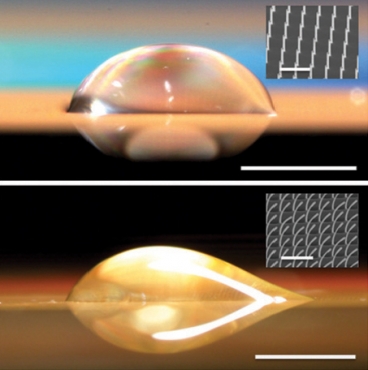 |
| A symmetrical droplet (top) forms on a surface with straight nano-pillars, while on a surface with bent pillars (bottom) the droplet is asymmetrical, extending out only to the right. Inset images are micrographs of the surface structure. Images: Kuang-Han Chu, Rong Xiao and Evelyn N. Wang |
Abstract:
MIT researchers find a way to make drops on a surface move in just one direction, with possible applications ranging from biology to electronics
By David L. Chandler, MIT News Office
Pushing droplets around
Cambridge, MA | Posted on March 29th, 2010Controlling the way liquids spread across a surface is important for a wide variety of technologies, including DNA microarrays for medical research, inkjet printers and digital lab-on-a-chip systems. But until now, the designers of such devices could only control how much the liquid would spread out over a surface, not which way it would go.
New research from mechanical engineers at MIT has revealed a new approach that, by creating specific kinds of tiny structures on a material's surface, can make a droplet spread only in a single direction.
A report on the new work, by Esther and Harold E. Edgerton Assistant Professor of Mechanical Engineering Evelyn N. Wang and graduate students Kuang-Han Chu and Rong Xiao, was published on March 28 in the journal Nature Materials.
The system Wang and her team developed is completely passive, based on producing a textured surface with tiny pillars shaped in specific ways to propel liquid in one direction and restrict its movement in others. Once the surface is prepared, no mechanical or electrical controls are needed to propel the liquid in the desired direction, and a droplet placed at any point on the surface will always spread the same way.
It's just the shapes on the surface that control how the drops spread, rather than the particular materials used, Wang says. The chips used for testing were made by etching a silicon wafer surface to produce a grid of tiny pillars, which then were selectively coated with gold on one side to make the pillars bend in one direction. To prove that the effect was caused just by the bent shapes rather than some chemical process involving the silicon and gold, the researchers, with the help of Professor Karen Gleason's group in the Department of Chemical Engineering, then coated the surface with a thin layer of a polymer so that the water would only come in contact with a single type of material. The pillars are all curved in one direction, and cause the liquid to move in that direction.
"Nobody had really studied this kind of geometry, because it's hard to fabricate," Wang says.
Wang explains that while this work is still early-stage basic research, in principle such systems could be used for a wide variety of applications. For example, it could provide new ways to manipulate biological molecules on the surface of a chip, for various testing and measurement systems. It might be used in desalination systems to help direct water that condenses on a surface toward a collection system. Or it might allow more precise control of cooling liquids on a microchip, directing the coolant toward specific hotspots rather than letting them spread out over the whole surface.
"It's a big deal to be able to cool local hotspots on a chip," Wang says, especially as the components on a chip continue to get smaller and thermal management becomes ever more critical. The research was funded in part by the National Science Foundation, DARPA, and Northrup Grumman.
Mark Shannon, professor of mechanical science and engineering at the University of Illinois, Urbana-Champaign, agrees that this method might be further developed for a variety of applications, including biomedical lab-on-a-chip systems for the detection of specific biomolecules in blood, for example. "Droplet manipulation has been heavily developed for moving samples from station to station for different analysis steps," he says, and this new method might provide a useful way to do that with minimal energy requirements, but to do so will require the ability to create multiple regions on a surface that propel the liquid in different directions for each stage. "This research will help enable these unit operations," he says, in combination with related research currently being carried out in other places.
Howard Stone, professor of mechanical and aerospace engineering at Princeton University, who was not involved in this research, says researchers have taken several approaches to surface patterning and control in recent years, some inspired by nature and some by materials applications. "This research advance for one-dimensional asymmetric spreading is a nice addition to the toolbox for surface patterning to control liquid spreading," he says.
####
About Massachusetts Institute of Technology
The mission of MIT is to advance knowledge and educate students in science, technology and other areas of scholarship that will best serve the nation and the world in the 21st century — whether the focus is cancer, energy, economics or literature.
For more information, please click here
Contacts:
Tel 617.253.2700
Copyright © Massachusetts Institute of Technology
If you have a comment, please Contact us.Issuers of news releases, not 7th Wave, Inc. or Nanotechnology Now, are solely responsible for the accuracy of the content.
Bookmark:


| Related News Press |
Videos/Movies
 New X-ray imaging technique to study the transient phases of quantum materials December 29th, 2022
Solvent study solves solar cell durability puzzle: Rice-led project could make perovskite cells ready for prime time September 23rd, 2022
Scientists prepare for the world’s smallest race: Nanocar Race II March 18th, 2022
Visualizing the invisible: New fluorescent DNA label reveals nanoscopic cancer features March 4th, 2022
Govt.-Legislation/Regulation/Funding/Policy
NRL charters Navy’s quantum inertial navigation path to reduce drift April 5th, 2024
Discovery points path to flash-like memory for storing qubits: Rice find could hasten development of nonvolatile quantum memory April 5th, 2024
Chemical reactions can scramble quantum information as well as black holes April 5th, 2024
Possible Futures
Discovery points path to flash-like memory for storing qubits: Rice find could hasten development of nonvolatile quantum memory April 5th, 2024
With VECSELs towards the quantum internet Fraunhofer: IAF achieves record output power with VECSEL for quantum frequency converters April 5th, 2024
Academic/Education
Rice University launches Rice Synthetic Biology Institute to improve lives January 12th, 2024
Multi-institution, $4.6 million NSF grant to fund nanotechnology training September 9th, 2022
Nanomedicine
New micromaterial releases nanoparticles that selectively destroy cancer cells April 5th, 2024
Good as gold - improving infectious disease testing with gold nanoparticles April 5th, 2024
Researchers develop artificial building blocks of life March 8th, 2024
Nanoelectronics
Interdisciplinary: Rice team tackles the future of semiconductors Multiferroics could be the key to ultralow-energy computing October 6th, 2023
Key element for a scalable quantum computer: Physicists from Forschungszentrum Jülich and RWTH Aachen University demonstrate electron transport on a quantum chip September 23rd, 2022
Reduced power consumption in semiconductor devices September 23rd, 2022
Atomic level deposition to extend Moore’s law and beyond July 15th, 2022
Announcements
NRL charters Navy’s quantum inertial navigation path to reduce drift April 5th, 2024
Discovery points path to flash-like memory for storing qubits: Rice find could hasten development of nonvolatile quantum memory April 5th, 2024
Water
Taking salt out of the water equation October 7th, 2022
Nanobiotechnology
New micromaterial releases nanoparticles that selectively destroy cancer cells April 5th, 2024
Good as gold - improving infectious disease testing with gold nanoparticles April 5th, 2024
Researchers develop artificial building blocks of life March 8th, 2024
 |
||
 |
||
| The latest news from around the world, FREE | ||
 |
||
|
|
||
| Premium Products | ||
 |
||
|
Only the news you want to read!
Learn More |
||
 |
||
|
Full-service, expert consulting
Learn More |
||
|
|
||