Home > Press > Argonne scientist awarded $2.5 million for Early Career Research Program
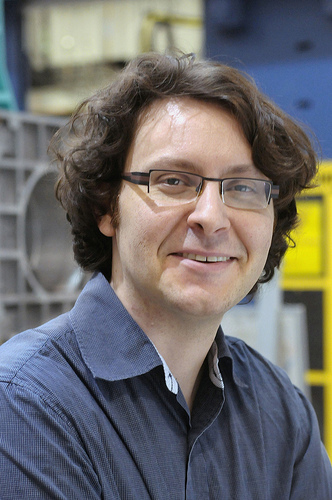 |
| Antonino Miceli, an Argonne physicist, has been awarded one of the Department of Energy's Early Career Research Grants -- $2.5 million over the next five years -- to improve high-resolution spectroscopic X-ray detectors using superconducting sensors. Photo courtesy Argonne National Laboratory. |
Abstract:
Physicist Antonino Miceli of the U.S. Department of Energy's (DOE) Argonne National Laboratory has been awarded $2.5 million over the next five years as part of DOE's Early Career Research Program.
Argonne scientist awarded $2.5 million for Early Career Research Program
Argonne, IL | Posted on February 1st, 2010Miceli's work concerns high-resolution spectroscopic X-ray detectors using superconducting sensors. Spectroscopic X-ray detectors are used for a wide variety of synchrotron experiments, including X-ray micro/nano-probes and X-ray absorption spectroscopy for biology and geophysical applications. The current state-of-the-art spectroscopic X-ray detectors are semiconductor devices, and their energy resolutions are approaching their theoretical limit of about 100eV at 6 keV.
"We plan to develop a research program focused on using superconducting sensors with an energy resolution of at least one order of magnitude better than silicon diode detectors, while maintaining a comparable count rate throughput," Miceli said. "This research program has the potential to revolutionize synchrotron spectroscopic experiments."
In addition, his research could lead to new techniques such as energy-dispersive X-ray diffraction, which would impact the field of materials science. The research program will be a collaboration involving Argonne's X-ray Science and Materials Science divisions and the Center for Nanoscale Materials.
The Early Career Research Program underscores the Obama Administration's commitment to investing in innovation and research. The program will provide 69 scientists from across the nation with up to $85 million in funding under the American Recovery and Reinvestment Act for five-year research grants. The new effort is designed to bolster the nation's scientific workforce by providing support to exceptional researchers during the crucial early career years, when many scientists do their most formative work.
"This investment reflects the administration's strong commitment to creating jobs and new industries through scientific innovation," said Secretary of Energy Steven Chu. "Strong support of scientists in the early career years is crucial to renewing America's scientific workforce and ensuring U.S. leadership in discovery and innovation for many years to come."
Beginning with the next fiscal year, the DOE's Office of Science plans to continue the program, choosing new candidates on an annual basis and supporting them under annual appropriations.
To be eligible for an award, a researcher must be an untenured, tenure-track assistant professor at a U.S. academic institution or a full-time employee at a DOE national laboratory and have received a Ph.D. within the past 10 years. Research topics are required to fall within the purview of the Office of Science's six major program offices: Advanced Scientific Computing Research, Basic Energy Sciences, Biological and Environmental Research, Fusion Energy Sciences, High Energy Physics, and Nuclear Physics.
####
About Argonne National Laboratory
Argonne National Laboratory seeks solutions to pressing national problems in science and technology. The nation's first national laboratory, Argonne conducts leading-edge basic and applied scientific research in virtually every scientific discipline. Argonne researchers work closely with researchers from hundreds of companies, universities, and federal, state and municipal agencies to help them solve their specific problems, advance America 's scientific leadership and prepare the nation for a better future. With employees from more than 60 nations, Argonne is managed by UChicago Argonne, LLC for the U.S. Department of Energy's Office of Science.
For more information, please click here
Contacts:
Brock Cooper
630/252-5565
Copyright © Argonne National Laboratory
If you have a comment, please Contact us.Issuers of news releases, not 7th Wave, Inc. or Nanotechnology Now, are solely responsible for the accuracy of the content.
Bookmark:


| Related News Press |
Physics
 Simulating magnetization in a Heisenberg quantum spin chain April 5th, 2024
News and information
Simulating magnetization in a Heisenberg quantum spin chain April 5th, 2024
NRL charters Navy’s quantum inertial navigation path to reduce drift April 5th, 2024
Discovery points path to flash-like memory for storing qubits: Rice find could hasten development of nonvolatile quantum memory April 5th, 2024
Jobs
Could quantum technology be New Mexico’s next economic boon? Quantum New Mexico Coalition aims to establish state as national hub April 1st, 2022
SEMI Partners with GLOBALFOUNDRIES to Offer Apprenticeship Program Aimed at Building the Electronics Talent Pipeline August 11th, 2020
Arrowhead Pharmaceuticals Reports Inducement Grants under NASDAQ Marketplace Rule 5635(c)(4) March 29th, 2019
Govt.-Legislation/Regulation/Funding/Policy
NRL charters Navy’s quantum inertial navigation path to reduce drift April 5th, 2024
Discovery points path to flash-like memory for storing qubits: Rice find could hasten development of nonvolatile quantum memory April 5th, 2024
Chemical reactions can scramble quantum information as well as black holes April 5th, 2024
Possible Futures
Discovery points path to flash-like memory for storing qubits: Rice find could hasten development of nonvolatile quantum memory April 5th, 2024
With VECSELs towards the quantum internet Fraunhofer: IAF achieves record output power with VECSEL for quantum frequency converters April 5th, 2024
Nanoelectronics
Interdisciplinary: Rice team tackles the future of semiconductors Multiferroics could be the key to ultralow-energy computing October 6th, 2023
Key element for a scalable quantum computer: Physicists from Forschungszentrum Jülich and RWTH Aachen University demonstrate electron transport on a quantum chip September 23rd, 2022
Reduced power consumption in semiconductor devices September 23rd, 2022
Atomic level deposition to extend Moore’s law and beyond July 15th, 2022
Announcements
NRL charters Navy’s quantum inertial navigation path to reduce drift April 5th, 2024
Discovery points path to flash-like memory for storing qubits: Rice find could hasten development of nonvolatile quantum memory April 5th, 2024
Tools
Ferroelectrically modulate the Fermi level of graphene oxide to enhance SERS response November 3rd, 2023
The USTC realizes In situ electron paramagnetic resonance spectroscopy using single nanodiamond sensors November 3rd, 2023
 |
||
 |
||
| The latest news from around the world, FREE | ||
 |
||
|
|
||
| Premium Products | ||
 |
||
|
Only the news you want to read!
Learn More |
||
 |
||
|
Full-service, expert consulting
Learn More |
||
|
|
||