Home > Press > Yap: Harnessing the Divas of the Nanoworld
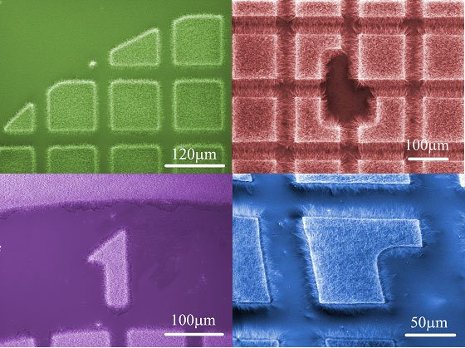 |
| Carpets of boron nitride nanotubes grown on a substrate by Yoke Khin Yap's research group |
Abstract:
Boron nitride nanotubes (BNNTs) are the divas of the nanoworld. In possession of alluring properties, they are also notoriously temperamental compared to their carbon-based cousins.
Yap: Harnessing the Divas of the Nanoworld
Houghton, MI | Posted on January 16th, 2010On the plus side, they can withstand incredibly high heat, well over 1,100 degrees Celsius, says Yoke Khin Yap, an associate professor of physics at Michigan Technological University. "Carbon nanotubes would burn like charcoal in a barbecue at half of those temperatures," he says. And the electrical properties of BNNTs are remarkably uniform. Perfect insulators, boron nitride nanotubes could be doped with other materials to form designer semiconductors that could be used in high-powered electronics.
Unfortunately, making nanotubes from boron and nitrogen is easier said than done. "Making carbon nanotubes is simpler, like cooking," says Yap. Boron nitride nanotubes, on the other hand, have always been fussy, requiring special instrumentation, dangerous chemistry, or temperatures of over 1,500 degrees Celsius to assemble. Even at that, the products are shot through with impurities.
"We've been stuck for more than 10 years because nobody could grow them well on substrates," says Yap. "But now we can."
As it turns out, boron nitride nanotubes just needed a little encouragement. Yap and his team have grown virtual Persian carpets of the tiny fibers on a substrate made from simple catalysts, magnesium oxide, iron or nickel. And they have managed it using the same instrumentation for growing carbon nanotubes, at about 1,100 degrees Celsius. And, their quality is perfect,.the present work. "I hope this encourages more researchers to grow BNNTs using the new technique," said Yap.
The boron nitride nanotubes can be made to assemble exclusively on these catalysts, so the researchers can control precisely where they grow. "You could write ‘Michigan Tech' in nanotubes," says Yap.
These transparent nanotube sheets have another interesting property: they shed water like a duck's back, a quality known as the lotus effect. "Water just slides away," he says. "Anything coated with it would not only be stain resistant, it would be protected from anything water-soluble." This superhydrophobicity holds at all pH levels, so anything coated with it would be protected from even the strongest acids and alkalies.
The research was funded through a National Science Foundation Career Grant. A paper detailing Yap's discoveries, "Patterned Growth of Boron Nitride Nanotubes by Catalytic Chemical Vapor Deposition," has been published online by the journal Chemistry of Materials.
Yap is the editor of the book "B-C-N Nanotubes and Related Nanostructures," the first book on nanostructures constructed from one or multiple elements using boron, carbon, and nitrogen. He was the lead organizer of the Nanotubes and Related Nanostructures Symposium at the 2009 Materials Research Society Fall Meeting on. For more information, visit www.phy.mtu.edu/yap/research.html
####
About Michigan Technological University
Michigan Technological University (mtu.edu) is a leading public research university developing new technologies and preparing students to create the future for a prosperous and sustainable world. Michigan Tech offers more than 130 undergraduate and graduate degree programs in engineering; forest resources; computing; technology; business; economics; natural, physical and environmental sciences; arts; humanities; and social sciences.
For more information, please click here
Contacts:
Marcia Goodrich
906-487-2343
Copyright © Michigan Technological University
If you have a comment, please Contact us.Issuers of news releases, not 7th Wave, Inc. or Nanotechnology Now, are solely responsible for the accuracy of the content.
Bookmark:


| Related News Press |
News and information
 Simulating magnetization in a Heisenberg quantum spin chain April 5th, 2024
NRL charters Navy’s quantum inertial navigation path to reduce drift April 5th, 2024
Discovery points path to flash-like memory for storing qubits: Rice find could hasten development of nonvolatile quantum memory April 5th, 2024
Chemistry
What heat can tell us about battery chemistry: using the Peltier effect to study lithium-ion cells March 8th, 2024
Nanoscale CL thermometry with lanthanide-doped heavy-metal oxide in TEM March 8th, 2024
Possible Futures
Discovery points path to flash-like memory for storing qubits: Rice find could hasten development of nonvolatile quantum memory April 5th, 2024
With VECSELs towards the quantum internet Fraunhofer: IAF achieves record output power with VECSEL for quantum frequency converters April 5th, 2024
Chip Technology
Discovery points path to flash-like memory for storing qubits: Rice find could hasten development of nonvolatile quantum memory April 5th, 2024
Utilizing palladium for addressing contact issues of buried oxide thin film transistors April 5th, 2024
HKUST researchers develop new integration technique for efficient coupling of III-V and silicon February 16th, 2024
Nanotubes/Buckyballs/Fullerenes/Nanorods/Nanostrings
Tests find no free-standing nanotubes released from tire tread wear September 8th, 2023
Detection of bacteria and viruses with fluorescent nanotubes July 21st, 2023
Nanoelectronics
Interdisciplinary: Rice team tackles the future of semiconductors Multiferroics could be the key to ultralow-energy computing October 6th, 2023
Key element for a scalable quantum computer: Physicists from Forschungszentrum Jülich and RWTH Aachen University demonstrate electron transport on a quantum chip September 23rd, 2022
Reduced power consumption in semiconductor devices September 23rd, 2022
Atomic level deposition to extend Moore’s law and beyond July 15th, 2022
Announcements
NRL charters Navy’s quantum inertial navigation path to reduce drift April 5th, 2024
Discovery points path to flash-like memory for storing qubits: Rice find could hasten development of nonvolatile quantum memory April 5th, 2024
Grants/Sponsored Research/Awards/Scholarships/Gifts/Contests/Honors/Records
Discovery points path to flash-like memory for storing qubits: Rice find could hasten development of nonvolatile quantum memory April 5th, 2024
Chemical reactions can scramble quantum information as well as black holes April 5th, 2024
 |
||
 |
||
| The latest news from around the world, FREE | ||
 |
||
|
|
||
| Premium Products | ||
 |
||
|
Only the news you want to read!
Learn More |
||
 |
||
|
Full-service, expert consulting
Learn More |
||
|
|
||