Home > Press > Nanoparticle therapeutic enhances cancer immunotherapy
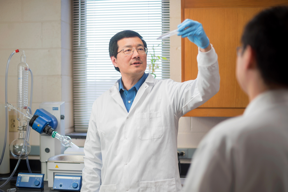 |
| Dawen Zhao, M.D., Ph.D., associate professor of biomedical engineering at Wake Forest School of Medicine, and team have discovered that a nanoparticle therapeutic enhances cancer immunotherapy and is a possible new approach in treating malignant pleural effusion (MPE). CREDIT Wake Forest School of Medicine |
Abstract:
Researchers at Wake Forest School of Medicine have discovered that a nanoparticle therapeutic enhances cancer immunotherapy and is a possible new approach in treating malignant pleural effusion (MPE). MPE is the accumulation of fluid between the chest wall and lungs and is accompanied by malignant cells and/or tumors.
Nanoparticle therapeutic enhances cancer immunotherapy
Winston-Salem, NC | Posted on December 17th, 2021Results from the study are published in the current issue of Nature Nanotechnology.
There are more than 200,000 new cases of MPE in the United States each year, and non-small cell lung cancer accounts for more than one-third of cases.
“MPE is indicative of late-stage metastatic cancer and is associated with a poor prognosis with an average survival of only four to nine months,” said Dawen Zhao, M.D., Ph.D., associate professor of biomedical engineering at Wake Forest School of Medicine. “MPE can also severely impact quality of life as it causes breathlessness, pain, weight loss and reduced physical activity.”
According to Zhao, recent clinical trials involving immune checkpoint inhibitors (ICI) or novel immunotherapies such as anti-PD-1 have shown some encouraging data in patients with MPE. However, only a small number of MPE patients benefit from immunotherapy and many experience immunotoxicity.
“Clinical evidence also suggests that MPE comprises abundant tumor-associated immune cells that prevent the body’s immune system from recognizing and eliminating the cancer,” Zhao said. “This ‘cold’ immune environment could be a major contributor to the failure of ICI.”
To mitigate the immune ‘cold’ MPE, Zhao and his team developed a nanoparticle called liposomal cyclic dinucleotide (LNP-CDN) for targeted activation of an immune pathway called STING, which reprograms tumor-associated immune cells to active anti-tumor ones.
MPE is often associated with two distinct compartments within the tumor microenvironment, the effusion and also pleural tumors, which co-exist within the pleural cavity. These two distinct compartments make therapeutic interventions and drug delivery challenging.
Upon intrapleural injection in a mouse model, the ‘cold’ immune environment lessened in not only the effusion space, but also within the tumors. Zhao’s team combined LNP-CDN with an anti-PD-L1 immunotherapy, which drastically reduced the volume of MPE and inhibited tumor growth in both the pleural cavity and lung tissue in mice with MPE, resulting in prolonged survival.
Zhao’s team also tested the nanoparticle therapeutic on human MPE tissue samples, and similar effects were observed—enhanced tumor cell killing by cytotoxic immune cells.
“Administered alone or with immunotherapy, this study demonstrates a possible treatment for MPE,” Zhao said. “Given the current prognosis of MPE patients, new interventions are needed to not only prolong survival, but also to improve quality of life.”
The Wake Forest School of Medicine researchers have filed a patent application for the nanoparticle-immunotherapy system.
Funding for the study was provided by NCI grant No. 1R01CA264102-0.
####
For more information, please click here
Contacts:
Myra Wright
Wake Forest Baptist Medical Center
Office: 336-713-8806
Copyright © Wake Forest Baptist Medical Center
If you have a comment, please Contact us.Issuers of news releases, not 7th Wave, Inc. or Nanotechnology Now, are solely responsible for the accuracy of the content.
Bookmark:


| Related Links |
| Related News Press |
News and information
 Researchers develop molecular qubits that communicate at telecom frequencies October 3rd, 2025
Next-generation quantum communication October 3rd, 2025
"Nanoreactor" cage uses visible light for catalytic and ultra-selective cross-cycloadditions October 3rd, 2025
Cancer
New molecular technology targets tumors and simultaneously silences two ‘undruggable’ cancer genes August 8th, 2025
Ben-Gurion University of the Negev researchers several steps closer to harnessing patient's own T-cells to fight off cancer June 6th, 2025
Self-propelled protein-based nanomotors for enhanced cancer therapy by inducing ferroptosis June 6th, 2025
Possible Futures
Spinel-type sulfide semiconductors to operate the next-generation LEDs and solar cells For solar-cell absorbers and green-LED source October 3rd, 2025
Nanomedicine
New molecular technology targets tumors and simultaneously silences two ‘undruggable’ cancer genes August 8th, 2025
New imaging approach transforms study of bacterial biofilms August 8th, 2025
Cambridge chemists discover simple way to build bigger molecules – one carbon at a time June 6th, 2025
Electrifying results shed light on graphene foam as a potential material for lab grown cartilage June 6th, 2025
Discoveries
Researchers develop molecular qubits that communicate at telecom frequencies October 3rd, 2025
Next-generation quantum communication October 3rd, 2025
"Nanoreactor" cage uses visible light for catalytic and ultra-selective cross-cycloadditions October 3rd, 2025
Announcements
Rice membrane extracts lithium from brines with greater speed, less waste October 3rd, 2025
Researchers develop molecular qubits that communicate at telecom frequencies October 3rd, 2025
Next-generation quantum communication October 3rd, 2025
"Nanoreactor" cage uses visible light for catalytic and ultra-selective cross-cycloadditions October 3rd, 2025
Interviews/Book Reviews/Essays/Reports/Podcasts/Journals/White papers/Posters
Spinel-type sulfide semiconductors to operate the next-generation LEDs and solar cells For solar-cell absorbers and green-LED source October 3rd, 2025
Rice membrane extracts lithium from brines with greater speed, less waste October 3rd, 2025
Nanobiotechnology
New molecular technology targets tumors and simultaneously silences two ‘undruggable’ cancer genes August 8th, 2025
New imaging approach transforms study of bacterial biofilms August 8th, 2025
Ben-Gurion University of the Negev researchers several steps closer to harnessing patient's own T-cells to fight off cancer June 6th, 2025
Electrifying results shed light on graphene foam as a potential material for lab grown cartilage June 6th, 2025
 |
||
 |
||
| The latest news from around the world, FREE | ||
 |
||
|
|
||
| Premium Products | ||
 |
||
|
Only the news you want to read!
Learn More |
||
 |
||
|
Full-service, expert consulting
Learn More |
||
|
|
||