Home > Press > UCSD engineers give solar power a boost
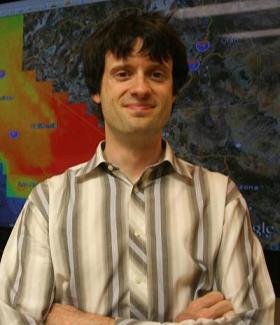 |
| UC San Diego environmental engineering professor Jan Kleissl is developing technologies and methods that allow homeowners, photovoltaic installers and utilities to better predict how much power they will get out of their solar systems. Credit: UC San Diego |
Abstract:
The growing popularity of solar photovoltaic (PV) systems across the United States has made it more important to maximize their power input. That's why UC San Diego environmental engineering professor Jan Kleissl is working on technologies and methods that will better predict how much power we can actually harness from the sun.
UCSD engineers give solar power a boost
San Diego, CA | Posted on January 12th, 2011In a paper recently published in the journal Renewable Energy (*), "Optimum fixed orientations and benefits of tracking for capturing solar radiation in the continental United States," Kleissl and his Ph.D. student Matt Lave explain why it's important to strategize on solar installation, depending upon the location of the building relative to the sun. For example, Kleissl and his students at the UC San Diego Jacobs School of Engineering have improved the solar map (solar.ucsd.edu/) for the state of California, which allows homeowners, photovoltaic installers and utilities to better predict how much energy they will get out of their solar systems. The map can be viewed via Google Earth for free.
"Probably the most important result of this work for California is that in all coastal areas (Los Angeles, San Francisco, San Diego) it is advantageous to install the panels facing about 10-degrees west of south," Kleissl said. "This not only optimizes energy production, but it also improves the correlation of solar power production with the load. Panels facing southwest 'see' the sun longer and at a better angle than panels facing south, which means that the energy generated is larger during the peak demand hours (3-to-5p.m.), making the energy more valuable. The generally clear conditions during the annual load peaks (also known as Santa Anas to Southern Californians) mean that the solar panels produce at the optimum power. On the other hand, wholesale energy prices during the peak time may be 10 times those during other days. In a future with more variable electricity rates this margin may tip the balance of economics in favor of solar energy and there will be greater incentives for installing panels facing southwest. Our maps show that there are already benefits of doing so now as the energy generation increases."
(*) www.sciencedirect.com/science/journal/09601481
Kleissl further explains his intensive solar research at UC San Diego in this recent video produced by SPIE the international society for optics and photonics:
mfile.akamai.com/65904/mov/spiestorage.download.akamai.com/65904/SPIEtv/JanKleissl.mov
####
For more information, please click here
Contacts:
Andrea Siedsma
858-822-0899
Copyright © University of California - San Diego
If you have a comment, please Contact us.Issuers of news releases, not 7th Wave, Inc. or Nanotechnology Now, are solely responsible for the accuracy of the content.
Bookmark:


| Related News Press |
News and information
 Quantum computer improves AI predictions April 17th, 2026
Flexible sensor gains sensitivity under pressure April 17th, 2026
A reusable chip for particulate matter sensing April 17th, 2026
Detecting vibrational quantum beating in the predissociation dynamics of SF6 using time-resolved photoelectron spectroscopy April 17th, 2026
Academic/Education
Rice University launches Rice Synthetic Biology Institute to improve lives January 12th, 2024
Multi-institution, $4.6 million NSF grant to fund nanotechnology training September 9th, 2022
Announcements
A fundamentally new therapeutic approach to cystic fibrosis: Nanobody repairs cellular defect April 17th, 2026
UC Irvine physicists discover method to reverse ‘quantum scrambling’ : The work addresses the problem of information loss in quantum computing system April 17th, 2026
Energy
Sensors innovations for smart lithium-based batteries: advancements, opportunities, and potential challenges August 8th, 2025
Simple algorithm paired with standard imaging tool could predict failure in lithium metal batteries August 8th, 2025
Solar/Photovoltaic
Spinel-type sulfide semiconductors to operate the next-generation LEDs and solar cells For solar-cell absorbers and green-LED source October 3rd, 2025
KAIST researchers introduce new and improved, next-generation perovskite solar cell November 8th, 2024
Groundbreaking precision in single-molecule optoelectronics August 16th, 2024
Development of zinc oxide nanopagoda array photoelectrode: photoelectrochemical water-splitting hydrogen production January 12th, 2024
 |
||
 |
||
| The latest news from around the world, FREE | ||
 |
||
|
|
||
| Premium Products | ||
 |
||
|
Only the news you want to read!
Learn More |
||
 |
||
|
Full-service, expert consulting
Learn More |
||
|
|
||