Home > Press > Scientists decipher structure of nature’s ‘light switch’
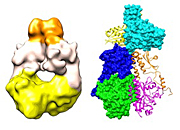 |
| Left: 3-D phytochrome map; Right: Fit-together fragments forming two sister units (one shown as ribbon, the other in space-filling format), revealing twisted structure. |
Abstract:
When the first warm rays of springtime sunshine trigger a burst of new plant growth, it's almost as if someone flicked a switch to turn on the greenery and unleash a floral profusion of color.
Scientists decipher structure of nature’s ‘light switch’
Posted on June 23rd, 2010Opening a window into this process, scientists at DOE's Brookhaven Lab and collaborators at the University of Wisconsin have deciphered the structure of a molecular "switch" known as a phytochrome that is much like the one plants use to sense light. They used a combination of electron microscopy, cryo-electron microscopy, and computational techniques to produce a 3-D map of the full structure. They then used this map to piece together the detailed structures of small phytochrome fragments that had been previously determined using x-ray crystallography.
The new structure revealed a long twisted area of contact between two individual "sister" units, with a good deal of flexibility at the untwisted ends. This structure supports the idea that the absorption of light somehow adjusts the strength or orientation of the contact, and through a series of conformation changes, transmits a signal down the length of the molecular interface. Understanding how these changes in shape send signals that help plants know when to flower, produce chlorophyll, and grow may help scientists design new ways to modify plant growth.
####
For more information, please click here
Contacts:
Karen McNulty Walsh
631.344.8350
Copyright © DOE Pulse
If you have a comment, please Contact us.Issuers of news releases, not 7th Wave, Inc. or Nanotechnology Now, are solely responsible for the accuracy of the content.
Bookmark:


| Related News Press |
News and information
 Quantum computer improves AI predictions April 17th, 2026
Flexible sensor gains sensitivity under pressure April 17th, 2026
A reusable chip for particulate matter sensing April 17th, 2026
Detecting vibrational quantum beating in the predissociation dynamics of SF6 using time-resolved photoelectron spectroscopy April 17th, 2026
Possible Futures
A fundamentally new therapeutic approach to cystic fibrosis: Nanobody repairs cellular defect April 17th, 2026
UC Irvine physicists discover method to reverse ‘quantum scrambling’ : The work addresses the problem of information loss in quantum computing system April 17th, 2026
Academic/Education
Rice University launches Rice Synthetic Biology Institute to improve lives January 12th, 2024
Multi-institution, $4.6 million NSF grant to fund nanotechnology training September 9th, 2022
Announcements
A fundamentally new therapeutic approach to cystic fibrosis: Nanobody repairs cellular defect April 17th, 2026
UC Irvine physicists discover method to reverse ‘quantum scrambling’ : The work addresses the problem of information loss in quantum computing system April 17th, 2026
Food/Agriculture/Supplements
New imaging approach transforms study of bacterial biofilms August 8th, 2025
SMART researchers pioneer first-of-its-kind nanosensor for real-time iron detection in plants February 28th, 2025
 |
||
 |
||
| The latest news from around the world, FREE | ||
 |
||
|
|
||
| Premium Products | ||
 |
||
|
Only the news you want to read!
Learn More |
||
 |
||
|
Full-service, expert consulting
Learn More |
||
|
|
||