Home > Press > More Design Tools for High-Power LED BriteFlash in Camera Phones, Digital Cameras
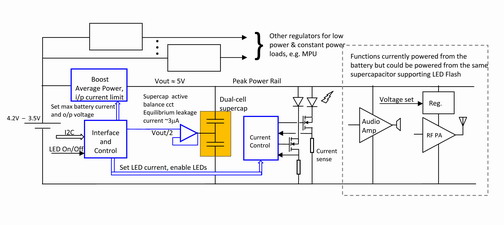 |
| Supercapacitor-Optimized LED Flash Drivers Integrate Circuitry Outlined in Blue |
Abstract:
Supercapacitor-optimized LED flash drivers from AnalogicTech, ON Semiconductor facilitate design
More Design Tools for High-Power LED BriteFlash in Camera Phones, Digital Cameras
Sydney, Australia | Posted on May 3rd, 2009CAP-XX Limited (LSE:CPX), developer of the supercapacitor-driven BriteFlash Power Architecture, today announced availability of supercapacitor-optimized LED flash drivers from several power management integrated circuit (PMIC) companies to facilitate design of high-power LED flash units for high-resolution camera phones and digital cameras.
AnalogicTech's AAT1282, and ON Semiconductor's CAT3224 and soon-to-be-released NCP5680 supercapacitor-optimized LED flash drivers team with a thin, prismatic supercapacitor to drive today's high-current white LEDs (WLEDs) in a thin-form solution which provides comparable light energy to a bulky xenon flash. These LED flash drivers integrate all circuitry required to charge the supercapacitor, manage in-rush current and control LED current, thus saving development time, board space and component cost. Both Seoul Semiconductor and ON Semiconductor have created LED flash module reference designs that demonstrate the thin-form BriteFlash solution.
"This is valuable for our customers, since it offers a more integrated approach to incorporating BriteFlash into small mobile handsets and digital cameras," said Peter Buckle, CAP-XX vice president of sales and marketing. More supercapacitor-optimized LED flash drivers are in late-stage development at other PMIC companies, reported CAP-XX.
To produce high-resolution pictures in low-light conditions, cameras of 5 or more megapixels require a high-intensity flash. Today's WLEDs can deliver such light energy, but need up to 400% more power than a battery can provide. To support the battery, a thin supercapacitor can drive the LED flash to full intensity while also handling other peak-power needs - zoom, auto-focus, audio, video, wireless transmissions, GPS readings and RF amplification - without compromising slimline design.
CAP-XX developed the BriteFlash Power Architecture to give designers a thin-form LED flash solution that delivers light energy that far exceeds standard battery-powered LED flash and rivals xenon flash.
BriteFlash combines an LED flash driver IC, supercapacitor, battery and WLEDs. The flash driver's boost converter charges the supercapacitor to 5.5V, which then delivers high-peak current to drive the LED flash. The battery only supplies average power, and recharges the supercapacitor between flashes. A white paper explains more at: www.cap-xx.com/resources/pres_wp/pres_wp.htm#wp
Supercapacitor-optimized LED flash drivers integrate tools to manage the supercapacitor in power-hungry portable applications. ON Semiconductor's low-power business unit director, Marie-Therese Capron, explains their two solutions. "While CAT3224 is an integrated 4A LED driver for compact camera-flash design, our upcoming NCP5680 is a 10A LED driver featuring fully-programmable outputs via I2C interface, and power regulation capability to drive other power-hungry circuitry such as audio. Both solutions provide high-intensity photo flash plus continuous lighting for capturing video in dark environments."
Phil Dewsbury, product line director for AnalogicTech said, "Lithium Ion batteries simply cannot supply the high-peak currents required for high-intensity LED flash. Supercapacitors can store the required energy while keeping the form factor small. However, charging them quickly while minimizing battery current presented a unique challenge. Our solution was the AAT1282, a 2A, dual-output LED flash driver IC. Since its introduction, EDN has named the chip a finalist in the magazine's annual Innovation Awards. We are also sampling the AAT1282-4 which boosts output to 4A to support higher-megapixel cameras."
####
About CAP-XX Limited
CAP-XX is a world leader in thin, flat supercapacitors for space-constrained electronics devices. Supercapacitors resolve the performance limitations of batteries and other current-limited power supplies, bridging the gap between the peak power demanded by the load and that available from the source, and provide backup power if the primary power source fails.
CAP-XX supercapacitors enable manufacturers to make smaller, thinner, longer-running and more feature-rich electronic devices such as camera phones, SSDs, PDAs, wireless sensors and medical devices. The company is listed on the Alternative Investment Market (AIM) in London and is based in Sydney, Australia with sales offices in the UK and USA.
For more information, please click here
Contacts:
CAP-XX
Michelle Moody
Moody & Associates
+1-214-363-3460
AnalogicTech:
Karolien Cools-Wittry
+1-408-737-4600
karoliencw at analogictech.com
ON Semiconductor:
Helene Acrosse
+33 5 34 61 10 00
Copyright © CAP-XX Limited
If you have a comment, please Contact us.Issuers of news releases, not 7th Wave, Inc. or Nanotechnology Now, are solely responsible for the accuracy of the content.
Bookmark:


| Related News Press |
News and information
 Quantum computer improves AI predictions April 17th, 2026
Flexible sensor gains sensitivity under pressure April 17th, 2026
A reusable chip for particulate matter sensing April 17th, 2026
Detecting vibrational quantum beating in the predissociation dynamics of SF6 using time-resolved photoelectron spectroscopy April 17th, 2026
Display technology/LEDs/SS Lighting/OLEDs
Spinel-type sulfide semiconductors to operate the next-generation LEDs and solar cells For solar-cell absorbers and green-LED source October 3rd, 2025
Efficient and stable hybrid perovskite-organic light-emitting diodes with external quantum efficiency exceeding 40 per cent July 5th, 2024
Memory Technology
Researchers tackle the memory bottleneck stalling quantum computing October 3rd, 2025
First real-time observation of two-dimensional melting process: Researchers at Mainz University unveil new insights into magnetic vortex structures August 8th, 2025
Utilizing palladium for addressing contact issues of buried oxide thin film transistors April 5th, 2024
Announcements
A fundamentally new therapeutic approach to cystic fibrosis: Nanobody repairs cellular defect April 17th, 2026
UC Irvine physicists discover method to reverse ‘quantum scrambling’ : The work addresses the problem of information loss in quantum computing system April 17th, 2026
Battery Technology/Capacitors/Generators/Piezoelectrics/Thermoelectrics/Energy storage
Decoding hydrogen‑bond network of electrolyte for cryogenic durable aqueous zinc‑ion batteries January 30th, 2026
COF scaffold membrane with gate‑lane nanostructure for efficient Li+/Mg2+ separation January 30th, 2026
MXene nanomaterials enter a new dimension Multilayer nanomaterial: MXene flakes created at Drexel University show new promise as 1D scrolls January 30th, 2026
 |
||
 |
||
| The latest news from around the world, FREE | ||
 |
||
|
|
||
| Premium Products | ||
 |
||
|
Only the news you want to read!
Learn More |
||
 |
||
|
Full-service, expert consulting
Learn More |
||
|
|
||