Home > Press > University of Delaware launches fuel cell center
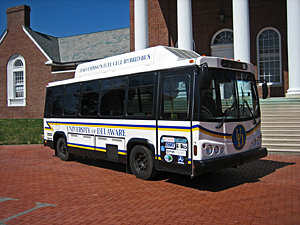 |
| This hydrogen fuel cell powered bus is part of the University of Delaware's shuttle fleet. |
Abstract:
The University of Delaware has established the Center for Fuel Cell Research (CFCR) to improve the understanding of fuel cells and address critical issues and barriers to commercialization.
University of Delaware launches fuel cell center
Newark, DE | Posted on December 12th, 2008The center will also provide undergraduate and graduate students with the opportunity to participate in fuel cell research and demonstration projects. Ajay Prasad, professor of mechanical engineering, founded the center and is serving as its first director.
CFCR research focuses on a broad range of topics in fuel cell and hydrogen infrastructure science and technology; the overall goal of the work is to improve performance and durability with novel materials, architectures, and operating strategies.
"Delaware is a great place to start a fuel cell center," Prasad says. "We have a large number of people here at UD doing work related to this subject, and many of the major players in the fuel cell market are within a 50-mile radius of the University."
The new center is housed in the Department of Mechanical Engineering and includes some 25 faculty members from the colleges of Engineering, Arts and Sciences, and Marine and Earth Studies.
Traditionally, fuel cell research was mostly done by electrochemists, but Prasad says that there are tremendous opportunities for engineers and material scientists as well.
"It is also necessary to involve diverse fields like biotechnology in fuel cell and hydrogen research," he adds. "For example, photobiological water splitting using certain types of bacteria and sunlight might offer an exciting, renewable way to produce hydrogen in the future."
Important components of the center's mission are technology transfer to industry and public outreach to educate the community about the benefits of fuel cells through programs such as the University's fuel cell bus. "By 2011, we should be up to four buses," Prasad says, "and we also have plans to build two more hydrogen refueling stations, one in Wilmington and one in Dover." There is already a station in Newark.
Prasad sees three barriers to widespread adoption of fuel cell technology: cost, durability, and the lack of a hydrogen infrastructure. CFCR research is addressing issues related to all three.
"Public acceptance is also an important issue," Prasad says, "and the bus project has helped by increasing awareness. The presence of three filling stations in the state also has the potential to contribute to future efforts to attract fuel-cell related research and demonstration projects to Delaware."
"I think that the University of Delaware will benefit from a timely confluence of political, industrial, and academic agendas centered on alternative energy approaches," he continues. "The fuel cell effort is an important part of that."
The CFCR is part of the overall energy research effort encompassed by the recently launched University of Delaware Energy Institute (UDEI).
Article by Diane Kukich
####
For more information, please click here
Contacts:
Office of Communications & Marketing
The Academy Building
105 East Main Street
University of Delaware
Newark, DE 19716 • USA
Phone: (302) 831-2792
Copyright © University of Delaware
If you have a comment, please Contact us.Issuers of news releases, not 7th Wave, Inc. or Nanotechnology Now, are solely responsible for the accuracy of the content.
Bookmark:


| Related News Press |
News and information
 Quantum computer improves AI predictions April 17th, 2026
Flexible sensor gains sensitivity under pressure April 17th, 2026
A reusable chip for particulate matter sensing April 17th, 2026
Detecting vibrational quantum beating in the predissociation dynamics of SF6 using time-resolved photoelectron spectroscopy April 17th, 2026
Openings/New facilities/Groundbreaking/Expansion
OCSiAl expands its graphene nanotube production capacities to Europe June 17th, 2022
GLOBALFOUNDRIES Moves Corporate Headquarters to its Most Advanced Semiconductor Manufacturing Facility in New York April 27th, 2021
Oxford Instruments Plasma Technology relocates to advanced manufacturing facility: Move driven by exceptional business growth February 12th, 2021
Academic/Education
Rice University launches Rice Synthetic Biology Institute to improve lives January 12th, 2024
Multi-institution, $4.6 million NSF grant to fund nanotechnology training September 9th, 2022
Announcements
A fundamentally new therapeutic approach to cystic fibrosis: Nanobody repairs cellular defect April 17th, 2026
UC Irvine physicists discover method to reverse ‘quantum scrambling’ : The work addresses the problem of information loss in quantum computing system April 17th, 2026
Energy
Sensors innovations for smart lithium-based batteries: advancements, opportunities, and potential challenges August 8th, 2025
Simple algorithm paired with standard imaging tool could predict failure in lithium metal batteries August 8th, 2025
Automotive/Transportation
Decoding hydrogen‑bond network of electrolyte for cryogenic durable aqueous zinc‑ion batteries January 30th, 2026
Sensors innovations for smart lithium-based batteries: advancements, opportunities, and potential challenges August 8th, 2025
Simple algorithm paired with standard imaging tool could predict failure in lithium metal batteries August 8th, 2025
Fuel Cells
Deciphering local microstrain-induced optimization of asymmetric Fe single atomic sites for efficient oxygen reduction August 8th, 2025
Current and Future Developments in Nanomaterials and Carbon Nanotubes: Applications of Nanomaterials in Energy Storage and Electronics October 28th, 2022
 |
||
 |
||
| The latest news from around the world, FREE | ||
 |
||
|
|
||
| Premium Products | ||
 |
||
|
Only the news you want to read!
Learn More |
||
 |
||
|
Full-service, expert consulting
Learn More |
||
|
|
||