Home > Press > China's first ZnO nanorod field-effect transistor fabricated in IMECAS
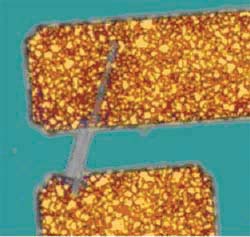 |
| China's first back-gate ZnO nanorod field-effect transistor |
Abstract:
Recently, zinc oxide (ZnO) nanorod field-effect transistor (FET), the first of its kind as a nano device in China, was successfully fabricated by scientists with the CAS Institute of Microelectronics, Chinese Academy of Sciences (IME).
China's first ZnO nanorod field-effect transistor fabricated in IMECAS
China | Posted on October 22nd, 2008 ZnO is a wide bandgap semiconductor and an important multifunctional material. The ZnO nano materials, such as nanowires, nanorods, nanobands and nanorings, attract intense worldwide attention for their unique optical, semiconducting and piezoelectric properties. At present, Chinese scientists in this filed mainly focus their research on material growth and diode development.
A research group headed by Prof. ZHANG Haiying from IME came up with a unique "bottom-up" method for designing and developing nano devices. Through the regular contact photolithography technology, they employed ZnO nanorods as the channel material and fabricated a metal-oxide-semiconductor FET by combining gate oxide and back gate metal, which displayed satisfying results.
Next, Prof. Zhang and her colleagues will further advance the technology in order to develop nanowires with an even smaller diameter and improve the performance of the devices, raising solutions to key problems in practical use.
####
About Chinese Academy of Sciences
CAS strives to build itself into a scientific research base at advanced international level, a base for fostering and bringing up advanced S&T talents, and a base for promoting the development of China's high and new technology industries. By 2010, CAS will have about 80 national institutes noted for their powerful capacities in S&T innovation and sustainable development or with distinctive features; thirty of them will become internationally acknowledged, high-level research institutions, and three to five will be world class.
For more information, please click here
Contacts:
Chinese Academy of Sciences
Add: 52 Sanlihe Rd., Beijing China
Postcode: 100864
Tel: 86 10 68597289
Fax: 86 10 68512458
Chief-Editor's Information:
Guo Haiyan
the Editor
Bulletin of Chinese Academy of Sciences
CAS Institute of Policy & Management,
P.O.Box 8712, Beijing 100080, China.
Copyright © Chinese Academy of Sciences
If you have a comment, please Contact us.Issuers of news releases, not 7th Wave, Inc. or Nanotechnology Now, are solely responsible for the accuracy of the content.
Bookmark:


| Related News Press |
News and information
 Quantum computer improves AI predictions April 17th, 2026
Flexible sensor gains sensitivity under pressure April 17th, 2026
A reusable chip for particulate matter sensing April 17th, 2026
Detecting vibrational quantum beating in the predissociation dynamics of SF6 using time-resolved photoelectron spectroscopy April 17th, 2026
Chip Technology
A reusable chip for particulate matter sensing April 17th, 2026
Metasurfaces smooth light to boost magnetic sensing precision January 30th, 2026
Discoveries
Quantum computer improves AI predictions April 17th, 2026
Flexible sensor gains sensitivity under pressure April 17th, 2026
A reusable chip for particulate matter sensing April 17th, 2026
Detecting vibrational quantum beating in the predissociation dynamics of SF6 using time-resolved photoelectron spectroscopy April 17th, 2026
Announcements
A fundamentally new therapeutic approach to cystic fibrosis: Nanobody repairs cellular defect April 17th, 2026
UC Irvine physicists discover method to reverse ‘quantum scrambling’ : The work addresses the problem of information loss in quantum computing system April 17th, 2026
 |
||
 |
||
| The latest news from around the world, FREE | ||
 |
||
|
|
||
| Premium Products | ||
 |
||
|
Only the news you want to read!
Learn More |
||
 |
||
|
Full-service, expert consulting
Learn More |
||
|
|
||