Home > Press > Energy storage for hybrid vehicles
 |
Abstract:
Hybrid technology combines the advantages of combustion engines and electric motors. Scientists are developing high-performance energy storage units, a prerequisite for effective hybrid motors.
Energy storage for hybrid vehicles
Germany | Posted on August 15th, 2008
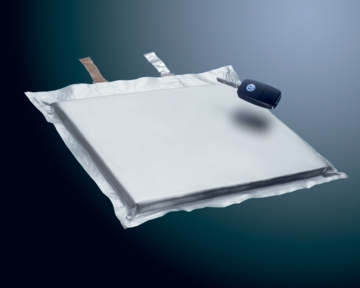
The vehicle is powered by petroleum on the freeway and by electricity in town, thus using considerably less energy. A hybrid propulsion system switches over to generator operation when the brakes go on, producing electric current that is temporarily stored in a battery. The electric motor uses this current when starting up. This yields tremendous savings, particularly in urban traffic. But up to now, hybrid technology has always had a storage problem. Scientists from three Fraunhofer Institutes are developing new storage modules in a project called "Electromobility Fleet Test". The pilot project was launched by Volkswagen and Germany's Federal Ministry for the Environment BMU together with seven other partners. The Fraunhofer Institutes for Silicon Technology ISIT in Itzehoe, Integrated Circuits IIS in Nuremberg, and Integrated Systems and Device Technology IISB in Erlangen will be pooling their expertise for the next three years. The researchers are developing an energy storage module based on lithium-polymer accumulator technology that is suitable for use in vehicles.
"This module has to be able to withstand the harsh environmental conditions it will encounter in a hybrid vehicle, and above all it must guarantee high operational reliability and a long service life," states ISIT scientist Dr. Gerold Neumann, who coordinates the Fraunhofer activities. The researchers hope to reach this goal with new electrode materials that are kinder to the environment. A specially developed battery management system makes the energy storage device more durable and reliable. The experts are also researching into new concepts that will enable large amounts of energy to be stored in a small space. To do this, they integrate mechanical and electrical components in a single module, devising systems for temperature control, performance data registration and high-voltage safety.
The tasks involved are distributed between the three Fraunhofer Institutes according to their skills: The ISIT experts, who have long experience in developing and manufacturing lithium accumulators, are manufacturing the cells. Their colleagues at IIS are responsible for battery management and monitoring. The scientists from IISB are contributing their know-how on power electronics components to configure the accumulator modules. The development and configuration of the new energy storage module is expected to be finished by mid-2010. Volks-
wagen AG - the industrial partner in this project - will then carry out field trials to test the modules' suitability for everyday use in the vehicles.
####
About Fraunhofer-Gesellschaft
The Fraunhofer-Gesellschaft undertakes applied research of direct utility to private and public enterprise and of wide benefit to society.
For more information, please click here
Contacts:
Dr. Gerold Neumann
Phone: +49 4821 17-4219
Fax: 04821 / 17-4250/4251
Send an e-mail
Fraunhofer-Institut für Siliziumtechnologie
ISIT
Fraunhoferstraße 1
25524 Itzehoe
Peter Spies
Phone: +49 911 58061-6363
Fax: +49 911 58061-6398
Fraunhofer Institute for Integrated Circuits
IIS
Am Wolfsmantel 33
91058 Erlangen
www.iis.fraunhofer.de
Dr.-Ing. Martin März
Phone: +49 9131 761-310
Fraunhofer-Institut für Integrierte Systeme und Bauelementetechnologie
IISB
Schottkystraße 10
91058 Erlangen
Copyright © Fraunhofer-Gesellschaft
If you have a comment, please Contact us.Issuers of news releases, not 7th Wave, Inc. or Nanotechnology Now, are solely responsible for the accuracy of the content.
Bookmark:


| Related News Press |
News and information
 Quantum computer improves AI predictions April 17th, 2026
Flexible sensor gains sensitivity under pressure April 17th, 2026
A reusable chip for particulate matter sensing April 17th, 2026
Detecting vibrational quantum beating in the predissociation dynamics of SF6 using time-resolved photoelectron spectroscopy April 17th, 2026
Discoveries
Quantum computer improves AI predictions April 17th, 2026
Flexible sensor gains sensitivity under pressure April 17th, 2026
A reusable chip for particulate matter sensing April 17th, 2026
Detecting vibrational quantum beating in the predissociation dynamics of SF6 using time-resolved photoelectron spectroscopy April 17th, 2026
Announcements
A fundamentally new therapeutic approach to cystic fibrosis: Nanobody repairs cellular defect April 17th, 2026
UC Irvine physicists discover method to reverse ‘quantum scrambling’ : The work addresses the problem of information loss in quantum computing system April 17th, 2026
Automotive/Transportation
Decoding hydrogen‑bond network of electrolyte for cryogenic durable aqueous zinc‑ion batteries January 30th, 2026
Sensors innovations for smart lithium-based batteries: advancements, opportunities, and potential challenges August 8th, 2025
Simple algorithm paired with standard imaging tool could predict failure in lithium metal batteries August 8th, 2025
Battery Technology/Capacitors/Generators/Piezoelectrics/Thermoelectrics/Energy storage
Decoding hydrogen‑bond network of electrolyte for cryogenic durable aqueous zinc‑ion batteries January 30th, 2026
COF scaffold membrane with gate‑lane nanostructure for efficient Li+/Mg2+ separation January 30th, 2026
MXene nanomaterials enter a new dimension Multilayer nanomaterial: MXene flakes created at Drexel University show new promise as 1D scrolls January 30th, 2026
 |
||
 |
||
| The latest news from around the world, FREE | ||
 |
||
|
|
||
| Premium Products | ||
 |
||
|
Only the news you want to read!
Learn More |
||
 |
||
|
Full-service, expert consulting
Learn More |
||
|
|
||