Home > Press > "Wiring up" enzymes for producing hydrogen in fuel cells
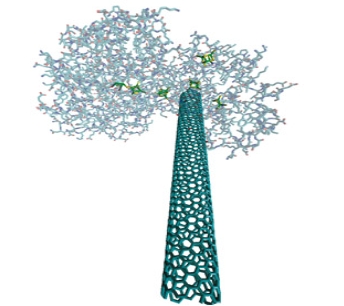 |
| Computer graphic representation of a single-walled carbon nanotube (elongated structure) "wired up" to a hydrogenase enzyme. Courtesy of Michael J. Heben, National Renewable Energy Laboratory |
Abstract:
Researchers in Colorado are reporting the first successful "wiring up" of hydrogenase enzymes. Those much-heralded proteins are envisioned as stars in a future hydrogen economy where they may serve as catalysts for hydrogen production and oxidation in fuel cells. Their report, describing a successful electrical connection between a carbon nanotube and hydrogenase, is scheduled for the Nov. issue of ACS' Nano Letters, a monthly journal.
"Wiring up" enzymes for producing hydrogen in fuel cells
Golden, CO | Posted on November 14th, 2007In the new study, Michael J. Heben, Paul W. King, and colleagues explain that bacterial enzymes called hydrogenases show promise as powerful catalysts for using hydrogen in fuel cells, which can produce electricity with virtually no pollution for motor vehicles, portable electronics, and other devices. However, scientists report difficulty incorporating these enzymes into electrical devices because the enzymes do not form good electrical connections with fuel cell components. Currently, precious metals, such as platinum, are typically needed to perform this catalysis.
The researchers combined hydrogenase enzymes with carbon nanotubes, submicroscopic strands of pure carbon that are excellent electrical conductors. In laboratory studies, the researchers demonstrated that a good electrical connection was established using photoluminescence spectroscopy measurements. These new "biohybrid" conjugates could reduce the cost of fuel cells by reducing or eliminating the need for platinum and other costly metal components, they say.
####
For more information, please click here
Contacts:
Science Inquiries: Michael Woods, editor
General Inquiries: Michael Bernstein
202-872-4400
Michael J. Heben, Ph.D.
Energy Sciences
National Renewable Energy Laboratory
Golden, Colorado 80401
Phone: 303-384-6641
Fax: 303-384-6432
Paul W. King, Ph.D.
Energy Sciences
National Renewable Energy Laboratory
Golden, Colorado 80401
Phone: 303-384-6277
Fax: 303-384-6150
Copyright © American Chemical Society
If you have a comment, please Contact us.Issuers of news releases, not 7th Wave, Inc. or Nanotechnology Now, are solely responsible for the accuracy of the content.
Bookmark:


| Related Links |
| Related News Press |
Discoveries
 Quantum computer improves AI predictions April 17th, 2026
Flexible sensor gains sensitivity under pressure April 17th, 2026
A reusable chip for particulate matter sensing April 17th, 2026
Detecting vibrational quantum beating in the predissociation dynamics of SF6 using time-resolved photoelectron spectroscopy April 17th, 2026
Announcements
A fundamentally new therapeutic approach to cystic fibrosis: Nanobody repairs cellular defect April 17th, 2026
UC Irvine physicists discover method to reverse ‘quantum scrambling’ : The work addresses the problem of information loss in quantum computing system April 17th, 2026
Energy
Sensors innovations for smart lithium-based batteries: advancements, opportunities, and potential challenges August 8th, 2025
Simple algorithm paired with standard imaging tool could predict failure in lithium metal batteries August 8th, 2025
Fuel Cells
Deciphering local microstrain-induced optimization of asymmetric Fe single atomic sites for efficient oxygen reduction August 8th, 2025
Current and Future Developments in Nanomaterials and Carbon Nanotubes: Applications of Nanomaterials in Energy Storage and Electronics October 28th, 2022
 |
||
 |
||
| The latest news from around the world, FREE | ||
 |
||
|
|
||
| Premium Products | ||
 |
||
|
Only the news you want to read!
Learn More |
||
 |
||
|
Full-service, expert consulting
Learn More |
||
|
|
||