Home > Press > Monitoring critical blood levels in real time in the ICU: EPFL has developed a miniaturized microfluidic device that will allow medical staff to monitor in real time levels of glucose, lactate a.s.o. and react more quickly
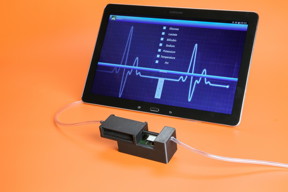 |
| This picture shows a device developed at EPFL that is capable of monitoring in real-time 5 vital substances for patients in ICU. Back: preview of the tablet app designed to monitor the values. CREDIT: Alain Herzog / EPFL 2015 |
Abstract:
No larger than a pack of chewing gum, the prototype developed by EPFL's Integrated Systems Laboratory (LSI) is deceptively simple in appearance. But this little black case with two thin tubes sticking out contains some real miniaturized high-tech wonders. "We embedded biosensors in it to measure several different substances in the blood or blood serum along with an array of electronics to transmit the results in real time to a tablet via Bluetooth," said Sandro Carrara, an LSI scientist.
Monitoring critical blood levels in real time in the ICU: EPFL has developed a miniaturized microfluidic device that will allow medical staff to monitor in real time levels of glucose, lactate a.s.o. and react more quickly
Lausanne, Switzerland | Posted on October 22nd, 2015Capable of being connected to a drainage tube that's already in place, the new system is much less invasive than the many monitoring devices that it's designed to replace. It keeps constant tabs on the blood levels of five substances: metabolites (glucose, lactate and bilirubin) and ions (calcium and potassium), all of which indicate changes in the condition of intensive-care patients.
"Nowadays, several of these levels are measured periodically. But in some cases, any change in level calls for an immediate response, something that is not possible with the existing systems," said Dr. Carrara.
Building on this principle, up to 40 molecules could be monitored in real time. This advance will drastically reduce the number of machines cluttered around patients - an obvious practical advantage for the medical staff, not to mention the psychological boon for loved ones.
The prototype, which was made with a 3D printer, has been successfully tested on rodents. Discussions are now under way for tests to be carried out at the University Hospital of Lausanne (CHUV). And a number of manufacturers have already expressed serious interest in developing this device. "We could hit the market in two to three years," said Dr. Carrara.
This progress towards more precise and effective medicine was achieved under the Nano-Tera initiative, which is financed by the Swiss government. The device was unveiled on October 22nd in Atlanta at the 2015 BioCAS Conference.
####
For more information, please click here
Contacts:
Sandro Carrara
41-792-488-632
Copyright © Ecole Polytechnique Fédérale de Lausanne
If you have a comment, please Contact us.Issuers of news releases, not 7th Wave, Inc. or Nanotechnology Now, are solely responsible for the accuracy of the content.
Bookmark:


| Related News Press |
Microfluidics/Nanofluidics
 Projecting light to dispense liquids: A new route to ultra-precise microdroplets January 30th, 2026
News and information
Decoding hydrogen‑bond network of electrolyte for cryogenic durable aqueous zinc‑ion batteries January 30th, 2026
COF scaffold membrane with gate‑lane nanostructure for efficient Li+/Mg2+ separation January 30th, 2026
Lab-on-a-chip
Micro-scale opto-thermo-mechanical actuation in the dry adhesive regime Peer-Reviewed Publication September 24th, 2021
Silicon-graphene hybrid plasmonic waveguide photodetectors beyond 1.55 μm March 13th, 2020
Govt.-Legislation/Regulation/Funding/Policy
Metasurfaces smooth light to boost magnetic sensing precision January 30th, 2026
New imaging approach transforms study of bacterial biofilms August 8th, 2025
Electrifying results shed light on graphene foam as a potential material for lab grown cartilage June 6th, 2025
Possible Futures
Decoding hydrogen‑bond network of electrolyte for cryogenic durable aqueous zinc‑ion batteries January 30th, 2026
COF scaffold membrane with gate‑lane nanostructure for efficient Li+/Mg2+ separation January 30th, 2026
Nanomedicine
New molecular technology targets tumors and simultaneously silences two ‘undruggable’ cancer genes August 8th, 2025
New imaging approach transforms study of bacterial biofilms August 8th, 2025
Cambridge chemists discover simple way to build bigger molecules – one carbon at a time June 6th, 2025
Electrifying results shed light on graphene foam as a potential material for lab grown cartilage June 6th, 2025
Sensors
Tiny nanosheets, big leap: A new sensor detects ethanol at ultra-low levels January 30th, 2026
From sensors to smart systems: the rise of AI-driven photonic noses January 30th, 2026
Sensors innovations for smart lithium-based batteries: advancements, opportunities, and potential challenges August 8th, 2025
Discoveries
From sensors to smart systems: the rise of AI-driven photonic noses January 30th, 2026
Decoding hydrogen‑bond network of electrolyte for cryogenic durable aqueous zinc‑ion batteries January 30th, 2026
COF scaffold membrane with gate‑lane nanostructure for efficient Li+/Mg2+ separation January 30th, 2026
Announcements
Decoding hydrogen‑bond network of electrolyte for cryogenic durable aqueous zinc‑ion batteries January 30th, 2026
COF scaffold membrane with gate‑lane nanostructure for efficient Li+/Mg2+ separation January 30th, 2026
Interviews/Book Reviews/Essays/Reports/Podcasts/Journals/White papers/Posters
Metasurfaces smooth light to boost magnetic sensing precision January 30th, 2026
COF scaffold membrane with gate‑lane nanostructure for efficient Li+/Mg2+ separation January 30th, 2026
Events/Classes
Institute for Nanoscience hosts annual proposal planning meeting May 16th, 2025
A New Blue: Mysterious origin of the ribbontail ray’s electric blue spots revealed July 5th, 2024
Researchers demonstrate co-propagation of quantum and classical signals: Study shows that quantum encryption can be implemented in existing fiber networks January 20th, 2023
 |
||
 |
||
| The latest news from around the world, FREE | ||
 |
||
|
|
||
| Premium Products | ||
 |
||
|
Only the news you want to read!
Learn More |
||
 |
||
|
Full-service, expert consulting
Learn More |
||
|
|
||