Home > Press > Nanocrystals make dentures shine: Chemists of Jena University develop novel glass ceramics for dentistry
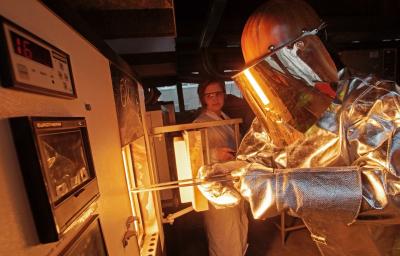 |
| The glass-ceramics are produced according to an exactly specified temperature scheme.
Credit: Photo: Jan-Peter Kasper/FSU |
Abstract:
The hardest substance in the human body is moved by its strongest muscles: When we heartily bite into an apple or a schnitzel, enormous strengths are working on the surface of our teeth. "What the natural tooth enamel has to endure also goes for dentures, inlays or bridges", glass chemist Prof. Dr. Dr. Christian Rüssel of the Friedrich Schiller University Jena (Germany) says. After all, these are worn as much as healthy teeth. Ceramic materials used so far are not very suitable for bridges, as their strengths are mostly not high enough. Now Prof. Rüssel and his colleagues of the Otto-Schott-Institute for Glass Chemistry succeeded in producing a new kind of glass ceramic with a nanocrystalline structure, which seems to be well suited to be used in dentistry due to their high strength and its optical characteristics. The glass chemists of Jena University recently published their research results in the online-edition of the science magazine Journal of Biomedical Materials Research (doi: 10.1002/jbm.b.31972).
Nanocrystals make dentures shine: Chemists of Jena University develop novel glass ceramics for dentistry
Jena, Germany | Posted on January 5th, 2012Glass-ceramics on the basis of magnesium-, aluminium-, and silicon oxide are distinguished by their enormous strength. "We achieve a strength five times higher than with comparable denture ceramics available today", Prof. Rüssel explains. The Jena glass chemists have been working for a while on high density ceramics, but so far only for utilisation in other fields, for instance as the basis of new efficient computer hard drives. "In combination with new optical characteristics an additional field of application is opening up for these materials in dentistry", Prof. Rüssel is convinced.
Materials, to be considered as dentures are not supposed to be optically different from natural teeth. At the same time not only the right colour shade is important. "The enamel is partly translucent, which the ceramic is also supposed to be", Prof. Rüssel says.
To achieve these characteristics, the glass-ceramics are produced according to an exactly specified temperature scheme: First of all the basic materials are melted at about 1.500 °C, then cooled down and finely cut up. Then the glass is melted again and cooled down again. Finally, nanocrystals are generated by controlled heating to about 1,000 °C. "This procedure determines the crystallisation crucial for the strength of the product", the glass chemist Rüssel explains. But this was a technical tightrope walk. Because a too strongly crystallised material disperses the light, becomes opaque and looks like plaster. The secret of the Jena glass ceramic lies in its consistence of nanocrystals. The size of these is at most 100 nanometers in general. "They are too small to strongly disperse light and therefore the ceramic looks translucent, like a natural tooth", Prof. Rüssel says.
A lot of developing work is necessary until the materials from the Jena Otto-Schott-Institute will be able to be used as dentures. But the groundwork is done. Prof. Rüssel is sure of it.
Original Publication:
Dittmer M, Rüssel C.: Colorless and high strength MgO/Al2O3/SiO2 glass-ceramic dental material using zirconia as nucleating agent. J Biomed Mater Res B Appl Biomater. 2011 Nov 21. doi: 10.1002/jbm.b.31972
####
For more information, please click here
Contacts:
Ute Schoenfelder
Prof. Dr. Dr. Christian Rüssel
Otto-Schott-Institute for Glass Chemistry
Friedrich Schiller University Jena
Fraunhoferstr. 6, D-07743 Jena
Phone: 49-3641/948501
Copyright © Friedrich-Schiller-Universitaet Jena
If you have a comment, please Contact us.Issuers of news releases, not 7th Wave, Inc. or Nanotechnology Now, are solely responsible for the accuracy of the content.
Bookmark:


| Related News Press |
News and information
 Simulating magnetization in a Heisenberg quantum spin chain April 5th, 2024
NRL charters Navy’s quantum inertial navigation path to reduce drift April 5th, 2024
Discovery points path to flash-like memory for storing qubits: Rice find could hasten development of nonvolatile quantum memory April 5th, 2024
Discoveries
Chemical reactions can scramble quantum information as well as black holes April 5th, 2024
New micromaterial releases nanoparticles that selectively destroy cancer cells April 5th, 2024
Utilizing palladium for addressing contact issues of buried oxide thin film transistors April 5th, 2024
Announcements
NRL charters Navy’s quantum inertial navigation path to reduce drift April 5th, 2024
Discovery points path to flash-like memory for storing qubits: Rice find could hasten development of nonvolatile quantum memory April 5th, 2024
Dental
Innovations in dentistry: Navigational surgery, robotics, and nanotechnology October 2nd, 2020
First measurement of electron energy distributions, could enable sustainable energy technologies June 5th, 2020
Gas storage method could help next-generation clean energy vehicles: Tremendous amounts of hydrogen and methane can be stored in nanoscopic pores April 17th, 2020
 |
||
 |
||
| The latest news from around the world, FREE | ||
 |
||
|
|
||
| Premium Products | ||
 |
||
|
Only the news you want to read!
Learn More |
||
 |
||
|
Full-service, expert consulting
Learn More |
||
|
|
||