Home > Press > Nanotribology: Tubular probes: Short, capped single-walled carbon nanotubes may serve as ideal probing tips to study friction, lubrication and wear at the microscale
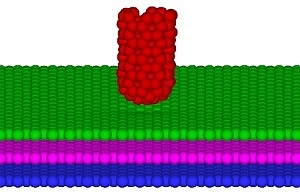 |
| Atomistic simulations show that short, capped single-walled carbon nanotubes (red) can elucidate the tribological properties of graphene surfaces Copyright : 2011 Elsevier |
Abstract:
Studying microscopic interactions at single asperities is vital for the understanding of friction and lubrication at the macroscale. Surface probe instruments with carbon nanotube tips may enable such investigations, as now demonstrated in a theoretical study led by Ping Liu and Yong-Wei Zhang at the A*STAR Institute of High Performance Computing1. The researchers showed that short, single-walled, capped carbon nanotubes are able to capture the frictional characteristics of graphene with atomic resolution.
Nanotribology: Tubular probes: Short, capped single-walled carbon nanotubes may serve as ideal probing tips to study friction, lubrication and wear at the microscale
Singapore | Posted on November 29th, 2011"For an ideal probing tip, its dimension should be as small as possible, its rigidity should be as large as possible, its geometry should be well-defined, and it should be chemically inert," explains Liu. The combination of such characteristics would allow surface characterization with atomic resolution while ensuring a long lifetime and geometrical, chemical and physical stability of the tip.
Carbon nanotubes, in particular short ones, are of great interest due to their inherent strong carbon-carbon bonds, which allows them to withstand buckling and bending deformation and recover to their original shape after deformation. Capped tubes in turn offer improved chemical stability and stiffness in comparison to non-capped tubes. These considerations indicate that short, capped single-walled carbon nanotubes may be ideal imaging probe tips.
As it is not yet possible to use such tips in experimental setups, to test this hypothesis Liu and Zhang performed large-scale atomistic simulations focusing on the interaction between such nanotube probing tips and graphene (see image)—a carbon material that is ideal for surface coating lubrication. "Because of advances in the development of accurate atomic potentials and massive parallel computing algorithms, atomistic simulations not only enable us to determine the probing characteristics of such tips, but also to investigate the frictional and defect characteristics of graphene with atomic resolution," says Liu.
The simulations could capture the dependence of the friction and average normal forces on tip-to-surface distance and number of graphene layers. The researchers analyzed and interpreted the observed characteristics in terms of different types of sliding motions of the tip across the surface, as well as energy dissipation mechanisms between the tip and underlying graphene layers. They could further identify clear signatures that distinguish the motion of a tip across a point defect or the so-called Stone-Thrower-Wales defect, which is thought to be responsible for nanoscale plasticity and brittle-ductile transitions in the graphene carbon lattice. "Our simulations provide insight into nanoscale friction and may provide guidelines on how to control it," says Liu.
The A*STAR-affiliated researchers contributing to this research are from the Institute of High Performance Computing.
####
For more information, please click here
Copyright © The Agency for Science, Technology and Research (A*STAR)
If you have a comment, please Contact us.Issuers of news releases, not 7th Wave, Inc. or Nanotechnology Now, are solely responsible for the accuracy of the content.
Bookmark:


| Related Links |
 Institute of High Performance Computing:
| Related News Press |
News and information
Simulating magnetization in a Heisenberg quantum spin chain April 5th, 2024
NRL charters Navy’s quantum inertial navigation path to reduce drift April 5th, 2024
Discovery points path to flash-like memory for storing qubits: Rice find could hasten development of nonvolatile quantum memory April 5th, 2024
Imaging
Nanoscale CL thermometry with lanthanide-doped heavy-metal oxide in TEM March 8th, 2024
Graphene/ Graphite
NRL discovers two-dimensional waveguides February 16th, 2024
Nanotubes/Buckyballs/Fullerenes/Nanorods/Nanostrings
Tests find no free-standing nanotubes released from tire tread wear September 8th, 2023
Detection of bacteria and viruses with fluorescent nanotubes July 21st, 2023
Discoveries
Chemical reactions can scramble quantum information as well as black holes April 5th, 2024
New micromaterial releases nanoparticles that selectively destroy cancer cells April 5th, 2024
Utilizing palladium for addressing contact issues of buried oxide thin film transistors April 5th, 2024
Announcements
NRL charters Navy’s quantum inertial navigation path to reduce drift April 5th, 2024
Discovery points path to flash-like memory for storing qubits: Rice find could hasten development of nonvolatile quantum memory April 5th, 2024
Tools
Ferroelectrically modulate the Fermi level of graphene oxide to enhance SERS response November 3rd, 2023
The USTC realizes In situ electron paramagnetic resonance spectroscopy using single nanodiamond sensors November 3rd, 2023
 |
||
 |
||
| The latest news from around the world, FREE | ||
 |
||
|
|
||
| Premium Products | ||
 |
||
|
Only the news you want to read!
Learn More |
||
 |
||
|
Full-service, expert consulting
Learn More |
||
|
|
||