Home > Press > Small particles show big promise in beating unpleasant odors
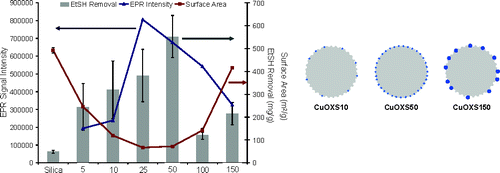 |
| Copper species coated silica nanoparticles (CuOXS) were synthesized for odor removal application. Coating with copper increased the capacity of silica nanoparticles for eliminating a model odor—ethyl mercaptan. Surface area, pore size distribution, and electron paramagnetic resonance spectroscopy analyses indicated that, at lower copper concentrations, copper species preferentially adsorb in 20 Å pores of silica. These copper species in a dispersed state are effective in catalytic removal of ethyl mercaptan. The best performance of copper-coated silica nanoparticles was achieved at a copper concentration of 3 wt %, at which all 20 Å nanopores were filled with isolated copper species. At higher copper loading, copper species are present as clusters on silica surfaces, which were found to be less effective in removing ethyl mercaptan. Gas chromatography experiments were carried out to verify catalytic conversion of ethyl mercaptan to diethyl disulfide by CuOXS particles. The present study suggests that the nature of the copper species and their site of adsorption, as well as state of dispersion, are important parameters to be considered for catalytic removal of sulfur-containing compounds. These parameters are critical for designing high-performance catalytic copper-coated silica nanoparticles for applications such as deodorization, removal of sulfur compounds from crude oil, hydrogenation, and antimicrobial activity. Credit Langmuir. |
Abstract:
Copper Coated Silica Nanoparticles for Odor Removal
Small particles show big promise in beating unpleasant odors
Washington, DC | Posted on December 25th, 2010Scientists are reporting development of a new approach for dealing with offensive household and other odors — one that doesn't simply mask odors like today's room fresheners, but eliminates them at the source. Their research found that a deodorant made from nanoparticles — hundreds of times smaller than peach fuzz — eliminates odors up to twice as effectively as today's gold standard. A report on these next-generation odor-fighters appears in ACS' Langmuir, a bi-weekly journal.
Brij Moudgil and colleagues note that consumers use a wide range of materials to battle undesirable odors in clothing, on pets, in rooms, and elsewhere. Most common household air fresheners, for instance, mask odors with pleasing fragrances but do not eliminate the odors from the environment. People also apply deodorizing substances that absorb smells. These materials include activated carbon and baking soda. However, these substances tend to have only a weak ability to absorb the chemicals responsible for the odor.
The scientists describe development of a new material consisting of nanoparticles of silica (the main ingredient in beach sand) — each 1/50,000th the width of a human hair — coated with copper. That metal has well-established antibacterial and anti-odor properties, and the nanoparticles gave copper a greater surface area to exert its effects. Tests of the particles against ethyl mercaptan, the stuff that gives natural gas its unpleasant odor, showed that nanoparticles were up to twice as effective as the gold standard — activated carbon — at removing the material's foul-smelling odor. In addition to fighting odors, the particles also show promise for removing sulfur contaminants found in crude oil and for fighting harmful bacteria, they add.
Visit this link for a video:
www.dailymotion.com/video/xfk5tt_florida-nano-tech-team-declares-war-on-bad-odors_tech
####
For more information, please click here
Contacts:
Science Inquiries:
Michael Woods
Editor
202-872-6293
General Inquiries:
Michael Bernstein
202-872-6042
Copyright © American Chemical Society
If you have a comment, please Contact us.Issuers of news releases, not 7th Wave, Inc. or Nanotechnology Now, are solely responsible for the accuracy of the content.
Bookmark:


| Related News Press |
News and information
 Quantum computer improves AI predictions April 17th, 2026
Flexible sensor gains sensitivity under pressure April 17th, 2026
A reusable chip for particulate matter sensing April 17th, 2026
Detecting vibrational quantum beating in the predissociation dynamics of SF6 using time-resolved photoelectron spectroscopy April 17th, 2026
Possible Futures
A fundamentally new therapeutic approach to cystic fibrosis: Nanobody repairs cellular defect April 17th, 2026
UC Irvine physicists discover method to reverse ‘quantum scrambling’ : The work addresses the problem of information loss in quantum computing system April 17th, 2026
Academic/Education
Rice University launches Rice Synthetic Biology Institute to improve lives January 12th, 2024
Multi-institution, $4.6 million NSF grant to fund nanotechnology training September 9th, 2022
Announcements
A fundamentally new therapeutic approach to cystic fibrosis: Nanobody repairs cellular defect April 17th, 2026
UC Irvine physicists discover method to reverse ‘quantum scrambling’ : The work addresses the problem of information loss in quantum computing system April 17th, 2026
Environment
A reusable chip for particulate matter sensing April 17th, 2026
Researchers unveil a groundbreaking clay-based solution to capture carbon dioxide and combat climate change June 6th, 2025
Sports
Electrifying results shed light on graphene foam as a potential material for lab grown cartilage June 6th, 2025
Surrey reveals its implantable biosensor that operates without batteries May 22nd, 2020
Collagen nanofibrils in mammalian tissues get stronger with exercise December 14th, 2018
Textiles/Clothing
Protective equipment with graphene nanotubes meets the strictest ESD safety standards March 25th, 2022
Polymer fibers with graphene nanotubes make it possible to heat hard-to-reach, complex-shaped items February 11th, 2022
Flexible material shows potential for use in fabrics to heat, cool July 3rd, 2020
 |
||
 |
||
| The latest news from around the world, FREE | ||
 |
||
|
|
||
| Premium Products | ||
 |
||
|
Only the news you want to read!
Learn More |
||
 |
||
|
Full-service, expert consulting
Learn More |
||
|
|
||