Home > Press > UA Polymer Scientists Unpeel Secrets Of Nanohair Adhesion
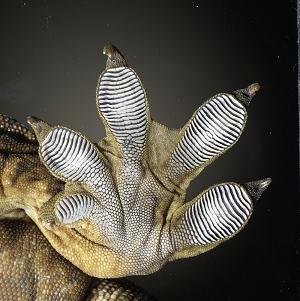 |
| Fine hairs on the soles of gecko feet allow the lizards to climb vertical surfaces with ease. UA polymer researchers have discovered a synthetic glue (carbon nanotubes) with nearly four times the adhesion power of gecko hairs. Now the scientists reveal why the mimic version offers its remarkable staying power. |
Abstract:
Not long after Dr. Ali Dhinojwala, chairman of The University of Akron Department of Polymer Science, unpeeled the secret (fine, clingy hairs) behind the remarkable adhesion of gecko feet, he and fellow researchers came up with a synthetic replica: carbon nanotubes. Now, five years after that initial discovery, the basis of the success of these nanotubes is published in the October issue of the American Chemical Society's NanoLetters pubs.acs.org/doi/abs/10.1021/nl102398w
UA Polymer Scientists Unpeel Secrets Of Nanohair Adhesion
Akron, OH | Posted on November 20th, 2010While the story of nanotubes is one of success, not all carbon nanotubes are equal, nor is the individual adhesion performance of each strand, according to Dhinojwala. Although Dhinojwala and UA polymer science graduate student Liehui Ge determined that these 8-nanometer-diameter carbon hairs — each 2,000 times smaller than the diameter of a human hair — adhere powerfully to glass and similar substrates, they furthered their research to learn why some strands have a firmer grip than others.
Findings by the UA scientists, in collaboration with Lijie Ci and Anubha Goyal, researchers with the Department of Mechanical Engineering and Materials Science at Rice University; Rachel Shi, UA Research Experience for Undergraduates (REU) intern; and L. Mahadevan, professor of applied mathematics and professor of organismic and evolutionary biology at Harvard University, reveal that the softer the nanotube, the greater its adhesion.
Using a combination of mechanics, electrical resistance and scanning electron microscopy (SEM) to study the contact between hairs of a large number of vertically aligned carbon nanotubes with glass or silicon substrates, the researchers found that soft nanotubes clasp and curve when pressure is applied, contributing to their adhesive strength.
"We found out that the diameter of the tubes is an important parameter for adhesion because we have to balance the adhesion and bending rigidity of the tubes," Ge says. "Also, if you apply a high pressure, the tubes bend and buckle and make a larger contact area with the surface, which is the reason for higher adhesion."
The dry adhesive, unlike liquid glue counterparts, promises successful use in extreme atmospheric and temperature conditions and in other applications that present challenges.
"The carbon nanotube-based gecko adhesives are going to open up opportunities to using these materials on robots, to climb vertical walls, and could actually be used in outer space (vacuum condition) because these materials stick without any liquid glue," Dhinojwala says.
####
About University of Akron
The University of Akron is the public research university for Northeast Ohio. The Princeton Review listed UA among the “Best in the Midwest” in its 2010 edition of Best Colleges: Region-by-Region. Approximately 29,300 students are enrolled in UA’s 300 associate, bachelor’s, master’s, doctorate and law degree programs and 100 certificate programs at sites in Summit, Wayne, Medina and Holmes counties. For more information, visit
For more information, please click here
Contacts:
Denise Henry
33-972-6477
Copyright © University of Akron
If you have a comment, please Contact us.Issuers of news releases, not 7th Wave, Inc. or Nanotechnology Now, are solely responsible for the accuracy of the content.
Bookmark:


| Related News Press |
News and information
 Simulating magnetization in a Heisenberg quantum spin chain April 5th, 2024
NRL charters Navy’s quantum inertial navigation path to reduce drift April 5th, 2024
Discovery points path to flash-like memory for storing qubits: Rice find could hasten development of nonvolatile quantum memory April 5th, 2024
Possible Futures
Discovery points path to flash-like memory for storing qubits: Rice find could hasten development of nonvolatile quantum memory April 5th, 2024
With VECSELs towards the quantum internet Fraunhofer: IAF achieves record output power with VECSEL for quantum frequency converters April 5th, 2024
Academic/Education
Rice University launches Rice Synthetic Biology Institute to improve lives January 12th, 2024
Multi-institution, $4.6 million NSF grant to fund nanotechnology training September 9th, 2022
Nanotubes/Buckyballs/Fullerenes/Nanorods/Nanostrings
Tests find no free-standing nanotubes released from tire tread wear September 8th, 2023
Detection of bacteria and viruses with fluorescent nanotubes July 21st, 2023
Announcements
NRL charters Navy’s quantum inertial navigation path to reduce drift April 5th, 2024
Discovery points path to flash-like memory for storing qubits: Rice find could hasten development of nonvolatile quantum memory April 5th, 2024
Aerospace/Space
Under pressure - space exploration in our time: Advancing space exploration through diverse collaborations and ethical policies February 16th, 2024
Bridging light and electrons January 12th, 2024
Manufacturing advances bring material back in vogue January 20th, 2023
Research partnerships
Discovery points path to flash-like memory for storing qubits: Rice find could hasten development of nonvolatile quantum memory April 5th, 2024
Researchers’ approach may protect quantum computers from attacks March 8th, 2024
'Sudden death' of quantum fluctuations defies current theories of superconductivity: Study challenges the conventional wisdom of superconducting quantum transitions January 12th, 2024
 |
||
 |
||
| The latest news from around the world, FREE | ||
 |
||
|
|
||
| Premium Products | ||
 |
||
|
Only the news you want to read!
Learn More |
||
 |
||
|
Full-service, expert consulting
Learn More |
||
|
|
||