Home > Press > Manufacturing advances bring material back in vogue
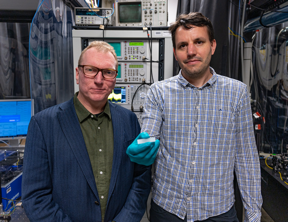 |
| Dr Andy Boes from the University of Adelaide's Institute of Photonics and Advanced Sensing (right) and RMIT University’s Distinguished Professor Arnan Mitchell. CREDIT The University of Adelaide. |
Abstract:
One of the world’s most important artificial materials is back in vogue because scientists are harnessing its properties for new and diverse future applications such as space navigation and farming.
Manufacturing advances bring material back in vogue
Adelaide, South Australia | Posted on January 20th, 2023The University of Adelaide’s Dr Andy Boes and RMIT University’s Distinguished Professor Arnan Mitchell are leaders in developing lithium niobate (LN) to harness its exceptional properties in photonic chips.
“Lithium niobate has new uses in the field of photonics - the science and technology of light - because unlike other materials it can generate and manipulate electro-magnetic (EM) waves across the full spectrum of light, from microwave to UV frequencies,” said Dr Boes.
“Silicon was the material of choice for electronic circuits, but its limitations have become increasingly apparent in photonics. LN has come back into vogue because of its superior capabilities and advances in manufacturing mean that LN is now readily available as thin films on semiconductor wafers.”
A layer of LN about 100 times thinner than a human hair, is placed on a semiconductor wafer/substrate. Photonic circuits are printed into the LN layer which are tailored according to the chip’s intended use. A hundred different circuits may be contained inside a chip the size of a fingernail.
“The ability to manufacture integrated photonic chips from LN will have major impact on applications in technology that use every part of the spectrum of light.” said Distinguished Professor Mitchell.
“Photonic chips can now transform industries well beyond optical fibre communications.”
As there is no GPS on the Moon navigation systems in lunar rovers of the future need to use an alternative system, which is where photonic chips come in. By detecting signals in the infrared part of the spectrum a photonic chip with a laser pointed at it can measure movement without needing external signals.
Dr Boes and Distinguished Professor Mitchell brought together a team of world leaders in LN and published their review of LN’s capabilities and its potential future applications in the journal Science.
Closer to home LN technology can be used to detect how ripe fruit is. Gas emitted by ripe fruit is absorbed by light in the mid-infrared part of the spectrum. A drone hovering in an orchard would transmit light to another which would sense the degree to which the light is absorbed and when fruit is ready for harvesting. Such a system has advantages over existing technology by being smaller, easily deployed and potentially giving more information in real time to farmers.
LN was first discovered in 1949 and has been used in photonics since then but only now are these advances being realised.
“We have the technology to manufacture these chips in Australia and we have the industries that will use them,” said Distinguished Professor Mitchell.
“This is not science fiction it’s happening now and competition to harness the potential of LN photonic technology is heating up.”
####
For more information, please click here
Contacts:
Media Contact
Crispin Savage
University of Adelaide
Cell: +61 (0)481 912 465
Expert Contact
Dr Andy Boes
The University of Adelaide
Cell: +61 (0)477 291 833
Copyright © University of Adelaide
If you have a comment, please Contact us.Issuers of news releases, not 7th Wave, Inc. or Nanotechnology Now, are solely responsible for the accuracy of the content.
Bookmark:


| Related Links |
| Related News Press |
News and information
 Quantum computer improves AI predictions April 17th, 2026
Flexible sensor gains sensitivity under pressure April 17th, 2026
A reusable chip for particulate matter sensing April 17th, 2026
Detecting vibrational quantum beating in the predissociation dynamics of SF6 using time-resolved photoelectron spectroscopy April 17th, 2026
Possible Futures
A fundamentally new therapeutic approach to cystic fibrosis: Nanobody repairs cellular defect April 17th, 2026
UC Irvine physicists discover method to reverse ‘quantum scrambling’ : The work addresses the problem of information loss in quantum computing system April 17th, 2026
Chip Technology
A reusable chip for particulate matter sensing April 17th, 2026
Metasurfaces smooth light to boost magnetic sensing precision January 30th, 2026
Optical computing/Photonic computing
ICFO researchers overcome long-standing bottleneck in single photon detection with twisted 2D materials August 8th, 2025
Programmable electron-induced color router array May 14th, 2025
Discoveries
Quantum computer improves AI predictions April 17th, 2026
Flexible sensor gains sensitivity under pressure April 17th, 2026
A reusable chip for particulate matter sensing April 17th, 2026
Detecting vibrational quantum beating in the predissociation dynamics of SF6 using time-resolved photoelectron spectroscopy April 17th, 2026
Announcements
A fundamentally new therapeutic approach to cystic fibrosis: Nanobody repairs cellular defect April 17th, 2026
UC Irvine physicists discover method to reverse ‘quantum scrambling’ : The work addresses the problem of information loss in quantum computing system April 17th, 2026
Interviews/Book Reviews/Essays/Reports/Podcasts/Journals/White papers/Posters
A fundamentally new therapeutic approach to cystic fibrosis: Nanobody repairs cellular defect April 17th, 2026
UC Irvine physicists discover method to reverse ‘quantum scrambling’ : The work addresses the problem of information loss in quantum computing system April 17th, 2026
Food/Agriculture/Supplements
New imaging approach transforms study of bacterial biofilms August 8th, 2025
SMART researchers pioneer first-of-its-kind nanosensor for real-time iron detection in plants February 28th, 2025
Aerospace/Space
Decoding hydrogen‑bond network of electrolyte for cryogenic durable aqueous zinc‑ion batteries January 30th, 2026
ICFO researchers overcome long-standing bottleneck in single photon detection with twisted 2D materials August 8th, 2025
Onion-like nanoparticles found in aircraft exhaust May 14th, 2025
Photonics/Optics/Lasers
Metasurfaces smooth light to boost magnetic sensing precision January 30th, 2026
From sensors to smart systems: the rise of AI-driven photonic noses January 30th, 2026
 |
||
 |
||
| The latest news from around the world, FREE | ||
 |
||
|
|
||
| Premium Products | ||
 |
||
|
Only the news you want to read!
Learn More |
||
 |
||
|
Full-service, expert consulting
Learn More |
||
|
|
||