Home > Press > Fluorographene: The World’s Thinnest Insulator
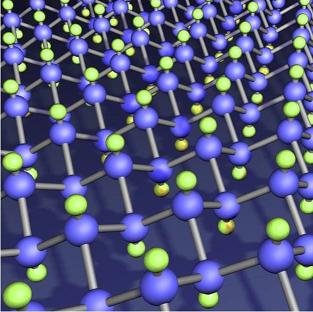 |
| A stoichiometric derivative of graphene with a fluorine atom attached to each carbon. Raman, optical, structural, micromechanical, and transport studies show that the material is qualitatively different from the known graphene-based nonstoichiometric derivatives. Fluorographene is a high-quality insulator (resistivity >1012Ù) with an optical gap of 3 eV. It inherits the mechanical strength of graphene, exhibiting a Young’s modulus of 100 N m−1 and sustaining strains of 15%. Fluorographene is inert and stable up to 400 °C even in air, similar to Teflon. |
Abstract:
The remarkable properties of graphene and Teflon have been combined in a new material by the winners of this year's Nobel Prize for Physics.
Fluorographene: The World’s Thinnest Insulator
UK | Posted on November 4th, 2010Kostya Novoselov and Andre Geim, working at the University of Manchester, UK, first isolated graphene in 2004. It was a tricky task, as one would expect if a Nobel Prize is among the rewards, even if it did involve using humble adhesive tape to peel away surfaces one layer at a time. They found graphene to be the thinnest and strongest form of carbon, and that it could conduct heat better than any other known material. As a conductor of electricity, it performs just as well as copper. Their most recent endeavours have led to a new derivative material that is just as strong and even more stable than the original graphene, but that does not conduct electricity at all: so-called fluorographene.
Graphene itself is a single atomic layer of the material graphite, commonly found in pencils. On a molecular level, it has a flat honeycomb structure of connecting hexagons with carbon atoms at the vertices. Clouds of electrons spread across the top and bottom surfaces, which is why the material conducts electricity so well.
The current achievement of the Manchester group, working closely with international collaborators, is to place a fluorine atom at every single carbon atom, thereby destroying the electron cloud and preventing electricity from flowing under normal conditions, but not impinging on the structural integrity of the carbon framework (see graphic). In previous work, they had added hydrogen atoms instead of fluorine, but found the resulting material to be unstable at high temperatures.
The latest breakthrough is published this week in the journal Small (*). Rahul Raveendran-Nair is a postgraduate researcher at the University of Manchester and responsible for the publication. He describes fluorographene as "the thinnest possible insulator, made by attaching fluorine atoms to each of the carbon atoms in graphene. It is the first stoichiometric chemical derivative of graphene and it is a wide-gap semiconductor. Fluorographene is a mechanically strong and chemically and thermally stable compound. Properties of this new material are very similar to Teflon and we call this material 2D Teflon."
Developing a suitable method for making this 2D Teflon was not simple. "Fluorine is a highly reactive element, and it reacts with all most everything. So the major challenge was to fully fluorinate graphene without damaging the graphene and its supporting substrates. Our fluorination of single-layer graphene membranes on chemically inert support grid and bulk graphene paper at elevated temperature overcomes this technical problem," explains Raveendran-Nair.
The authors envisage that fluorographene will be used in electronics, but acknowledge that "for realistic electronic applications the electronic quality has to be improved. We hope this can be achieved very soon. Some possible electronic applications of fluorographene are its use as a tunnel barrier and as a high-quality insulator or barrier material for organic electronics." Other fields of application are also possible. For example, as a wide-gap semiconductor that is fully transparent to visible light, fluorographene could well find use in LEDs (light-emitting diodes) and displays.
The Manchester group was not the only one involved, and collaborators from China (Shenyang National Laboratory for Materials Science), The Netherlands (Radboud University of Nijmegen), Poland (Institute of Electronic Materials Technology), and Russia (Nikolaev Institute of Inorganic Chemistry) added their expertise. According to Raveendran-Nair, having such a large team helped undertake a thorough investigation of fluorographene; "All of us worked very hard to make this project successful. We used a large variety of characterisation techniques and very detailed studies to understand the properties of this new material."
During the course of the project the leaders were named as Nobel Laureates, but apparently life working in the group has not changed very much. "Even in their new busy life both professors still work very closely with all those in the group and are very much involved in the day-to-day research", says Raveendran-Nair. "Working under them is a great inspiration. It is both a rewarding and enjoyable place to undertake research."
(*) "Fluorographene: A Two-Dimensional Counterpart of Teflon", Rahul R. Nair et al., Small 2010; DOI: doi.wiley.com/10.1002/smll.201001555
####
For more information, please click here
Contacts:
Dr. Rahul Raveendran-Nair www.condmat.physics.manchester.ac.uk/people/postgrad/nair/
Department of Physics and Astronomy,
University of Manchester,
Oxford Road,
Manchester, M13 9PL, UK
Tel: +44 (0) 161 275 4074
Fax: +44 (0) 161 275 4056
Copyright © WILEY-VCH
If you have a comment, please Contact us.Issuers of news releases, not 7th Wave, Inc. or Nanotechnology Now, are solely responsible for the accuracy of the content.
Bookmark:


| Related News Press |
News and information
 Simulating magnetization in a Heisenberg quantum spin chain April 5th, 2024
NRL charters Navy’s quantum inertial navigation path to reduce drift April 5th, 2024
Discovery points path to flash-like memory for storing qubits: Rice find could hasten development of nonvolatile quantum memory April 5th, 2024
Possible Futures
Discovery points path to flash-like memory for storing qubits: Rice find could hasten development of nonvolatile quantum memory April 5th, 2024
With VECSELs towards the quantum internet Fraunhofer: IAF achieves record output power with VECSEL for quantum frequency converters April 5th, 2024
Academic/Education
Rice University launches Rice Synthetic Biology Institute to improve lives January 12th, 2024
Multi-institution, $4.6 million NSF grant to fund nanotechnology training September 9th, 2022
Chip Technology
Discovery points path to flash-like memory for storing qubits: Rice find could hasten development of nonvolatile quantum memory April 5th, 2024
Utilizing palladium for addressing contact issues of buried oxide thin film transistors April 5th, 2024
HKUST researchers develop new integration technique for efficient coupling of III-V and silicon February 16th, 2024
Nanoelectronics
Interdisciplinary: Rice team tackles the future of semiconductors Multiferroics could be the key to ultralow-energy computing October 6th, 2023
Key element for a scalable quantum computer: Physicists from Forschungszentrum Jülich and RWTH Aachen University demonstrate electron transport on a quantum chip September 23rd, 2022
Reduced power consumption in semiconductor devices September 23rd, 2022
Atomic level deposition to extend Moore’s law and beyond July 15th, 2022
Discoveries
Chemical reactions can scramble quantum information as well as black holes April 5th, 2024
New micromaterial releases nanoparticles that selectively destroy cancer cells April 5th, 2024
Utilizing palladium for addressing contact issues of buried oxide thin film transistors April 5th, 2024
Announcements
NRL charters Navy’s quantum inertial navigation path to reduce drift April 5th, 2024
Discovery points path to flash-like memory for storing qubits: Rice find could hasten development of nonvolatile quantum memory April 5th, 2024
 |
||
 |
||
| The latest news from around the world, FREE | ||
 |
||
|
|
||
| Premium Products | ||
 |
||
|
Only the news you want to read!
Learn More |
||
 |
||
|
Full-service, expert consulting
Learn More |
||
|
|
||