Home > Press > UB chemist to receive award from American Chemical Society
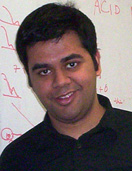 |
| Sarbajit Banerjee, assistant professor of chemistry |
Abstract:
A UB chemist has been recognized by the American Chemical Society for his research on a material that could be used in the next generation of transistors.
By ELLEN GOLDBAUM
UB chemist to receive award from American Chemical Society
Buffalo, NY | Posted on June 7th, 2010Sarbajit Banerjee, assistant professor of chemistry, will be awarded the ExxonMobil Solid-State Chemistry Award at the American Chemical Society's fall meeting in August. The award will be presented by the ACS Division of Inorganic Chemistry.
The award is given "to recognize significant contributions in solid-state chemistry by junior faculty at U.S. institutions and support solid-state chemistry as a recognized discipline," according to the ACS website. Banerjee is the sole recipient this year.
"It's definitely an honor to be recognized so early in my career," Banerjee says, acknowledging that the accolade rewards everyone involved in his project, especially graduate and undergraduate students. "It's essentially recognition from the community that what we do is important."
Banerjee received his undergraduate education at the University of Delhi and his doctorate at Stony Brook University. Before coming to UB, he was a postdoctoral research scientist at Columbia University.
Banerjee's research includes the study of vanadium oxide, currently used in night-vision technologies. Vanadium oxide is a unique substance that switches between metallic and non-metallic phases at a specific temperature, usually about 160 degrees Fahrenheit. By reducing vanadium oxide to a nanomaterial and doping the material with tungsten, Banerjee and his team have reduced the tipping point to a minimum of around -4 degrees Fahrenheit.
"When we look at crystal structures, what we find is that when you make them small, like a nanoparticle, the arrangement of atoms can change," he says. "We can get all these cool materials that don't normally exist at room temperature. We have a lot of control over how we stabilize them, too."
Another benefit of using these oxides as nanomaterials, Banerjee explains, is that they act more predictably in smaller pieces.
"You can uncover new phenomena that are obscured in larger materials," he says. "You can uncover its intrinsic properties because there aren't as many defects in it."
The research could lead to a new generation of smart materials that could be used in windows, for example, for thermally specific heat conductivity. Banerjee also notes that the material potentially could be used in "high-mobility switching elements, and the next generation of transistors."
He is interested in how different disciplines can collaborate to find chemical solutions to human problems.
"Science is becoming more interdisciplinary as time goes by," he says. "It's actually part of what UB 2020 is all about. A lot of challenges are at the intersection of different disciplines."
Banerjee says he often has students in his classes who are studying engineering, as well as those who are pursuing the natural sciences. For him, the examination and manipulation of the chemical world has merit for everyone, not just those vested in academic interests. Chemistry, he says, is a point of view that unlocks the secret structures within the objects humans take for granted.
"Solid-state chemistry really is the way I see the world," Banerjee says.
####
For more information, please click here
Copyright © University at Buffalo
If you have a comment, please Contact us.Issuers of news releases, not 7th Wave, Inc. or Nanotechnology Now, are solely responsible for the accuracy of the content.
Bookmark:


| Related News Press |
News and information
 Simulating magnetization in a Heisenberg quantum spin chain April 5th, 2024
NRL charters Navy’s quantum inertial navigation path to reduce drift April 5th, 2024
Discovery points path to flash-like memory for storing qubits: Rice find could hasten development of nonvolatile quantum memory April 5th, 2024
Chemistry
What heat can tell us about battery chemistry: using the Peltier effect to study lithium-ion cells March 8th, 2024
Nanoscale CL thermometry with lanthanide-doped heavy-metal oxide in TEM March 8th, 2024
Possible Futures
Discovery points path to flash-like memory for storing qubits: Rice find could hasten development of nonvolatile quantum memory April 5th, 2024
With VECSELs towards the quantum internet Fraunhofer: IAF achieves record output power with VECSEL for quantum frequency converters April 5th, 2024
Academic/Education
Rice University launches Rice Synthetic Biology Institute to improve lives January 12th, 2024
Multi-institution, $4.6 million NSF grant to fund nanotechnology training September 9th, 2022
Chip Technology
Discovery points path to flash-like memory for storing qubits: Rice find could hasten development of nonvolatile quantum memory April 5th, 2024
Utilizing palladium for addressing contact issues of buried oxide thin film transistors April 5th, 2024
HKUST researchers develop new integration technique for efficient coupling of III-V and silicon February 16th, 2024
Nanoelectronics
Interdisciplinary: Rice team tackles the future of semiconductors Multiferroics could be the key to ultralow-energy computing October 6th, 2023
Key element for a scalable quantum computer: Physicists from Forschungszentrum Jülich and RWTH Aachen University demonstrate electron transport on a quantum chip September 23rd, 2022
Reduced power consumption in semiconductor devices September 23rd, 2022
Atomic level deposition to extend Moore’s law and beyond July 15th, 2022
Announcements
NRL charters Navy’s quantum inertial navigation path to reduce drift April 5th, 2024
Discovery points path to flash-like memory for storing qubits: Rice find could hasten development of nonvolatile quantum memory April 5th, 2024
 |
||
 |
||
| The latest news from around the world, FREE | ||
 |
||
|
|
||
| Premium Products | ||
 |
||
|
Only the news you want to read!
Learn More |
||
 |
||
|
Full-service, expert consulting
Learn More |
||
|
|
||